Can Ethanol Change Business Dynamics For Sugar Industry?
A few policy decisions made by the government early this year are expected to give a fillip to the sugar industry.
The central government in May had asked oil marketers to target 10 percent blending of ethanol with petrol as part of a national policy for biofuels. In September, it hiked the procurement price of ethanol by nearly 25 percent, spelling relief for sugar mills that were grappling with record output of the commodity. Further, it permitted ethanol production from sugarcane juice, potentially leading to higher remuneration.
The rating agency ICRA said in a recent report that ethanol has emerged as a more viable revenue stream for sugar companies following the government's decision.
Here's how increased ethanol production can be beneficial for a sugar mill.
The Economics Behind Sugar Production
Typically, one litre of ethanol is produced from 1.6 kilograms of sugarcane. This is also known as the conversion rate.
- By dividing the conversion rate with revised ethanol prices, one can arrive at the realisation derived by selling 1 kilogram of sugar.
- Sugar is typically is extracted in three stages: the residue from the first stage is processed further to extract sugar.
- The resultant residue, known as B-heavy molasses, has higher sucrose content, which can be further processed to extract sugar.
- This leaves behind a residue known as C- heavy molasses that can be processed to sugar as well.
Here's a table that illustrates the specifics.
Now that ethanol has turned more remunerative, what would it mean for a sugar company to produce more of it? Here is an example based on our interactions with industry experts and analysts.
The years ended March 2016 and March 2018 were difficult for the sugar industry due to high production. Price pressures led to negative margin. Ethanol margin, on the other hand, are largely stable as the government fixes its procurement price before every sugar season. Producing more ethanol reduces the cyclicality of earnings for mills with distillery capacity and increases profitability which in turn would curb the issue of cane arrears, brokerage Stewart and Mackertich said in a report.
Realisation, though, may take at least a year as sugar mills have to invest in increasing capacity to produce ethanol, Tarun Sawhney, vice chairman and managing director of the distilleries company Triveni Engineering and Industries Ltd., told BloombergQuint.
Other Positives
The potential to blend ethanol with fuel is high, with the government targeting 10 percent blend. The current national average, according to Indian Sugar Mills Association, is 4.02 percent.
Oil marketers have released tenders to procure nearly 48.5 crore litre of ethanol produced from B-heavy molasses and 1.84 crore litre of the fuel made from sugarcane juice. The association estimates that this could result in sugar production dropping by nearly 0.5 million tonnes.
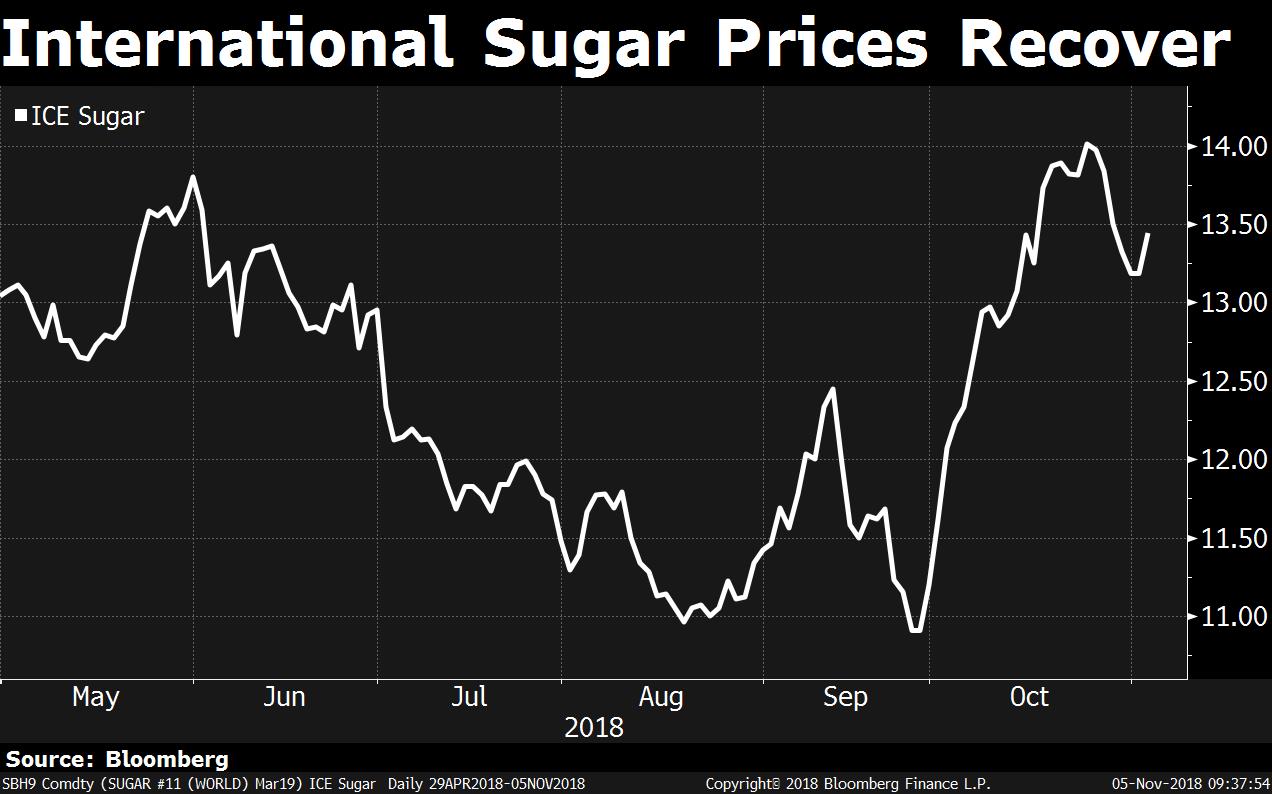
Sugar prices have rallied over 25 percent in the international market in October due to lower-than-anticipated production in Brazil. “Higher rainfall in key cane growing regions and strong ethanol demand is expected to lower Brazil's output by nearly 9 million tonnes,” said Narendra Murkumbi, former vice chairman and managing director of Shree Renuka Sugars Ltd.
Watch the interview here
India could export 4-4.5 million tonnes of the commodity, due to the government's incentives and exports becoming competitive due to a depreciating rupee.
Industry experts and analyst said that while this may not be the start of a bull run, it's a long-awaited welcome change, and the sector that has been in tumult over the past decade, could stabilise.
Here's the video

-
Signature Play: The Classic Cocktail Is Dead. Or Is It?

Classic cocktails are disappearing from India's cocktail menus. But they're still being ordered, taught to bartenders and borrowed from. So, who's really having the last drink?
-
A New Samvat Wishlist: Inclusive Prosperity And Human Development
India has strengthened its economic foundations through infrastructure, digital access and enterprise. Its next growth chapter must deepen productivity, create better livelihoods and widen participation in prosperity.
-
Love, Sex Aur Dhokha: The Audacious Plot To Spy On Jensen Huang
A Taipei dinner, a Singapore chip buyer and a suspected Chinese asset: inside the alleged spy operation that got close to NVIDIA's Jensen Huang.
-
Ten Things I Learnt This Samvat
Patience can be a trap. Cheap stocks can stay cheap. Leverage can wipe you out. What did Samvat 2082 teach us? Niraj Shah writes on 10 lessons from the year gone by.
-
Talking Points This Week: Tech Nerves, FII Buying, And A Faraway Banking Shock
The global markets are not shining this Diwali. The exception in the large markets is, India.
-
Midterm Rally Lasted A Day. The Hard Reality Of A Divided US May Last Two Years | Opinion
Between a contested AI boom, a debt ceiling that arrives in 2027 and a president with every incentive to act alone, the next two years may prove more volatile than the first day's rally suggests.
-
Blue Wave Will Derail the AI Trade but Won't Dismantle the AI Era | Unhedged Position
The Democrats' sweep of the US Congress will see politics collide with economic forces both over the long and short term.
-
It's Time To Take The GST Council's Bet On Trust Global
Payment records can prove India's services exports, and clear, proportionate rules can bring foreign digital sellers into the tax net.
-
Opinion | India at 38: From Innovation Overperformer to Innovation Powerhouse
India now has 453 VC-backed deep science startups, 18 of them late-stage, after 117 percent growth since 2020. Laurus Labs, at USD 9.3 billion, is the most valuable deep science company in any middle-income economy outside China.









