Buffett Inspires Retail Investors To Bet On Japan Trading Houses

Japan's retail investors have started to place their bets on trading house stocks, heavily backed by Berkshire Hathaway Inc.'s legendary investor Warren Buffett, eyeing strong business models and stellar shareholder returns.
Investment demand from Nippon Individual Savings Accounts, or NISA for short, has spread to trading companies alongside traditional favorites like Nippon Telegraph & Telephone Corp., Japan Tobacco Inc. and Mitsubishi UFJ Financial Group Inc.
Mitsubishi Corp., one of Japan's biggest trading companies, placed third for the first time since March among retail holdings under the tax-exempt savings program. That's according to data from SBI Securities Co., while Rakuten Securities' ranked it fourth since April.
Reflecting the support from retail investors, trading house shares have been outperforming the market since US President Donald Trump's “Liberation Day” tariffs on April 2, despite uncertainties over effects on trade.
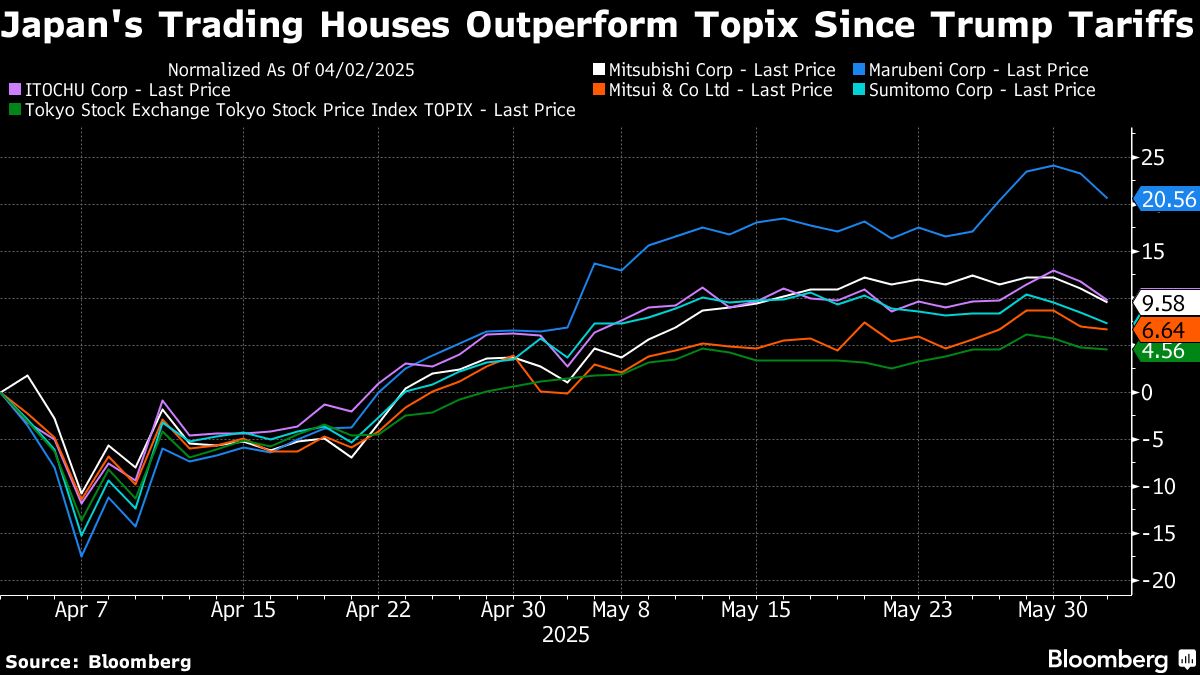
Japanese trading companies shares gained following comments from Buffett at the Berkshire Hathaway's annual meeting that he expects his company to hold the shares for 50 years or more. Mitsubishi Corp., Marubeni Corp., Mitsui & Co., Itochu Corp. and Sumitomo Corp. rose by more than 3% in reaction.
“Many individual investors feel that their value-investing style aligns with Warren Buffett, who is known for such an approach, and they are inclined to follow his lead — ‘If Buffett is buying, I'll follow',” said Naomi Kurimoto, an employee in the SBI Securities Investment Market Research Department. Buffett's name on reports boosts page views driven by individual investors, she added.

The five major Japanese trading houses released cautious profit forecasts for the year, setting aside hundreds of millions of dollars to hedge against tariff uncertainty. Despite these concerns, the companies have actively been pursuing dividend increases.
The projected 12-month dividend yields for Mitsubishi Corp., Mitsui & Co., Sumitomo and Marubeni are all above 3.5%, exceeding the 2.7% estimated calendar year average for 2025 for the Topix index. Although Itochu's projected 12-month dividend yield was 2.66%, it joins the other four in having doubled dividend payouts over the past five years.
Characteristics of the sectors favored under the NISA program are those with low risk of dividend cuts, even if their earnings growth or share price aren't expected to rapidly rise, said Yusuke Maeyama, a researcher at NLI Research Institute. “Among high-dividend stocks, trading companies may offer an additional advantage in the form of strong expectations for future dividend increases,” he added.
Corporate governance reforms also play a major role in influencing individual investors' stock selection process. The Tokyo Stock Exchange is planning to encourage companies to conduct stock splits, which would make it easier for retail investors to participate. Because trading on the TSE uses 100 share lots, a stock split would reduce the minimum investment amount.
While Buffett's influence has helped trading house shares, the companies themselves have been making efforts to expand their shareholder base in the past year. Before the launch of the revamped NISA system at the end of 2023, Mitsubishi Corp conducted a 3-for-1 stock split, lowering the minimum investment amount. Mitsui & Co. conducted a stock split at the end of June last year, halving the minimum investment amount.
Trading houses will benefit from increased retail investor participation through programs like NISA as “they can expect medium- to long-term ownership, which helps build a more stable shareholder base,” said Kazuhiro Sasaki, head of research at Phillip Securities Japan. On the other hand, there could be downsides like increased burden associated with servicing hundreds of investor accounts and handling of much larger shareholder meetings, he added.
The total amount of new purchases made under the growth investment quota across all financial institutions' NISA accounts in 2024 reached approximately ¥12.5 trillion ($87.4 billion), according to data compiled by Japan Securities Dealers Association. At the end of 2024, the total number of NISA accounts stood at 25.6 million. Among securities firms, Rakuten Securities held the largest share with 6 million accounts, followed by SBI Securities with 5.36 million.
Any deployment of funds by domestic investors would be positive for Japanese equities and even a 1 percentage point shift from cash into domestic stocks “would unleash $220 billion of flows into equities,“ said HSBC strategists including Herald van der Linde in a note.

-
Why Swapping Your Old Gold Can Trigger A Rs 5 Lakh Tax Bill, And How You Can Avoid It Legally

Swapping old gold for new is taxed as a sale and a fresh purchase. Getting your own gold remade can cut most of that bill, though it has its own costs.
-
The AI Trade is Done. The Real Opportunity for Investors Starts in 2027 | Unhedged Position
As pureplay AI stocks plunge and circular, capex-led financing unwinds, 2027 is set to be a year of reckoning for AI companies. Yet the bust clears the way for a better opportunity for investors in 2027 -- shifting the spotlight from AI builders to the companies using AI.
-
Leadership As Mission: Why The Age Of AI Demands More Human Leadership
Debjani Ghosh examines how AI is changing leadership, arguing that its success must be measured by its impact on people and the accountability of those guiding its use.
-
We May Need Another Tukaram Mundhe To Fight Air Pollution | The Reason Why
Developers may install basic measures such as sprinklers and green nets, resume work, and continue violating rules when this equipment stops working.
-
Extracting Value From Battery Scrap Could Be Challenging For India | The Reason Why
A discarded lithium-ion battery still contains valuable materials such as lithium, nickel and cobalt. These can be recovered and reused. When such batteries are crushed and shredded, they produce a dark powder called black mass.
-
One El Nino, India Can Handle. Two Could Break The Granary
India's grain stocks can absorb one bad year, but a second El Nino could drain the buffer in two to three years, economists say.
-
India's Troika Of Good Luck | Joining The Dots
As Jensen Huang's exit drags Nvidia down, a cooling AI trade and resilient earnings have revived investor interest in India. A likely RBI rate hike looms.
-
Talking Points This Week: Leadership Shock At Nvidia, Earnings Strength, And The Fog Over Hormuz
The Anthropic IPO pricing and first trading day, Nvidia's upcoming earnings, and any fresh signals from Iran will set the tone for the following week.
-
Signature Play: The Classic Cocktail Is Dead. Or Is It?
Classic cocktails are disappearing from India's cocktail menus. But they're still being ordered, taught to bartenders and borrowed from. So, who's really having the last drink?
-
A New Samvat Wishlist: Inclusive Prosperity And Human Development
India has strengthened its economic foundations through infrastructure, digital access and enterprise. Its next growth chapter must deepen productivity, create better livelihoods and widen participation in prosperity.









