Bitcoin Retreats After Record-Setting Run That Topped $69,000
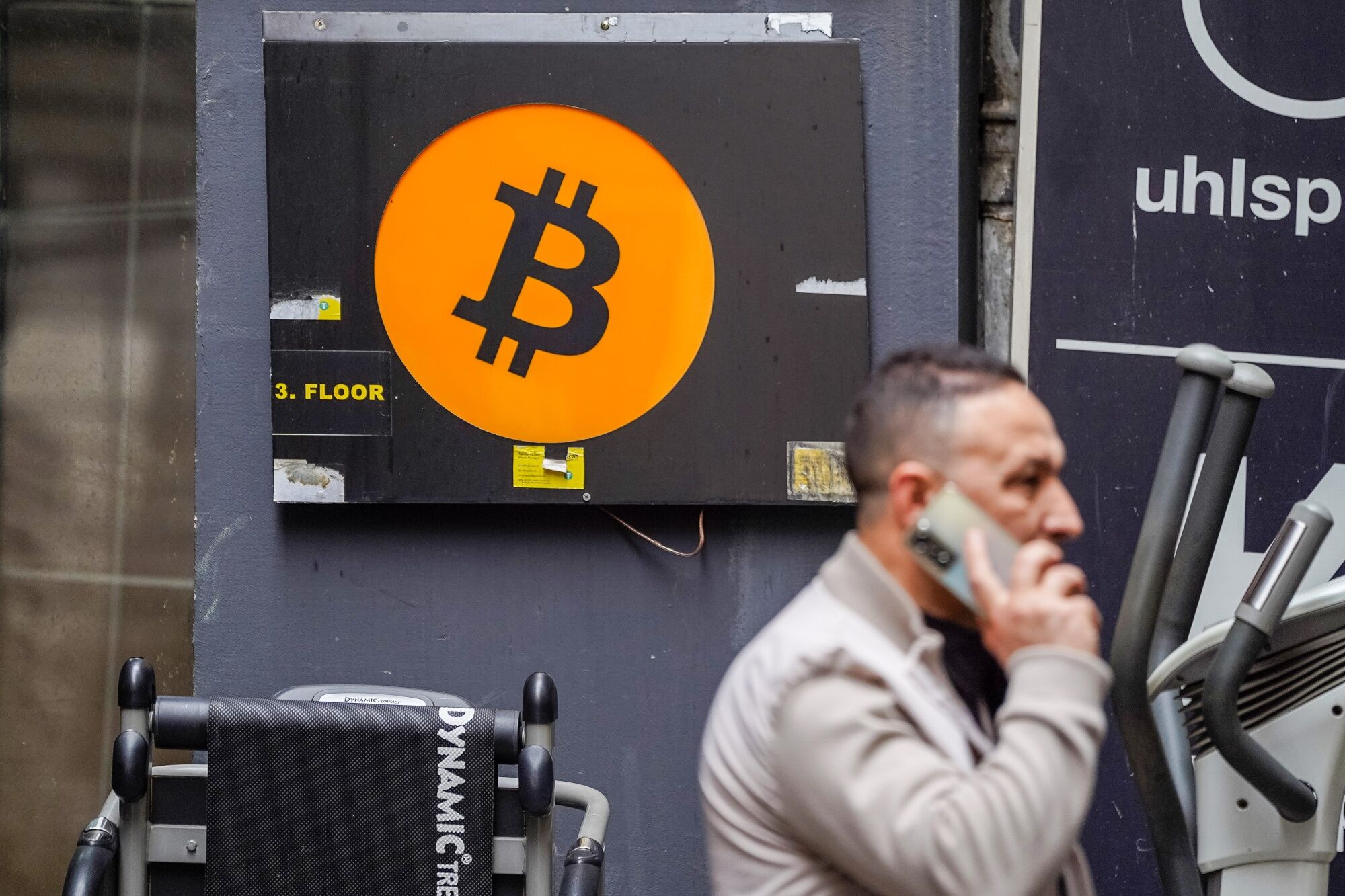
(Bloomberg) -- Bitcoin surged to a record for the first time in more than two years, yet the original cryptocurrency didn't stay at its new all-time high very long as many traders appear to have taken the opportunity to book some profit.
The token jumped as much as 2.5% to $69,191.95 shortly after 10 a.m. in New York, then almost immediately reversed course in a plunge that at one point sent it 14% below the record to $59,317.16.
“Given that nearly everyone who has ever bought Bitcoin is now in profit, there are decent odds we see some amount of profit taking,” said Zaheer Ebtikar, founder of crypto fund Split Capital.
The volatile price swings on Tuesday were the latest example of the boom-or-bust nature of Bitcoin. Its recent gains had been amplified by bullish bets made in the derivatives market, where investors in the past could get leverage of as much as 100 times the size of their positions in products such as perpetual futures. With Bitcoin reversing its early gains, more than $800 million worth of bullish positions were quickly liquidated in the perpetual futures market, according to crypto data tracker Coinglass.
Read More: Bitcoin Faces ‘Sell-the-News' Moment After Setting Record High
Bitcoin has experienced a breathtaking rebound this year amid strong demand from new US exchange-traded funds and a looming reduction in growth of the token's supply. At its high on Tuesday, Bitcoin was up about 63% so far in 2024, outperforming global stocks and spreading optimism across the digital-asset market.
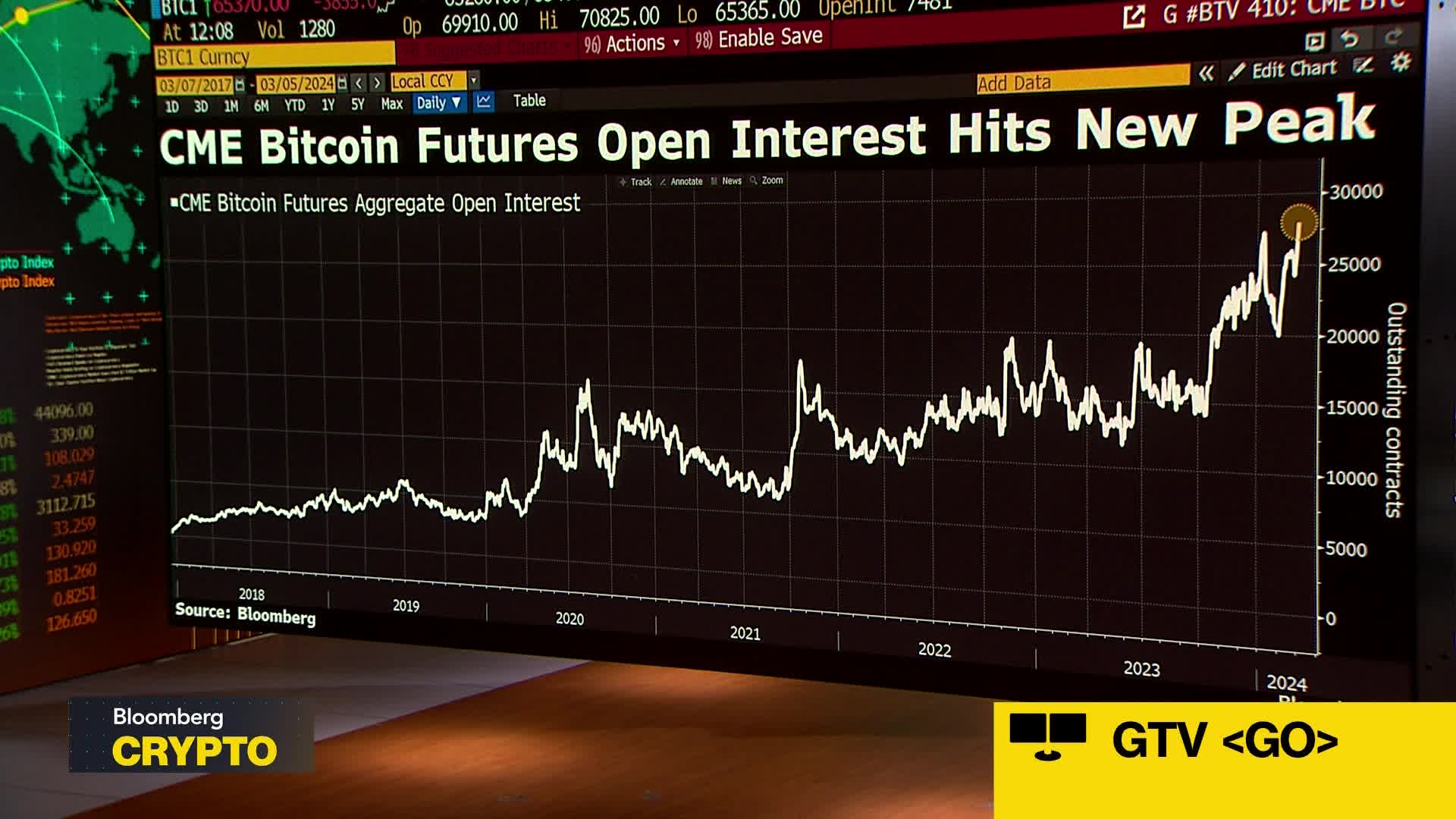
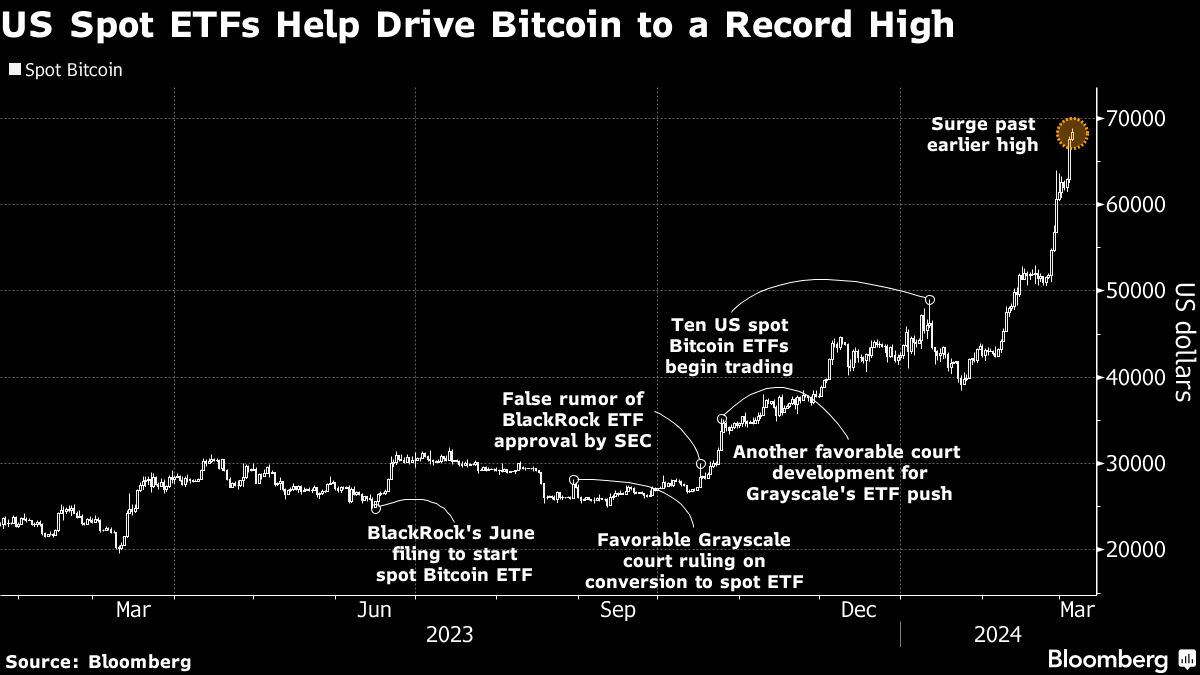
In an ironic twist, Bitcoin owes much of its resurgence to a regulator long-viewed as hostile to crypto: the US Securities and Exchange Commission. The SEC approved spot-Bitcoin exchange-traded funds in early January after suffering a legal defeat last year in its attempt to reject them. The move has widened the mass-market accessibility of Bitcoin, helping the crypto sector to turn the page following a bear market in 2022 and a string of subsequent bankruptcies, including the implosion of Sam Bankman-Fried's FTX exchange.
Read more: How Spot Bitcoin ETFs Became Big Win for Wall Street: QuickTake
A steady tide of money has poured into the ETFs issued by investment heavyweights including BlackRock Inc. and Fidelity Investments. The net inflow of almost $8 billion in less than two months is colliding with a looming reduction in Bitcoin's supply growth — known as the halving — that is also stoking bullish sentiment.
“Breaking all-time highs, with the current momentum in spot ETFs as well as the upcoming halving narrative, would likely awaken true FOMO — fear of missing out — among participants currently watching markets from the sidelines,” said Stefan von Haenisch, head of trading at OSL SG Pte.
The comeback in Bitcoin that started in early 2023 has lifted the overall market value of digital assets to about $2.6 trillion. Its revival from a low in November 2022 caps a bust-to-boom cycle that left the industry it spawned irrevocably changed.
Read more: What Is Bitcoin ‘Halving'? Does It Push Up the Price?: QuickTake
Bitcoin hit its previous peak of $68,991.85 on Nov. 10, 2021, according to data compiled by Bloomberg, powered by the monetary and fiscal stimulus that governments around the world deployed to tackle the impact of Covid-19. The rally was driven partly by crypto purists known for their mantra of “HODL,” the result of a misspelling of “hold” that's been adopted as an acronym for “hold on for dear life.”
Reckoning in 2022
What was hailed by some as crypto's ultimate coming-of-age moment back then instead turned out to be the start of a brutal reckoning.
Soon after touching its high in 2021, Bitcoin — and wider crypto markets — began a precipitous descent as central banks turned hawkish to fight runaway inflation. By the end of 2021, Bitcoin's price had tumbled by almost a third from its peak.
Read more: Wall Street Turbocharges Bitcoin's Wild Rally and Rakes In Cash
The bear market exposed widespread fraud and reckless risk-taking among many of crypto's key players, embodied by the implosion of the TerraUSD stablecoin and the collapse of Bankman-Fried's FTX exchange and related companies. Binance, the largest digital-asset exchange, and its founder Changpeng “CZ” Zhao also came under increased regulatory scrutiny.
Bankman-Fried and Zhao are now awaiting sentencing in the US on criminal charges. TerraUSD creator Do Kwon, who was imprisoned in Montenegro last year for traveling with a fake passport, is fighting extradition to the US, where he's wanted on fraud charges.
As the crypto dominoes fell during the 2022 slump, regulators around the world were already laying the groundwork for increased oversight — efforts given added impetus by the market crash. Dubai and Hong Kong have adopted new regulatory regimes, and the European Union passed the sweeping Markets in Crypto-Assets (MiCA) legislation last year. Countries from Australia to India and the UK have stepped up efforts to ensure that unlicensed crypto exchanges don't cater to their residents.
BlackRock's Impact
But just as crypto skeptics from JPMorgan Chase & Co.'s Jamie Dimon to Berkshire Hathaway Inc.'s Charlie Munger derided Bitcoin as an intrinsically worthless object of mindless speculation, one of the world's largest financial companies was about to add fuel to its rebound.
On June 15 last year, BlackRock filed an application with the SEC for the iShares Bitcoin Trust, which would invest directly in the token. While there had already been several similar attempts, BlackRock's size and influence — it is the biggest ETF provider — was seen as an indication that this time, the outcome might be different.
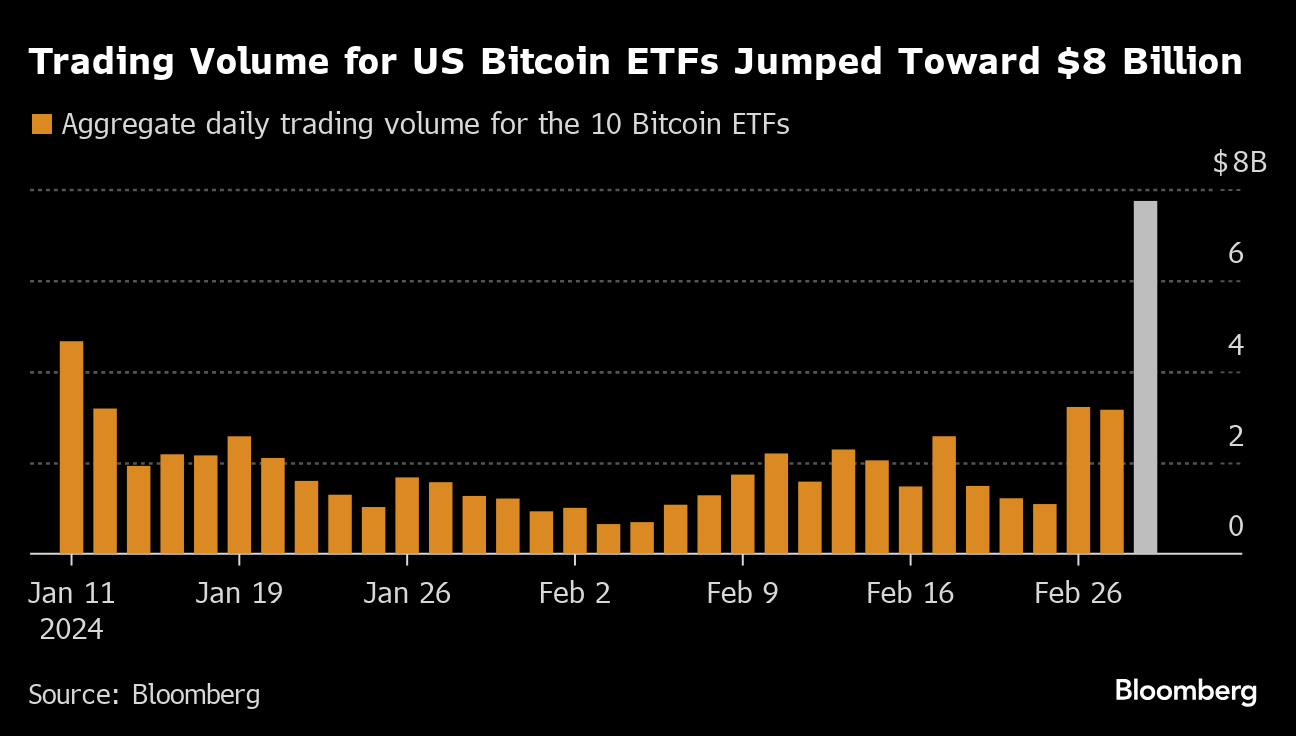
BlackRock's ETF, trading under the IBIT ticker, was among the first batch of such products approved in early January. In less than two months, its assets have swelled to more than $10 billion. Bitcoin, meanwhile, has more than doubled in value since BlackRock made its application.
“The Bitcoin all-time high marks a turning point for crypto,” said Nathan McCauley, CEO and co-founder of Anchorage Digital. “Traditional institutions were once sitting out; today, they are here in full force as the principal drivers of the crypto bull market.”
--With assistance from David Pan, Muyao Shen, Sidhartha Shukla and Suvashree Ghosh.
More stories like this are available on bloomberg.com
©2024 Bloomberg L.P.

-
Signature Play: The Classic Cocktail Is Dead. Or Is It?

Classic cocktails are disappearing from India's cocktail menus. But they're still being ordered, taught to bartenders and borrowed from. So, who's really having the last drink?
-
A New Samvat Wishlist: Inclusive Prosperity And Human Development
India has strengthened its economic foundations through infrastructure, digital access and enterprise. Its next growth chapter must deepen productivity, create better livelihoods and widen participation in prosperity.
-
Love, Sex Aur Dhokha: The Audacious Plot To Spy On Jensen Huang
A Taipei dinner, a Singapore chip buyer and a suspected Chinese asset: inside the alleged spy operation that got close to NVIDIA's Jensen Huang.
-
Ten Things I Learnt This Samvat
Patience can be a trap. Cheap stocks can stay cheap. Leverage can wipe you out. What did Samvat 2082 teach us? Niraj Shah writes on 10 lessons from the year gone by.
-
Talking Points This Week: Tech Nerves, FII Buying, And A Faraway Banking Shock
The global markets are not shining this Diwali. The exception in the large markets is, India.
-
Midterm Rally Lasted A Day. The Hard Reality Of A Divided US May Last Two Years | Opinion
Between a contested AI boom, a debt ceiling that arrives in 2027 and a president with every incentive to act alone, the next two years may prove more volatile than the first day's rally suggests.
-
Blue Wave Will Derail the AI Trade but Won't Dismantle the AI Era | Unhedged Position
The Democrats' sweep of the US Congress will see politics collide with economic forces both over the long and short term.
-
It's Time To Take The GST Council's Bet On Trust Global
Payment records can prove India's services exports, and clear, proportionate rules can bring foreign digital sellers into the tax net.
-
Opinion | India at 38: From Innovation Overperformer to Innovation Powerhouse
India now has 453 VC-backed deep science startups, 18 of them late-stage, after 117 percent growth since 2020. Laurus Labs, at USD 9.3 billion, is the most valuable deep science company in any middle-income economy outside China.









