Bitcoin ‘Halving’ Due Next Year Spurs Predictions of Rally in Token Past $50,000

(Bloomberg) -- Bitcoin's rebound is just the start of a rally that will take it past $50,000 next year courtesy of a process known as halving that curbs the supply of new tokens, according to projections from crypto analysts.
The largest digital asset has climbed 67% since Dec. 31 in a partial revival from an epic rout in 2022. While the token at the moment is struggling in the vicinity of $30,000, halving holds the potential to trigger an advance of at least 81%, according to Bloomberg Intelligence and Matrixport.
A halving – or halvening – cuts in half the amount of tokens that Bitcoin miners receive as reward for their work. The quadrennial event is due next around April 2024 and is part of the process of capping Bitcoin supply at 21 million tokens. The coin hit records after each of the last three halvings.
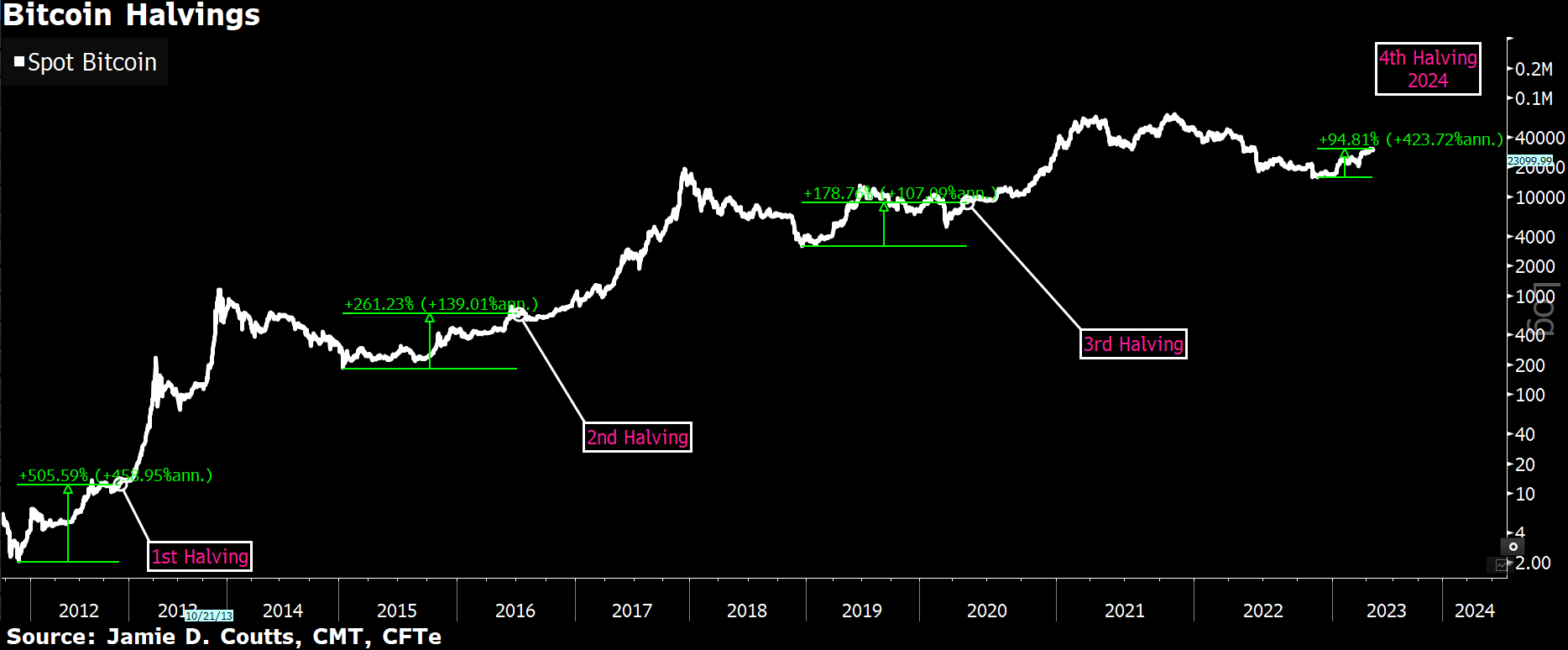
The upcoming halving is currently about 50% priced in based on previous cycles, said Jamie Douglas Coutts, a Bloomberg Intelligence analyst. Coutts predicts that Bitcoin can scale $50,000 by April 2024.
“Bitcoin cycles bottom around 12-18 months prior to the halving and this cycle structure looks similar to the past ones, albeit many things have changed — while the network is vastly stronger, Bitcoin has never endured a prolonged severe economic contraction,” he said.
The Bitcoin bounce has sputtered of late, restrained by cooling expectations of Federal Reserve interest-rate cuts amid persistent inflation. A US regulatory crackdown on crypto in the wake of the FTX exchange's collapse in November 2022 also threatens to darken the market outlook.
FTX Low
“If the collapse of FTX was indeed the bottom of this cycle, then history would suggest that we still have approximately 350 days of ‘accumulation' before witnessing the characteristic post-halving breakout price action,” said Jacob Joseph, an analyst at CCData.
Markus Thielen, research head at Matrixport, said in a recent note that Bitcoin will reach around $65,623 by April 2024 — more than double the current price.
Bitcoin remains about $41,000 down from its all-time high of almost $69,000 in November 2021 — which came 18 months after its 2020 halving. Crypto markets crashed last year as central banks jacked up rates to curb price pressures and digital-asset companies imploded.
“Bitcoin may once again reach a new all-time high in the future, however, it is unlikely to see the same growth as previous cycles due to increased market size and competition from other digital assets,” said CCData's Joseph.
Bitcoin edged up less than 0.5% to $27,590 as of 8 a.m. in Singapore on Monday after retreating a little more than 9% last week. Smaller tokens like Ether, Cardano and Solana also made modest gains as the trading week got underway in the Asia-Pacific region.
More stories like this are available on bloomberg.com
©2023 Bloomberg L.P.

-
One El Nino, India Can Handle. Two Could Break The Granary

India's grain stocks can absorb one bad year, but a second El Nino could drain the buffer in two to three years, economists say.
-
India's Troika Of Good Luck | Joining The Dots
As Jensen Huang's exit drags Nvidia down, a cooling AI trade and resilient earnings have revived investor interest in India. A likely RBI rate hike looms.
-
Why Prashant Jain's 3P Investment Managers Bought 2.5% Stake In This Healthcare Firm
After slowing acquisitions, Entero now has the opportunity to extract greater value from the network. The key, however, will be execution.
-
Taxing A Promise: The Unsettled Story Of GST On Corporate Guarantees
These concerns are particularly relevant for businesses in the infrastructure, real estate, power and EPC sectors, where guarantees run for several years over the duration of the project and involve substantial amounts.
-
Who Will Care When Women Work? That Is The Wrong Question
The debate on women and work becomes strangely patronising when even our most enlightened elites assume that care is a woman's natural duty.
-
AI Disruption Is Exponential, Businesses Need A Margin Of Safety: HDFC AMC's Navneet Munot
According to Munot, one of the biggest challenges in assessing AI's impact is that the pace of change is exponential rather than linear.
-
The AI Race Is Bigger Than AI Models | The Week In Whys
The AI race and the humanoid race may look like two different technology stories. But underneath, they are increasingly about the same thing: who controls the ecosystem needed to build the technology.
-
FCNR Deposits Beat Estimates, RBI To Pull Out Rs 6-7 Lakh Crore: Pranjul Bhandari
HSBC's chief India economist says the central bank must drain up to Rs 7 lakh crore of surplus liquidity within a fortnight, either through a cash reserve ratio hike or dollar sales, as Foreign Currency Non-Resident (Bank) deposits far outpace expectations
-
Joining The Dots | CAS Turmoil, The Large-Cap Debate And Zee's Almost Rs 22,000-Crore Haircut
Time bends on Dalal Street, Dylan's lyrics haunt the large-cap debate, and Zee's promoter picks up the bargain of the year.
-
India Wants To Be Vietnam; Vietnam Wants To Be China | The Reason Why
India may become a global hub for smartphones. It could also make more camera modules, batteries and semiconductor packaging over the years.