Bearish Sentiment on Stocks Is Best Thing Rally Has Going for It
(Bloomberg) -- Skeptics, cranks, disbelievers. The stock market is overrun with them. It may be one of the reasons equities keep rising.
Rarely has the consensus been more uniformly bearish than it is now. Investors are sitting with the lowest allocation to US stocks in almost two decades, have kept cash holdings high for the longest stretch since the dot-com crash and are embracing recession trades more than any time since 2020. And why not? The banking system is stressed, the Federal Reserve pushed forward with another interest-rates increase while recession warnings continued to flare in bonds.
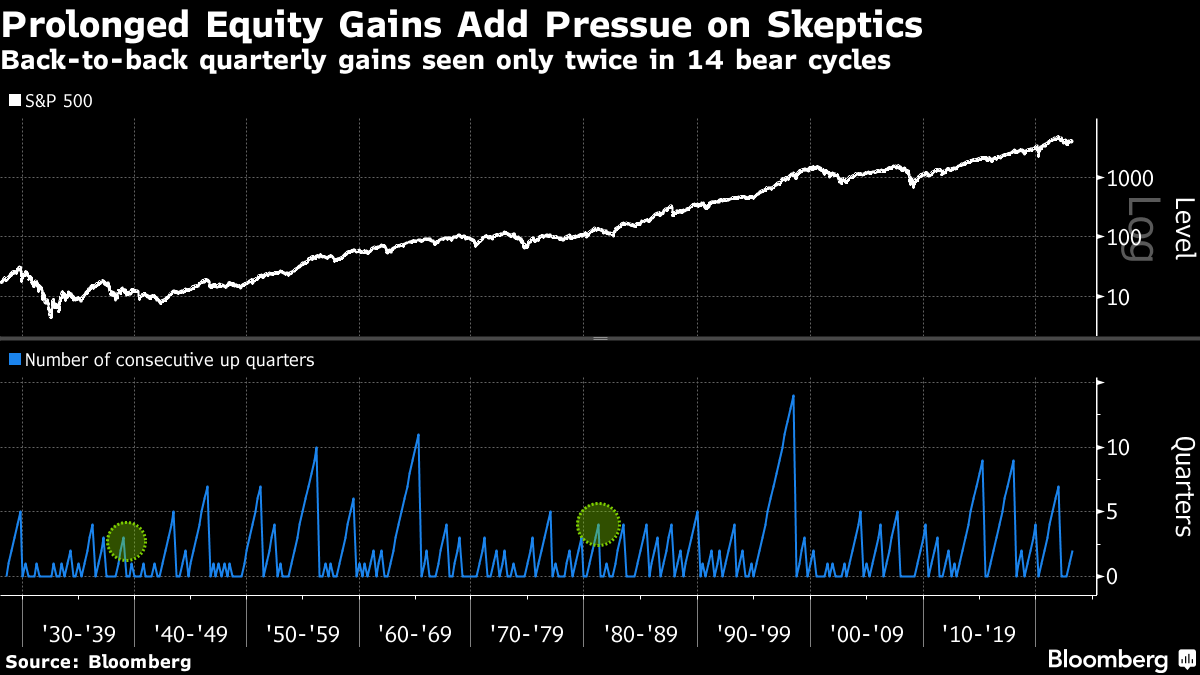
But when everyone's leaning one way, big swings are apt to break out in the other, as the consensus is strained and people give in. Small gains can snowball when the worry is missing out on the next big rally. Lately the concern has been warranted. The S&P 500 just finished the first three months of the year up 7%, rounding out back-to-back quarterly gains. That hasn't happened during any bear market in the past four decades.
“Zero bulls out there,” wrote Brian Garrett, a managing director at Goldman Sachs Group Inc., in a note this week citing a recent client survey showing 85% of the respondents were bearish or neutral. “Part of me wonders if the trigger finger is starting to itch.”
The pain of being a bear was evident in the performance of most-hated stocks, which as a group rose twice as much as the market on Friday, handing losses to short sellers. An index tracking them climbed for the first time in seven quarters.
Pessimists abound, even after a rally that has added $4 trillion in equity values over nearly six months. In the latest Bank of America Corp. survey of money managers this month, allocation to US stocks fell to an 18-year low, while their cash levels held above 5% for 15 straight months, the longest run since 2002.
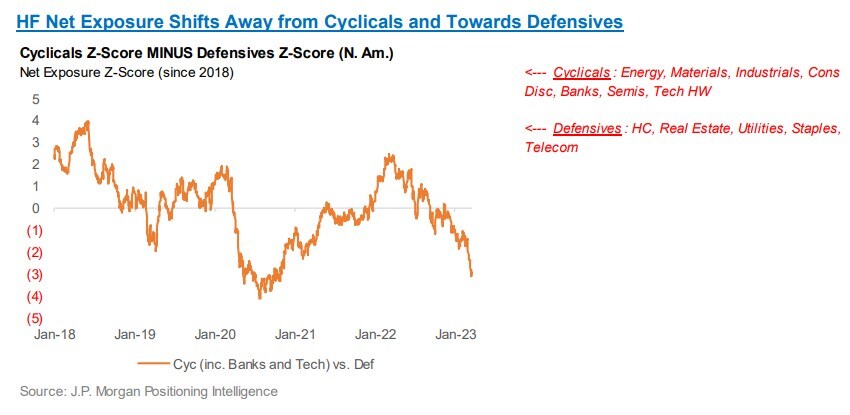
Among professional speculators, caution also prevails. Hedge funds have slashed their positions in economically sensitive shares such as banks, driving their cyclical exposure versus defensive stocks toward the lowest level since early 2020, according to JPMorgan Chase & Co.'s prime brokerage unit.
At Goldman, hedge fund clients saw their net equity exposure hovering near five-year lows. Garrett noted that the group's broad positioning has barely moved in the last four months.
The lack of action echoes a pattern among Wall Street forecasters. While news about banking stress has been fast and furious, estimates on where the S&P 500 will end the year and how much profit corporate America will earn have largely stayed the same. Part of the inertia likely reflects confusion as to where the economy and market are heading.
The duration of equity strength is getting hard to ignore and calls into question the claim that this rally is nothing but a bear market bounce, a view shared by top-ranked strategists such as Morgan Stanley's Mike Wilson and JPMorgan's Marko Kolanovic.
Of the 14 previous bear markets, only two saw the S&P 500 experience back-to-back quarterly gains, in 1981 and 1938. Put another way, history is not on the side of bears when stock momentum is as strong as it has been.
“It is the bears who are trapped and could fuel further gains in April,” said Tom Lee, co-founder at Fundstrat Global Advisors LLC who considers the S&P 500's October low as the start of a bull cycle.
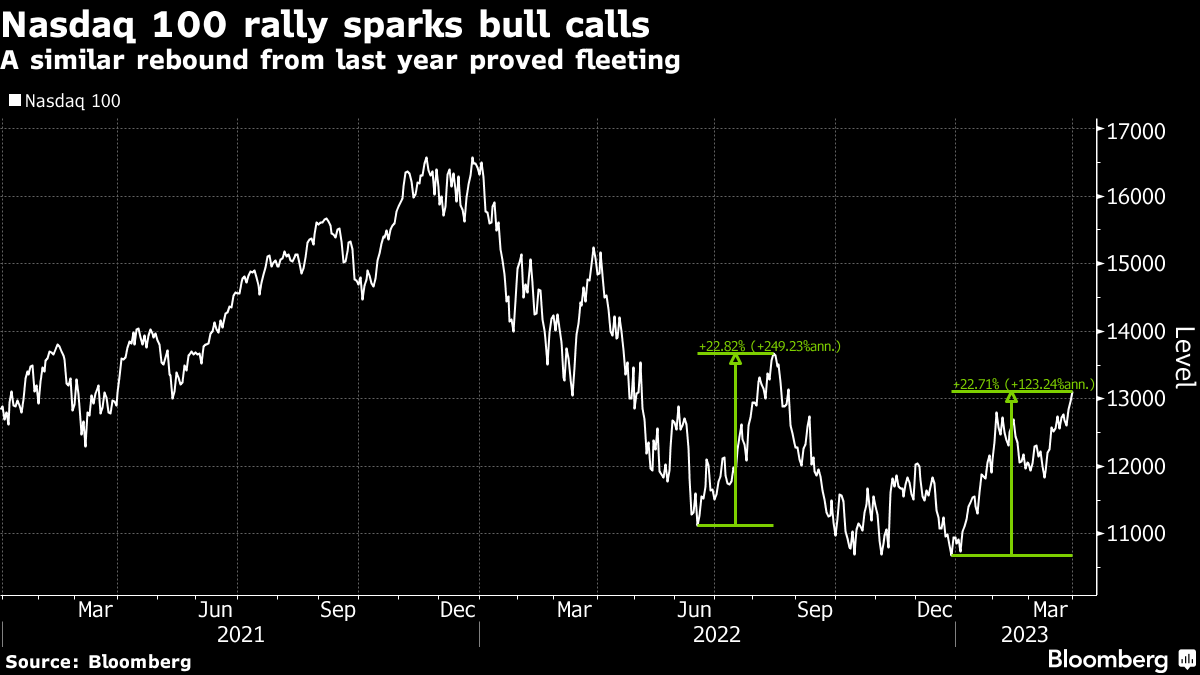
One big winner out of the banking chaos has been technology megacaps. The Nasdaq 100 climbed for a third straight week, extending an advance from its December trough to 23%, as investors rotated out of financial shares and sought safety in cash-rich companies.
While the surge across the 20% threshold fueled calls for a fresh bull cycle for the Nasdaq, it's worth noting that the tech-heavy gauge scored a similar rebound last summer, only to resume declines and reach new lows in December. When the internet bubble burst from 2000 to 2002, investors had to endure five episodes that saw recoveries of that size before the market ultimately found a bottom.
To Tony Roth, chief investment officer at Wilmington Trust, the current market buoyancy is built on false hopes that the Fed will lower interest rates with the banking crisis threatening to thrust the economy into a recession. The firm in November went underweight equities for the first time in eight years, and Roth expects the bear run to last until inflation is under control.
“The market is basically telling you that these rate cuts later this year are going to support higher multiples and we're not convinced those rate cuts are going to come,” he said. “The markets are misreading the Fed.”
In many ways, the fundamental picture is not encouraging. Analysts have been trimming their 2023 earnings estimates since June. While the S&P 500's price-earnings ratio is in line with its own historic average, stocks look rather unattractive when stacked next to cash yielding 5%.
When the market has every reason to fall and it hasn't, theories are proffered as to what is holding it up. To Matthew Reiner, an equity sales trader with JPMorgan, it boils down to positioning.
“Equities are remarkably resilient. Positioning remains very light,” Reiner wrote in a note. “We all need to ask, is sentiment shifting around the edges? If so, investors need to start making their bets. Real fast.”
--With assistance from Isabelle Lee and Melissa Karsh.
More stories like this are available on bloomberg.com
©2023 Bloomberg L.P.

-
The Economic Imperative: Analysing The Material Driving Force Behind India-Canada Strategic Reset

This economic complementarity is further reinforced by deep institutional investment ties and talent mobility, which form the bedrock of the bilateral framework.
-
Medicine Pricing: Where Must Profit Stop?
India must confront excessive margins, hidden incentives and regulatory gaps that threaten the integrity of medicine.
-
Why Amazon And Flipkart Are Struggling To Beat Meesho In India's Smaller Cities
With 274 million users and lowest-cost logistics, Meesho is defending its value commerce crown against giants like Amazon and Flipkart.
-
High US Salaries, No Green Card Certainty: The Financial Calculation Facing Indian H-1B Families
The suspension of PERM processing at eight technology employers does not cancel existing H-1B visas. What it does is force a question many Indian families have been avoiding: is the US salary worth tying your career and family plans to one employer?
-
Swiggy vs Eternal: Food Delivery's Two Rivals Are No Longer In The Same Race
Eternal is building a private AI assistant, dark.ai. Swiggy is still working out how to make Instamart pay, with an operating loss of Rs 895 crore in the July-September quarter while Blinkit stayed profitable.
-
Where You Live Shapes How You Get To Work | The Reason Why
Two-wheelers are the most popular way to get to work in India, accounting for nearly 43% of workplace commutes.
-
Unhedged Position: Can India See An Indonesia-Style Time Correction?
The Nifty is trading below levels it first clocked in 2024. Is there, then, as I have suggested in the headline, potential that the current time correction drags on painfully for the next three-five, even ten years?
-
Navigating Friction And Energy Realities: An Analysis Of Marco Rubio's October Visit To India
Occurring at a critical juncture marked by stalled trade negotiations and escalating geopolitical pressures over global energy supplies, the visit offers a profound window into modern US-India relations.
-
India Exports Capital. Why Not Export Trusteeship?
The big question, then, is whether India can build an institution that global borrowers, investors, banks, and lawyers can trust, even without an Indian connection.
-
France's Economy & Politics Are In Crisis | The Reason Why
Let's look at how the French economy and politics evolved under Nicolas Sarkozy, Franois Hollande and Emmanuel Macron.










