Bank Of Baroda Q4 Results: NII Slips 7%; Final Dividend Declared
 230523 RBI's Rs 2,000 currency exchange facility opens..jpeg?downsize=1010:568 "Bank Of Baroda Q4 Results: NII Slips 7%; Final Dividend Declared")
Bank of Baroda Ltd.'s standalone net profit during the quarter ended March rose 3.3% to Rs 5,048 crore, compared to Rs 4,886 crore in the year-ago period.
The net interest income—the difference of interest earned and interest paid— for the quarter fell 7% to Rs 11,020 crore. This compares to Rs 11,793 crore reported in the corresponding quarter of the previous fiscal. It is below Bloomberg's estimate of Rs 11,689 crore.
Bank of Baroda's asset quality improved during the quarter under review, with the gross non-performing assets ratio declining to 2.26% from 2.43% in the October-December period. In absolute terms, the gross NPA slipped to Rs 27,834.88 crore from Rs 28,471.22 crore in the previous quarter.
The net NPA ratio contracted 10 basis points to 0.58% from 0.59% in the preceding quarter. In absolute terms, the net NPA advanced to Rs 6,994.24 crore from Rs 6,825.06 crore.
Operating profit rose 0.3% to Rs 8,132 crore in comparison to Rs 8,106 crore in the same quarter last year. Provisions rose 43.4% to Rs 1,552 crore in comparison to Rs 1,082 crore reported in the previous quarter.
Return on assets remains above 1% and stands at 1.16% for financial year 2025, the bank said in its press release. Return on equity stands at 16.96% for fiscal year 2025.
The board of directors also approved the final dividend of Rs 8.35 per share. The bank has set June 6 as the record date for the purpose of dividend payment.
Bank of Baroda Shares Decline
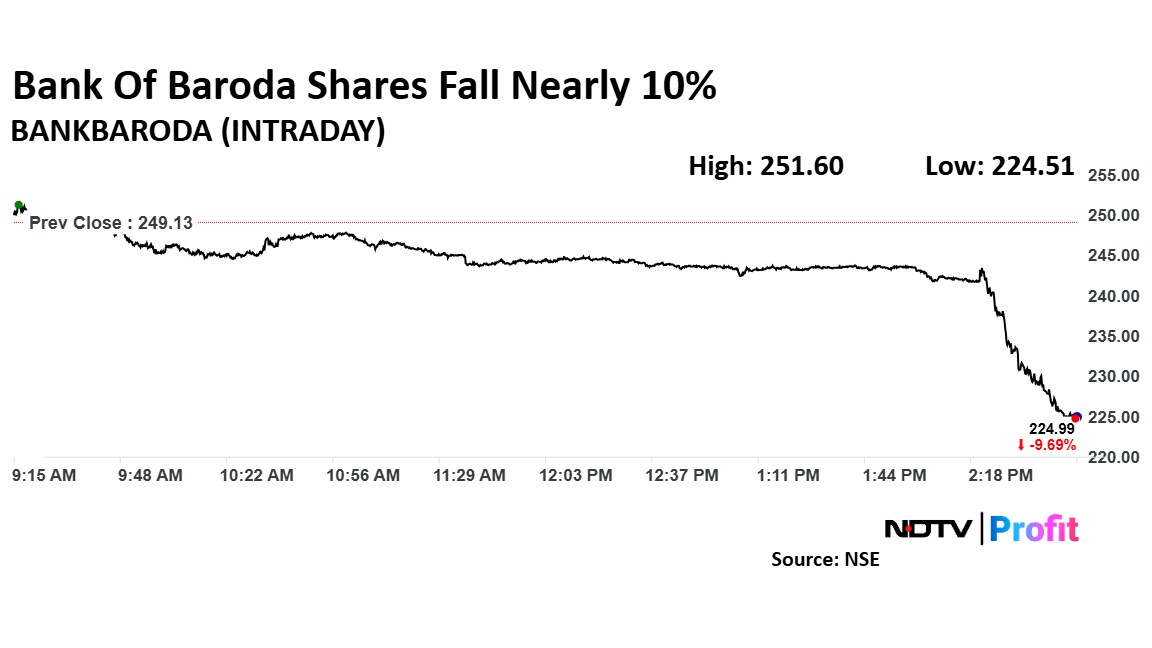
After the quarterly results were declared, shares of Bank of Baroda fell as much as 9.88% to Rs 224.51 apiece, the lowest level since April 15. It pared losses to trade 9.73% lower at Rs 224.88 apiece, as of 3:08 p.m. This compares to a 0.29% decline in the NSE Nifty 50 Index.
The stock has fallen 15.51% in the last 12 months and 6.68% year-to-date. Total traded volume so far in the day stood at 1.2 times its 30-day average. The relative strength index was at 52.38.
Out of 37 analysts tracking the company, 29 maintain a 'buy' rating, six recommend a 'hold,' and two suggest 'sell,' according to Bloomberg data. The average 12-month consensus price target implies an upside of 21.7%.

-
Signature Play: The Classic Cocktail Is Dead. Or Is It?

Classic cocktails are disappearing from India's cocktail menus. But they're still being ordered, taught to bartenders and borrowed from. So, who's really having the last drink?
-
A New Samvat Wishlist: Inclusive Prosperity And Human Development
India has strengthened its economic foundations through infrastructure, digital access and enterprise. Its next growth chapter must deepen productivity, create better livelihoods and widen participation in prosperity.
-
Love, Sex Aur Dhokha: The Audacious Plot To Spy On Jensen Huang
A Taipei dinner, a Singapore chip buyer and a suspected Chinese asset: inside the alleged spy operation that got close to NVIDIA's Jensen Huang.
-
Ten Things I Learnt This Samvat
Patience can be a trap. Cheap stocks can stay cheap. Leverage can wipe you out. What did Samvat 2082 teach us? Niraj Shah writes on 10 lessons from the year gone by.
-
Talking Points This Week: Tech Nerves, FII Buying, And A Faraway Banking Shock
The global markets are not shining this Diwali. The exception in the large markets is, India.
-
Midterm Rally Lasted A Day. The Hard Reality Of A Divided US May Last Two Years | Opinion
Between a contested AI boom, a debt ceiling that arrives in 2027 and a president with every incentive to act alone, the next two years may prove more volatile than the first day's rally suggests.
-
Blue Wave Will Derail the AI Trade but Won't Dismantle the AI Era | Unhedged Position
The Democrats' sweep of the US Congress will see politics collide with economic forces both over the long and short term.
-
It's Time To Take The GST Council's Bet On Trust Global
Payment records can prove India's services exports, and clear, proportionate rules can bring foreign digital sellers into the tax net.
-
Opinion | India at 38: From Innovation Overperformer to Innovation Powerhouse
India now has 453 VC-backed deep science startups, 18 of them late-stage, after 117 percent growth since 2020. Laurus Labs, at USD 9.3 billion, is the most valuable deep science company in any middle-income economy outside China.









