Bajaj Housing Finance Shares Hit Record Low As Promoter Plans To Sell Stake Worth Rs 1,580 Crore

The shares of Bajaj Housing Finance Ltd. fell over 9% on Tuesday to hit record low as promoter Bajaj Finance will offload 2% stake to comply with the requirements of minimum public shareholding.
According to Bloomberg, 2.5% equity of the company changed hands through 21 bunches on Tuesday. The floor price for the block deal is Rs 95 per share, a 9.6% discount to the previous close, as per a termsheet accessed by NDTV Profit. The deal value aggregates to Rs 1,580 crore.
The promoter stake aggregates to 88.7% of the total paid up capital of the company as on date. "Out of the total share capital held, the seller proposes to divest upto 2% of its equity share capital of the Company not exceeding in aggregate upto 166,600,000 shares in one or more tranches," an exchange filing said on Monday.
According to SEBI rules, listed companies must have at least 25% public float to ensure market integrity and liquidity. Companies with a post-issue market capitalisation (market cap) between Rs 50,000 crore and Rs 1 lakh crore have up to five years to meet the 25% MPS, and those with a market cap over Rs 1 lakh crore can have up to ten years.
The remaining promoter equity will be locked-in for 60 days.
IIFL Capital Services Ltd. is the sole merchant banker to the deal.
Bajaj Housing Finance Share Price
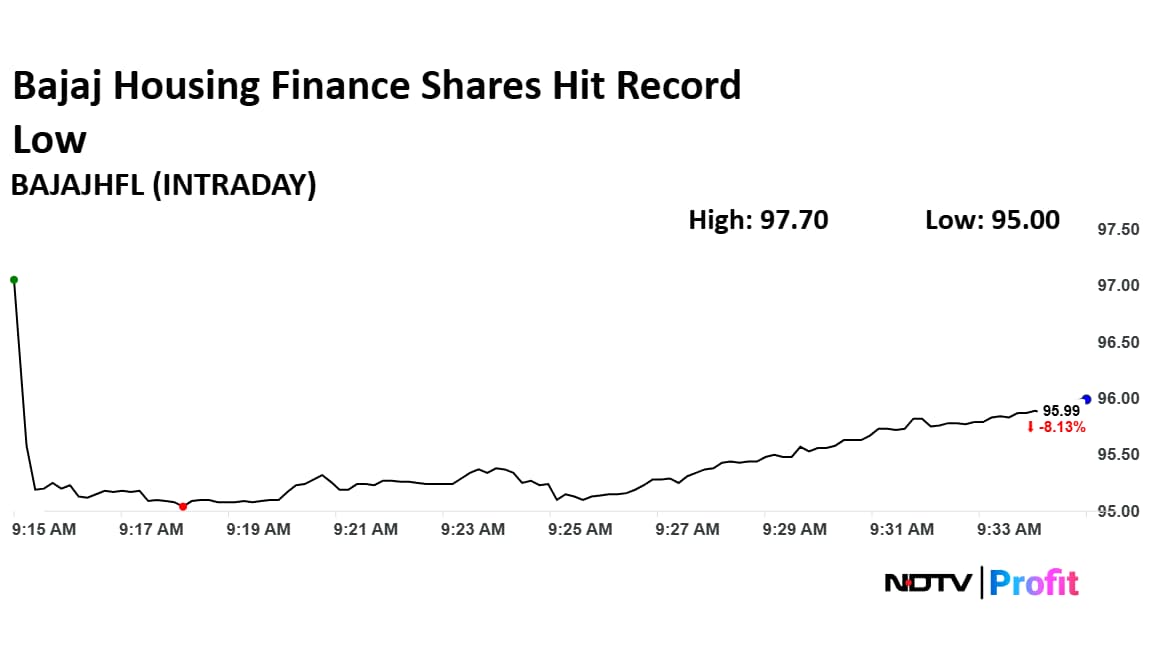
The scrip fell as much as 9.08% to Rs 95 apiece on Tuesday the lowest since its listing last year. It pared gains to trade 8.82% lower at Rs 95.27 apiece, as of 9:35 a.m. This compares to a 0.23% decline in the NSE Nifty 50 Index.
It has fallen 28.67% in the last 12 months and 24.59% year-to-date. Total traded volume so far in the day stood at 3.47 times its 30-day average. The relative strength index was at 34.50.
Out of 11 analysts tracking the company, two maintain a 'buy' rating, three recommend a 'hold,' and six suggest 'sell,' according to Bloomberg data. The average 12-month consensus price target of Rs 111.10 implies an upside of 16.6%.

-
The Economic Imperative: Analysing The Material Driving Force Behind India-Canada Strategic Reset

This economic complementarity is further reinforced by deep institutional investment ties and talent mobility, which form the bedrock of the bilateral framework.
-
Medicine Pricing: Where Must Profit Stop?
India must confront excessive margins, hidden incentives and regulatory gaps that threaten the integrity of medicine.
-
Why Amazon And Flipkart Are Struggling To Beat Meesho In India's Smaller Cities
With 274 million users and lowest-cost logistics, Meesho is defending its value commerce crown against giants like Amazon and Flipkart.
-
High US Salaries, No Green Card Certainty: The Financial Calculation Facing Indian H-1B Families
The suspension of PERM processing at eight technology employers does not cancel existing H-1B visas. What it does is force a question many Indian families have been avoiding: is the US salary worth tying your career and family plans to one employer?
-
Swiggy vs Eternal: Food Delivery's Two Rivals Are No Longer In The Same Race
Eternal is building a private AI assistant, dark.ai. Swiggy is still working out how to make Instamart pay, with an operating loss of Rs 895 crore in the July-September quarter while Blinkit stayed profitable.
-
Where You Live Shapes How You Get To Work | The Reason Why
Two-wheelers are the most popular way to get to work in India, accounting for nearly 43% of workplace commutes.
-
Unhedged Position: Can India See An Indonesia-Style Time Correction?
The Nifty is trading below levels it first clocked in 2024. Is there, then, as I have suggested in the headline, potential that the current time correction drags on painfully for the next three-five, even ten years?
-
Navigating Friction And Energy Realities: An Analysis Of Marco Rubio's October Visit To India
Occurring at a critical juncture marked by stalled trade negotiations and escalating geopolitical pressures over global energy supplies, the visit offers a profound window into modern US-India relations.
-
India Exports Capital. Why Not Export Trusteeship?
The big question, then, is whether India can build an institution that global borrowers, investors, banks, and lawyers can trust, even without an Indian connection.
-
France's Economy & Politics Are In Crisis | The Reason Why
Let's look at how the French economy and politics evolved under Nicolas Sarkozy, Franois Hollande and Emmanuel Macron.










