European Bonds Sell Off Amid German Market Swings: Markets Wrap
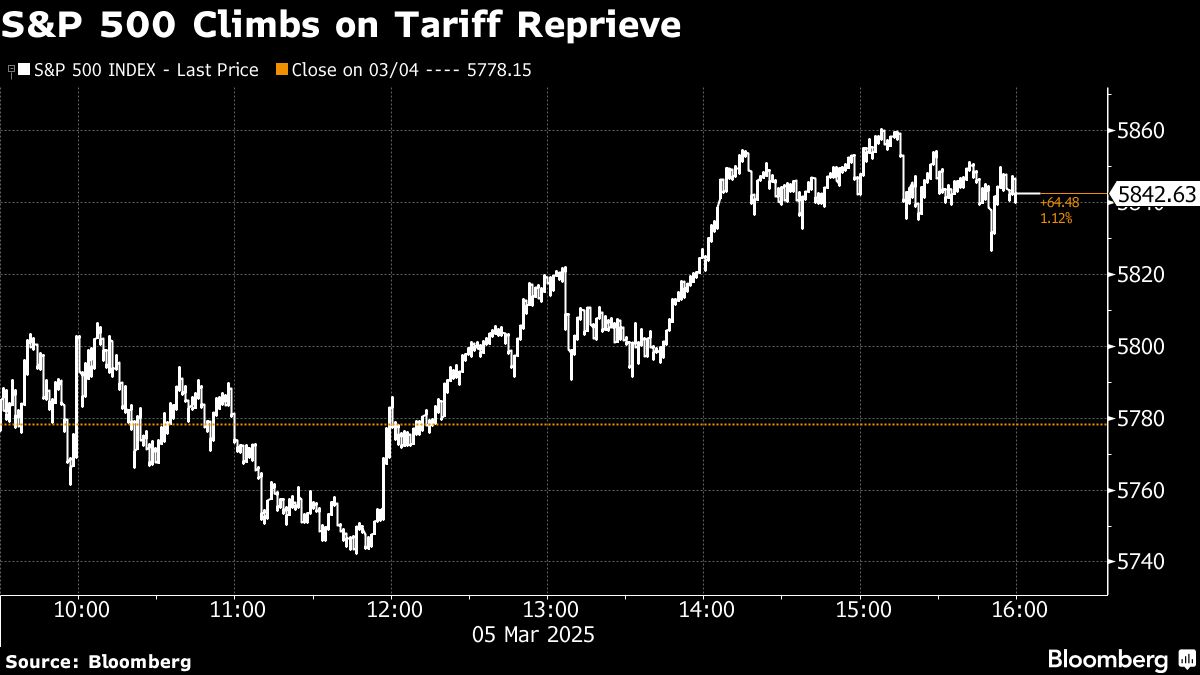
A late-session runup in US stocks capped another volatile day for global markets, a session that also featured extreme moves in European bonds and equities. Geopolitical news dominated sentiment once again, including a delay in the imposition of auto tariffs in Canada and Mexico by the White House.
Wall Street remained focused on the latest developments around trade negotiations and how that could impact the economy and Federal Reserve decisions. The S&P 500 rose over 1%, rebounding from a two-day slide. Treasuries saw small losses in a stark contrast to the plunge in their European counterparts. German bunds tumbled the most since 1990. The dollar fell 1%. Oil sank to the lowest in about six months.
The market has been on a wild ride, and traders expect more of that as they assess the latest tariff developments and brace for Friday's US payrolls report. Options trading projects the S&P 500 to move 1.3% in either direction, in what would be the most for any jobs day since the regional bank turmoil in March 2023.
The S&P 500 rose 1.1%. The Nasdaq 100 added 1.4%. The Dow Jones Industrial Average gained 1.1%.
The yield on 10-year Treasuries rose four basis points to 4.28%. The dollar dropped against most major currencies.
Corporate Highlights
Marvell Technology Inc. issued a revenue forecast that fell short of the highest estimates, disappointing investors who were looking for a bigger payoff from the AI boom.
Apple Inc. rolled out updated MacBook Air laptops and Mac Studio desktops, seeking to maintain a sales resurgence for the company's computer line.
Novo Nordisk A/S is following in rival Eli Lilly & Co.'s footsteps by selling its hit weight-loss drug Wegovy directly to US patients at a discount.
Microsoft Corp.'s $13 billion investment into OpenAI Inc. was cleared by the UK's antitrust watchdog, ending months of uncertainty over the tie-up.
Abercrombie & Fitch Co. is struggling to meet investors' lofty expectations. The retailer said revenue this year would grow 3% to 5%. Wall Street projected an average of $5.2 billion in annual sales, which would be a gain of about 5.5%.
Foot Locker Inc., the struggling sneaker chain, faces limited direct exposure to new US-imposed tariffs, with executives calling their impact small to moderate.
Oil refiner Phillips 66 is fighting back against activist investor Elliott Investment Management in a letter to shareholders Wednesday.
Key events this week:
Eurozone retail sales, ECB rate decision, Thursday
US trade, initial jobless claims, wholesale inventories, Thursday
US Treasury Secretary Scott Bessent speaks, Thursday
Fed's Christopher Waller and Raphael Bostic speak, Thursday
Eurozone GDP, Friday
US jobs report, Friday
Fed Chair Jerome Powell gives keynote speech at an event in New York hosted by University of Chicago Booth School of Business, Friday
Fed's John Williams, Michelle Bowman and Adriana Kugler speak, Friday
Some of the main moves in markets:
Stocks
The S&P 500 rose 1.1% as of 4 p.m. New York time
The Nasdaq 100 rose 1.4%
The Dow Jones Industrial Average rose 1.1%
The MSCI World Index rose 1.5%
Currencies
The Bloomberg Dollar Spot Index fell 1%
The euro rose 1.6% to $1.0792
The British pound rose 0.8% to $1.2899
The Japanese yen rose 0.6% to 148.88 per dollar
Cryptocurrencies
Bitcoin rose 3.3% to $90,367.57
Ether rose 2.3% to $2,228.73
Bonds
The yield on 10-year Treasuries advanced four basis points to 4.28%
Germany's 10-year yield advanced 30 basis points to 2.79%
Britain's 10-year yield advanced 15 basis points to 4.68%
Commodities
West Texas Intermediate crude fell 2.7% to $66.45 a barrel
Spot gold rose 0.1% to $2,921.24 an ounce
This story was produced with the assistance of Bloomberg Automation.
© 2025 Bloomberg L.P.

-
Foreign Investors Own Half Of HDFC Bank and ICICI Bank. An LTCG Cut Could Matter Most Here

Foreign portfolio investors have US$115 billion parked in HDFC Bank, ICICI Bank. If the government cuts long-term capital gains tax, Jefferies says returning foreign money could land here first.
-
'Never Seen This Level Of Negativity': Sandeep Tandon Says The Next Rally May Be Closer Than You Think
Veteran investor Sandeep Tandon says foreign selling is easing, large-caps are due a comeback and mid-caps are crowded, while he turns positive on gold, power and pharma this Diwali.
-
Indians Stay With Family, Not In Hotels | The Reason Why
India still lacks enough clean, reliable and affordable hotels for budget-conscious travellers.
-
The Economic Imperative: Analysing The Material Driving Force Behind India-Canada Strategic Reset
This economic complementarity is further reinforced by deep institutional investment ties and talent mobility, which form the bedrock of the bilateral framework.
-
Medicine Pricing: Where Must Profit Stop?
India must confront excessive margins, hidden incentives and regulatory gaps that threaten the integrity of medicine.
-
Why Amazon And Flipkart Are Struggling To Beat Meesho In India's Smaller Cities
With 274 million users and lowest-cost logistics, Meesho is defending its value commerce crown against giants like Amazon and Flipkart.
-
High US Salaries, No Green Card Certainty: The Financial Calculation Facing Indian H-1B Families
The suspension of PERM processing at eight technology employers does not cancel existing H-1B visas. What it does is force a question many Indian families have been avoiding: is the US salary worth tying your career and family plans to one employer?
-
Swiggy vs Eternal: Food Delivery's Two Rivals Are No Longer In The Same Race
Eternal is building a private AI assistant, dark.ai. Swiggy is still working out how to make Instamart pay, with an operating loss of Rs 895 crore in the July-September quarter while Blinkit stayed profitable.
-
Where You Live Shapes How You Get To Work | The Reason Why
Two-wheelers are the most popular way to get to work in India, accounting for nearly 43% of workplace commutes.
-
Unhedged Position: Can India See An Indonesia-Style Time Correction?
The Nifty is trading below levels it first clocked in 2024. Is there, then, as I have suggested in the headline, potential that the current time correction drags on painfully for the next three-five, even ten years?










