Asian Stocks Open Higher As Tariff Threat Eases: Markets Wrap
(Bloomberg) -- Asian stocks advanced with US equity futures after President Donald Trump held off from imposing sweeping trade tariffs in his first day in office.
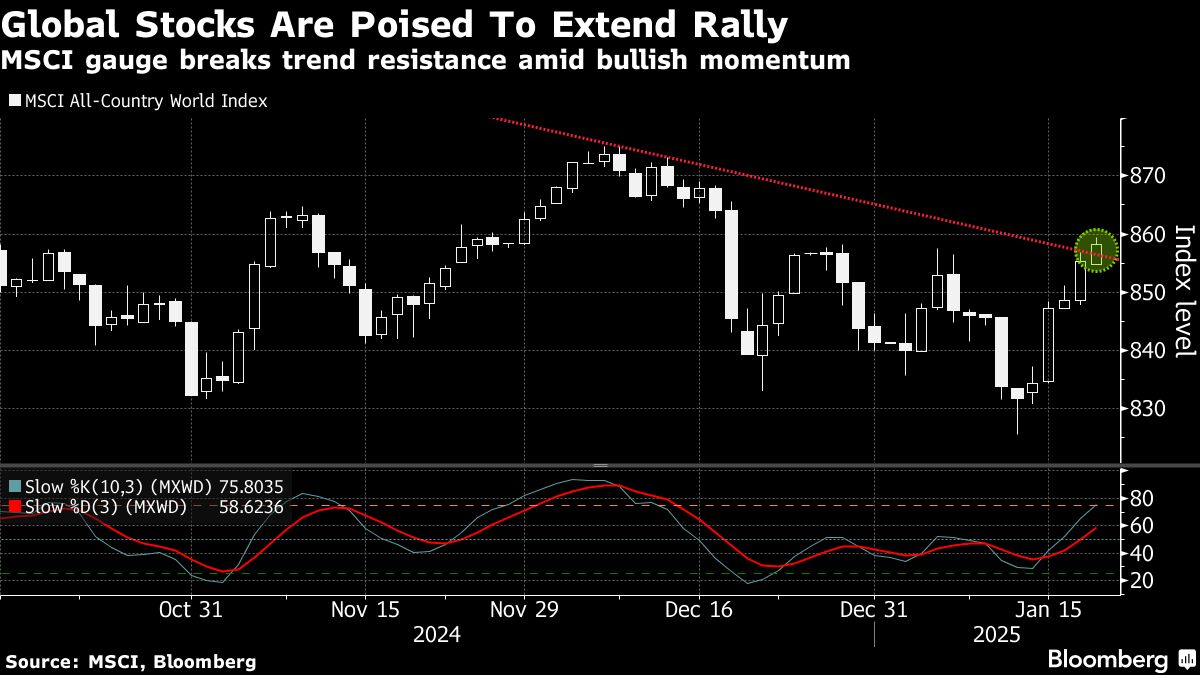
Shares climbed from the open in Australia, Japan and South Korea, with the MSCI Asia Pacific Index rising as much as 0.8%. US futures extended their rally from Monday when the cash market was closed. Asian currencies strengthened as Bloomberg's gauge of the dollar dropped for a second day. Treasuries climbed.
After being sworn into office, Trump promised to sign a series of executive orders, including one that declares a national emergency at the U.S.-Mexico border. For now though, the executive action will not include new tariffs on the three biggest US trading partners. The president instead ordered his administration to address unfair trade practices globally, suggesting he will take a more deliberative approach to trade relations.
“The fact that we're seeing signs of a more conciliatory relationship between the US and China, and the fact there could be a more tactful application of tariffs is great for the region,” said Kyle Rodda, a senior analyst at Capital.com in Melbourne. “Trump is pretty mercurial and it all could change in a Twitter post, but for now it's filling investors with confidence that the worst of the trade war may not materialize.”
Monday's whipsaw moves in equity futures and currencies were seen as providing a foretaste of the uncertainty and volatility to come. Shares in a number of sectors across Asia from electric cars to China-exposed companies and cryptocurrency stocks may see extra volatility Tuesday as they respond to the start of Trump's presidency.
“As much as there is relief today in markets there's probably now going to be greater volatility going forward,” said Brad Bechtel, head of foreign exchange at Jefferies LLC. “In some ways, it might have been better if we got whatever we were going to get on day one.”
Chinese property developers will also be in focus after Bloomberg reported officials are taking steps to stabilize operations at China Vanke Co. Trading in three of Vanke's yuan bonds was halted Monday after prices surged 20% or more following the report that officials of Shenzhen, the southern metropolis where Vanke is based, held a closed-door meeting to discuss the company on Friday.
Treasury 10-year yields fell as much as nine basis points to 4.54% as cash trading resumed following Monday's holiday. Yield dropped as the absence of any new China tariffs was seen as limiting any potential increase in US inflation.
Investors had been on tenterhooks for the first executive orders to stem from the White House after Trump vowed to quickly implement his “America First” agenda. Since his November election victory, everything from the Australian dollar to European equities have been whipsawed on concern widespread tariffs would add to global trade frictions, while the dollar surged as the Federal Reserve turned more cautious on easing policy.
An index of Asian currencies this month fell to a record low in data starting in 2006 amid broad greenback strength, while the region's central banks turned dovish to shore up their economies amid concern economic growth would be crimped.
Betting on the dollar has become one of Wall Street's favored trades for those investors expecting that sweeping trade tariffs will crimp global growth, lift US inflation and potentially cause the Fed to refrain from lowering borrowing costs this year.
In commodities, oil slumped after Trump said he plans to invoke emergency powers boost domestic crude production and held off on tariffs that may have restricted supplies. A shift away from renewable energy sources sparked declines in Siemens Energy AG, Enel SpA and Vestas Wind Systems A/S.
Bitcoin retreated from a record high amid heightened swings in crypto markets around Trump's inauguration.
Here's how analysts reacted as Trump was sworn into office:
Tom di Galoma, head of fixed income at Curvature Securities:
Trump seems to be more focused on the border and less focused on trade issues at this point. He's probably trying to be really careful with the tariffs at this point to not spook the markets. This should do the trick to bring yields lower this week.
Chamath de Silva, head of fixed income at BetaShares Holdings Pty:
With the exception of tariffs, most of the expected executive orders probably won't be market-moving in the short term. The fact that Trump appears to be holding off from enacting tariffs should be risk-positive for markets and negative for the USD, which should support Asian markets. Furthermore, many of the new administration's trade goals are at odds with a stronger US dollar.
Priya Misra, a portfolio manager at JPMorgan Asset Management:
The lack of tariffs on Day 1 is positive for risk assets and Treasuries and negative for the dollar. The market was pricing in at least china tariffs on Day 1 and some chance of universal tariffs, so some of that risk premium will be unwound.
Steve Chiavarone, senior portfolio manager and head of multi-asset at Federated Hermes:
Generally speaking, the market views Trump's agenda as being pro-growth. The focus today for markets is primarily on tariff policy. There wasn't anything really new there during the inaugural speech. That's one reason why the dollar is softer and markers are higher. The executive orders will be the next area to watch.
Jun Bei Liu, a portfolio manager at Tribeca Investment Partners Pty:
This is good news that his speech is cooperative. It simply means a little more time for the Asian region and businesses that need to adjust their manufacturing base. It is unclear if tariffs will go higher but it will involve a lot of negotiation. I think global businesses will continue to diversify their cost base and increase US production if possible.
Billy Leung, an investment strategist at Global X ETFs:
For Asian markets, the absence of immediate tariff announcements offers a temporary reprieve. This is particularly relevant for export-driven economies such as China and South Korea, which are highly sensitive to US trade policy shifts. The strengthening of the Chinese yuan reflects cautious optimism, but volatility may resurface as trade details emerge.
Key events this week:
UK jobless claims, unemployment, Tuesday
Canada CPI, Tuesday
ECB President Christine Lagarde and other officials speak at Davos, Wednesday
South Korea GDP, Thursday
Eurozone consumer confidence, Thursday
Trump will join the World Economic Forum for an online “dialogue”
Japan CPI, rate decision, Friday
India, euro area, UK PMIs, Friday
ECB President Christine Lagarde and BlackRock CEO Larry Fink speak at Davos, Friday
Some of the main moves in markets:
Stocks
S&P 500 futures rose 0.5% as of 9:37 a.m. Tokyo time
Hang Seng futures rose 1.6%
Nikkei 225 futures (OSE) rose 0.3%
Japan's Topix rose 0.2%
Australia's S&P/ASX 200 rose 1%
Euro Stoxx 50 futures rose 0.1%
Currencies
The Bloomberg Dollar Spot Index was little changed
The euro was little changed at $1.0422
The Japanese yen rose 0.3% to 155.20 per dollar
The offshore yuan was little changed at 7.2632 per dollar
Cryptocurrencies
Bitcoin fell 0.3% to $102,202.04
Ether fell 0.7% to $3,258.11
Bonds
The yield on 10-year Treasuries declined eight basis points to 4.55%
Japan's 10-year yield declined 1.5 basis points to 1.175%
Australia's 10-year yield declined six basis points to 4.42%
Commodities
West Texas Intermediate crude fell 1.3% to $76.89 a barrel
Spot gold was little changed

-
Gold Is Rs 22,000 Cheaper Than A Month Ago. Should You Buy Amid The Wedding Season?

Gold's potential slide to $3,500 could save around Rs 4,700 per 10 grams, but a soft inflation print could just as easily push prices back up. One way to split the risk is to buy in parts, some now and the rest after the Fed's Dec. 9 decision.
-
AI Agents Are Gaining Power. Who Governs Them?
Artificial intelligence agents promise to transform productivity by moving machines from assisting decisions to executing them. But as organisations delegate greater authority to these AI-agents, they must first establish who controls that authority and who remains accountable when things go wrong.
-
Why Swapping Your Old Gold Can Trigger A Rs 5 Lakh Tax Bill, And How You Can Avoid It Legally
Swapping old gold for new is taxed as a sale and a fresh purchase. Getting your own gold remade can cut most of that bill, though it has its own costs.
-
The AI Trade is Done. The Real Opportunity for Investors Starts in 2027 | Unhedged Position
As pureplay AI stocks plunge and circular, capex-led financing unwinds, 2027 is set to be a year of reckoning for AI companies. Yet the bust clears the way for a better opportunity for investors in 2027 -- shifting the spotlight from AI builders to the companies using AI.
-
Leadership As Mission: Why The Age Of AI Demands More Human Leadership
Debjani Ghosh examines how AI is changing leadership, arguing that its success must be measured by its impact on people and the accountability of those guiding its use.
-
We May Need Another Tukaram Mundhe To Fight Air Pollution | The Reason Why
Developers may install basic measures such as sprinklers and green nets, resume work, and continue violating rules when this equipment stops working.
-
Extracting Value From Battery Scrap Could Be Challenging For India | The Reason Why
A discarded lithium-ion battery still contains valuable materials such as lithium, nickel and cobalt. These can be recovered and reused. When such batteries are crushed and shredded, they produce a dark powder called black mass.
-
One El Nino, India Can Handle. Two Could Break The Granary
India's grain stocks can absorb one bad year, but a second El Nino could drain the buffer in two to three years, economists say.
-
India's Troika Of Good Luck | Joining The Dots
As Jensen Huang's exit drags Nvidia down, a cooling AI trade and resilient earnings have revived investor interest in India. A likely RBI rate hike looms.
-
Talking Points This Week: Leadership Shock At Nvidia, Earnings Strength, And The Fog Over Hormuz
The Anthropic IPO pricing and first trading day, Nvidia's upcoming earnings, and any fresh signals from Iran will set the tone for the following week.









