Nasdaq 100 Falls 1% As Nvidia Hit Before Earnings: Markets Wrap
.jpg?downsize=1010:568 "Nasdaq 100 Falls 1% As Nvidia Hit Before Earnings: Markets Wrap")
(Bloomberg) -- Some of the world's largest technology companies dragged down stocks after a rally that put the market on the brink of its all-time highs, with Nvidia Corp.'s earnings due in just a few days.
A gauge of the “Magnificent Seven” megacaps slid 1.2%. While more than half of the shares in the S&P 500 gained, the US equity benchmark edged lower on Monday — a consequence of weakness in the tech giants that dominate it. Small caps finished little changed after climbing almost 1% on hopes the bull market will broaden out of big tech as Jerome Powell signaled Friday the Fed will cut rates soon. The Dow Jones Industrial Average rose to a record.
“Powell sealed the deal for a September cut at Jackson Hole — leaving intact our thesis for continued broadening/rotation,” said Ohsung Kwon at Bank of America Corp. “But don't sleep on Nvidia earnings, a consistent driver of S&P returns and still a risk to markets if they disappoint.”
Strong flows from corporate buybacks, systematic funds and retail investors are expected to push stocks higher in the coming weeks, according to Goldman Sachs Group Inc.'s Scott Rubner.
He estimates there will be $17 billion of “unemotional demand between robots and corporates every day this week.” Rubner also sees a so-called “green sweep” for commodity trading advisers, or CTAs, over the coming week, which means those funds will likely be buying stocks however the market trades.
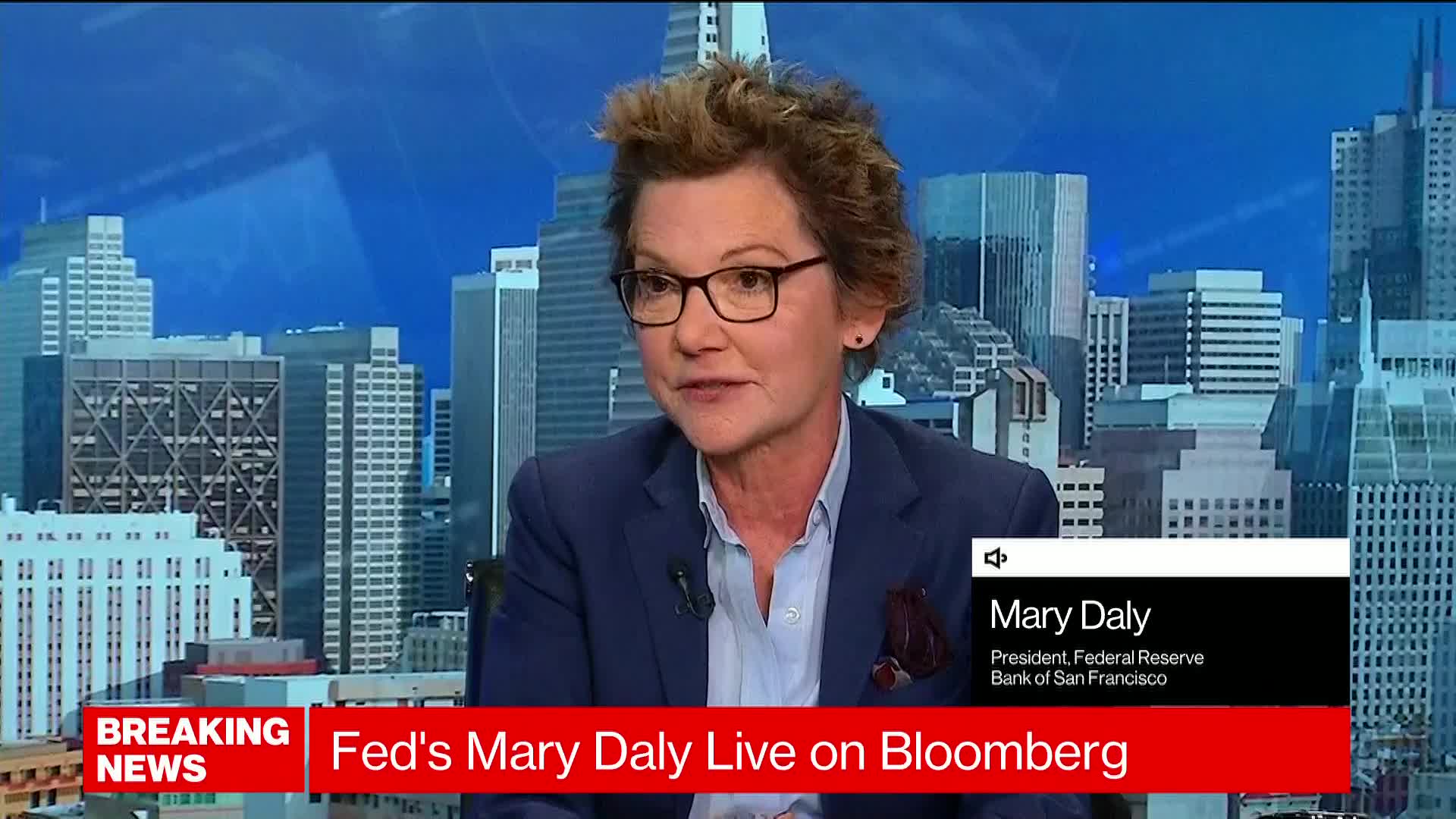
Traders continued to keep a close eye on US policymakers, with Fed Bank of San Francisco President Mary Daly telling Bloomberg Television she believes it's appropriate to begin cutting rates. Her Richmond counterpart Thomas Barkin says he still sees upside risks for inflation, though he supports “dialing down” rates in the face of a cooling labor market.
The S&P 500 fell to 5,616.84 amid thin trading volume. An equal-weighted version of the gauge — one that gives Target Corp. as much clout as Microsoft Corp. — hovered near all-time highs. The tech-heavy Nasdaq 100 slid 1%.
Treasury 10-year yields rose two basis points to 3.82%. Oil advanced after Libya's eastern government said it will halt exports, building on tensions in the Middle East after Israeli strikes on Hezbollah targets in southern Lebanon.
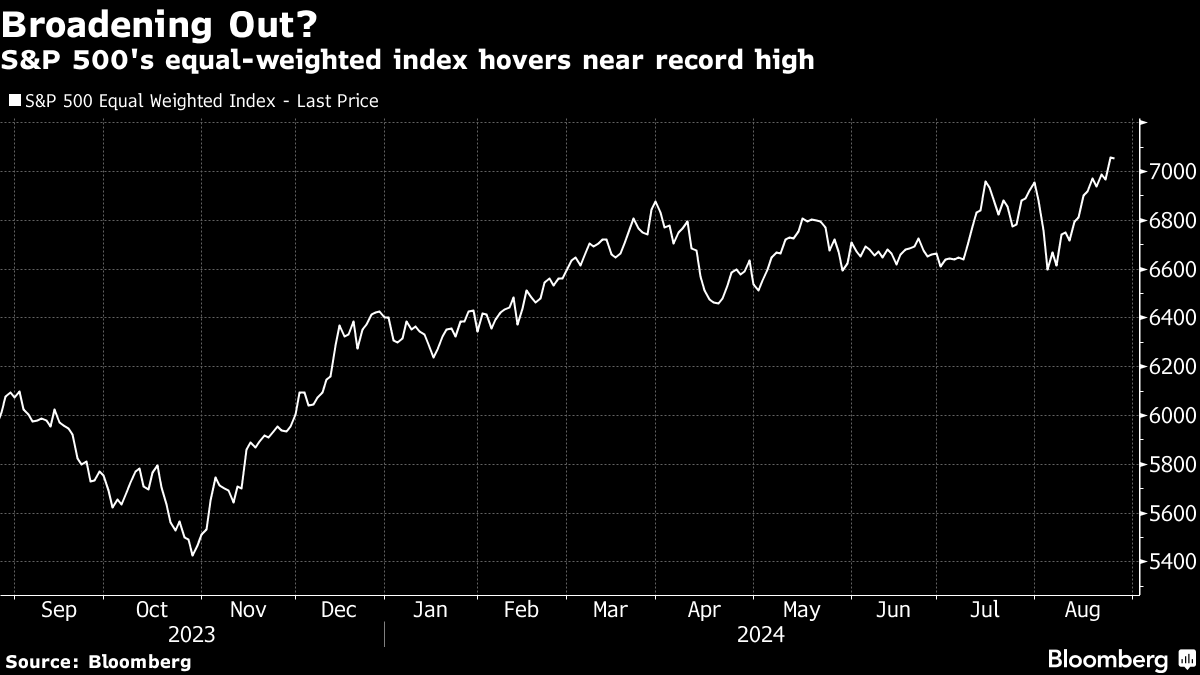
The market has been on a healthier track over the past few weeks, moving away from the overly strong reliance on a few big tech names that we saw in the first seven months this year, according to Mark Hackett at Nationwide. With that said, we are currently in what can best be described as a “market pause,” he noted.
“September is historically the worst month on the calendar, so investors should expect some volatility, especially if key indicators like the PCE inflation data, Nvidia earnings, or upcoming payroll disappoint,” he said.
To Chris Larkin at E*Trade from Morgan Stanley, in order to push to fresh highs this week, stocks may need to avoid any major surprises from earnings — especially Nvidia — “which has been driving a good deal of the sentiment in the tech sector.”
Expectations heading into the giant chipmaker's earnings on Wednesday are high, with analysts anticipating another strong consensus beat that could prompt the chipmaker to raise its profit guidance. Trading in the options market suggest investors see potential for a 9% move in either direction on the day following the report, Citigroup Inc.'s Vishal Vivek said last week.
“Move over, Powell. It's Jensen Huang's turn to move markets,” said Anthony Saglimbene at Ameriprise, referring to Nvidia's chief. “In our view, Nvidia's earnings report this week may actually have more impact on the overall market than Powell's Jackson Hole speech last week.”
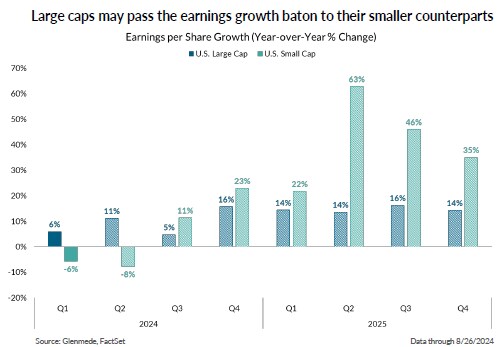
Its report this week will wrap up results for the “Magnificent Seven,” which combined are on track to post 34% year-over-year growth in earnings for the second quarter — compared to 6% for the rest of the S&P 500, according to Jason Pride and Michael Reynolds at Glenmede.
This comes after a nearly year-long period in which the cohort of megacaps posted earnings growth of more than 40% — while the rest of the index saw outright declines.
“The back half of this year is likely to be the beginning of a process that gives way to broader fundamental improvement,” they said. “Broader earnings growth participation should favor small caps and investment processes that avoid the pitfalls of market concentration.”
“At current valuations, stocks are expensive and any further upside will depend on improving earnings,” said Richard Saperstein at Treasury Partners. “Abundant liquidity coupled with declining inflation and an accommodative central bank will provide the backdrop for higher stock prices.”
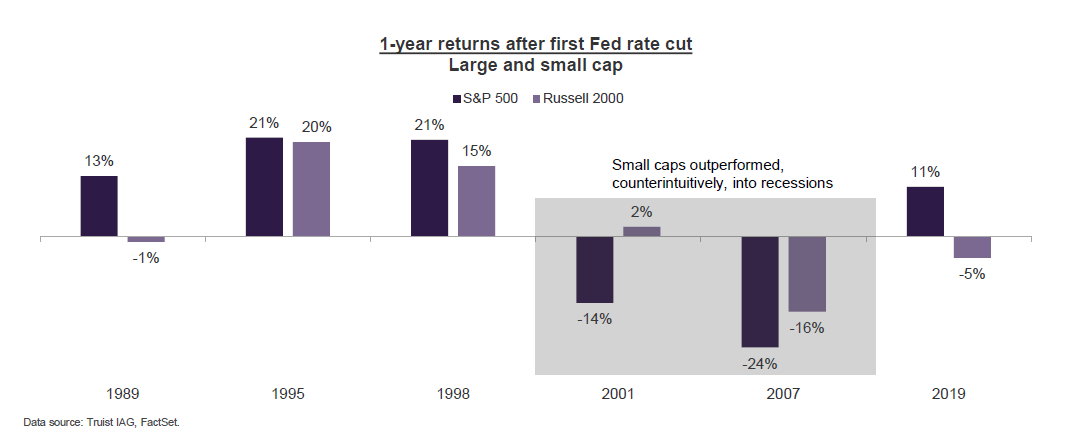
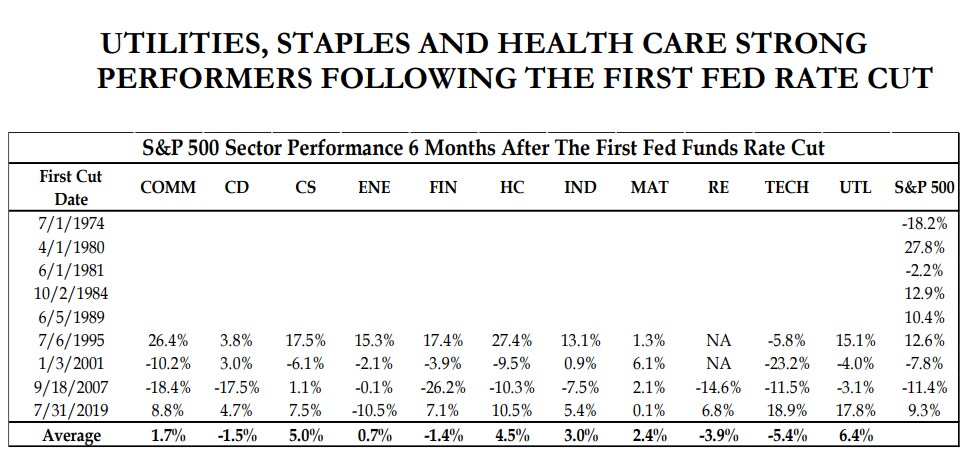
S&P 500 returns following the initial Fed rate cut tend to be positive — unless the economy falls into recession, according to Keith Lerner at Truist Advisory Services, who also notes that's not his base-case scenario.
“Small caps are likely to do better in the near term — but longer term we still prefer large caps,” Lerner said. “Small caps are a greater beneficiary of lower short-term rates, and valuations are cheap. However, historical trends after first Fed rate cut are mixed, earnings trends are still weak, and a cooling economy is historically a headwind for the asset class.”
“Growth stocks are losing bullish momentum right now in both outright price and relative strength to the S&P 500 while the opposite is true for value stocks which hit fresh all-time highs last week and are stabilizing relative to the S&P 500,” said Tom Essaye at The Sevens Report. “More evidence is needed but a value-over-growth trade is emerging.”
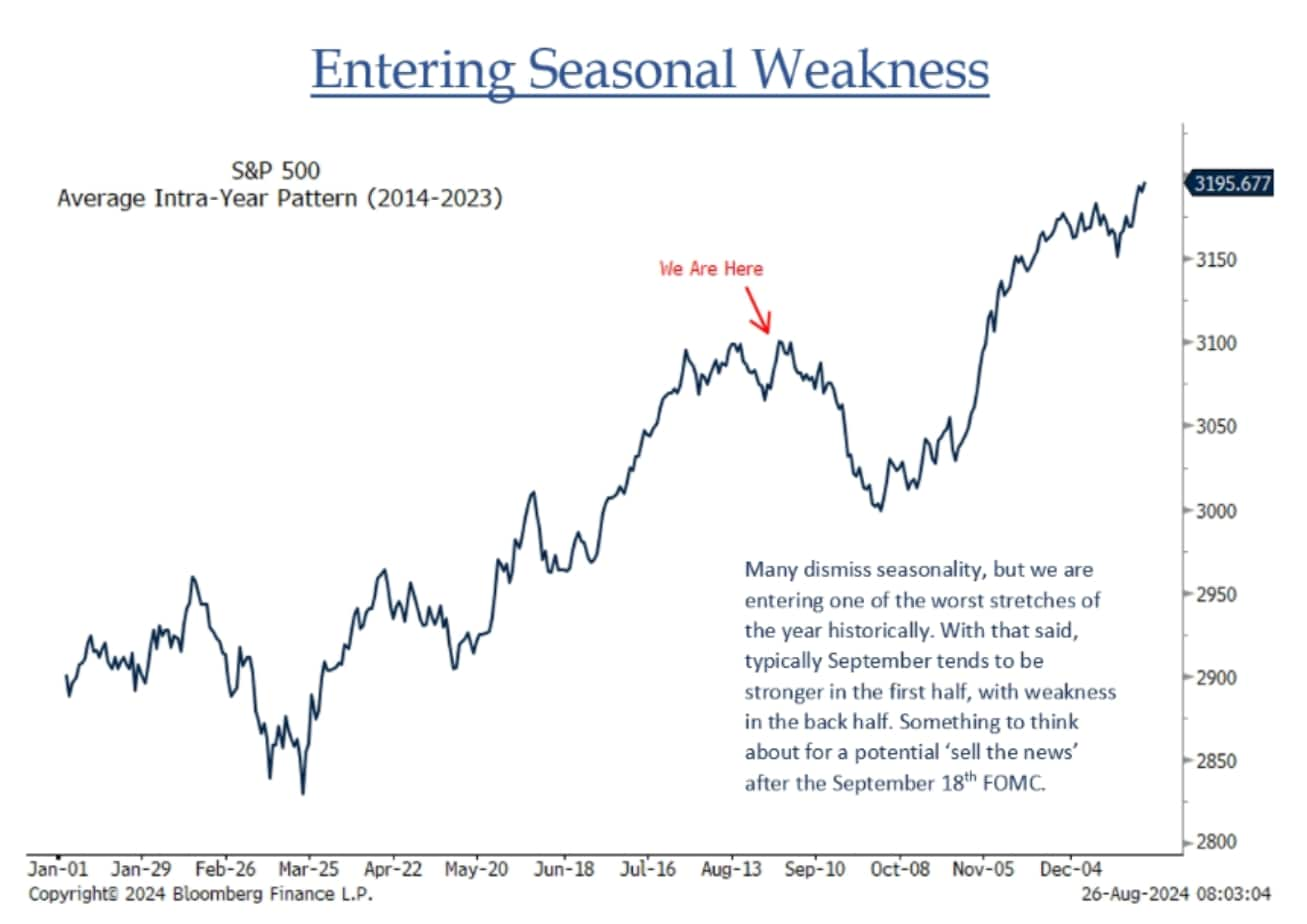
While it's hard to stand in front of a market trending higher that is about to get rate cuts, we continue to think equities will show some consolidation around the area of prior highs, said Jonathan Krinsky at BTIG.
“No rush to push all your chips in right here, especially as we enter one of the worst seasonal stretches of the year,” Krinsky noted. “Small caps remain above their key breakout level, but we are more interested in the potential turn in the relative trend. Rate cuts should help this trade, assuming the eco data holds up.”
US inflation figures this week will reinforce that long-awaited interest-rate cuts are coming soon, while a reading on consumer spending is seen indicating that the central bank has been successful at keeping the expansion intact.
Economists see the personal consumption expenditures price index excluding food and energy — the Fed's preferred measure of underlying inflation — rising 0.2% in July for a second month. That would pull the three-month annualized rate of so-called core inflation down to 2.1%, a smidgen above the central bank's 2% goal.
Corporate Highlights:
- Elliott Investment Management has increased its equity stake in Southwest Airlines Co. to 9.7%, nearing the amount needed to call a special shareholder meeting at which the activist hopes to replace most of the carrier's board.
- Apple Inc. has sent out invitations for a product launch event at its headquarters on Sept. 9, when it's set to announce details of the iPhone 16 and other new devices.
- Longtime Apple Chief Financial Officer Luca Maestri will step down from the job at the end of the year, handing the role to top deputy Kevan Parekh after more than a decade.
- Applied Materials Inc. said the US Department of Justice has requested information on its applications for federal grants, adding another layer to government investigations into its operations.
- Paramount Global is moving ahead with asset disposals to raise cash, people familiar with the matter said, amid the ongoing takeover saga involving the media company.
- McKesson Corp. agreed to buy a controlling stake in an arm of Florida Cancer Specialists & Research Institute, a privately held operator of clinics.
- PDD Holdings Inc.'s shares tumbled after Temu's owner warned that revenue growth will inevitably dwindle, highlighting the challenges of sustaining its pace of expansion against aggressive rivals like ByteDance Ltd.
- China industrial profits, Tuesday
- Germany GDP, Tuesday
- US Conference Board consumer confidence, Tuesday
- Nvidia earnings, Wednesday
- Fed's Raphael Bostic and Christopher Waller speak, Wednesday
- Eurozone consumer confidence, Thursday
- US GDP, initial jobless claims, Thursday
- Fed's Raphael Bostic speaks, Thursday
- Japan unemployment, Tokyo CPI, industrial production, retail sales, Friday
- Eurozone CPI, unemployment, Friday
- US personal income, spending, PCE; consumer sentiment, Friday
- The S&P 500 fell 0.3% as of 4 p.m. New York time
- The Nasdaq 100 fell 1%
- The Dow Jones Industrial Average rose 0.2%
- The MSCI World Index fell 0.3%
- Bloomberg Magnificent 7 Total Return Index fell 1.2%
- The Russell 2000 Index was little changed
- The Bloomberg Dollar Spot Index rose 0.3%
- The euro fell 0.3% to $1.1160
- The British pound fell 0.2% to $1.3185
- The Japanese yen fell 0.1% to 144.58 per dollar
- Bitcoin fell 1.4% to $63,359.76
- Ether fell 3.2% to $2,681.56
- The yield on 10-year Treasuries advanced two basis points to 3.82%
- Germany's 10-year yield advanced two basis points to 2.25%
- Britain's 10-year yield declined five basis points to 3.91%
- West Texas Intermediate crude rose 3% to $77.09 a barrel
- Spot gold rose 0.2% to $2,518.29 an ounce
Key events this week:
Some of the main moves in markets:
Stocks
Currencies
Cryptocurrencies
Bonds
Commodities
This story was produced with the assistance of Bloomberg Automation.
--With assistance from Robert Brand, Catherine Bosley and Jason Scott.
More stories like this are available on bloomberg.com
©2024 Bloomberg L.P.

-
AI Bias In Investing Cannot Be Eliminated, But It Can Be Governed

Framing is a particularly important example as identical financial information presented in terms of gains rather than losses can lead an LLM to reach a different assessment.
-
Joining The Dots | Dark Skies, Steady Diya: Why Hope Holds This Diwali
With war, a weak rupee and foreign outflows weighing on sentiment, policymakers at the NDTV World Summit and market veterans at NDTV Profit Ignite: Diwali Edition offered the same advice: stay invested and filter out the noise.
-
The Curious Case of Equitas Small Finance Bank And A CEO Who Quit For Stock
PN Vasudevan believes persistent investor concerns over a perceived conflict of interest had become a governance overhang on Equitas Small Finance Bank's stock, even as the lender improved profitability and asset quality.
-
Talking Points This Week: AI Cash Burn, A Tiger Comeback And An India That Still Finds Its Own Path
India is not immune to higher oil or tighter global liquidity, yet its earnings base is broader, its domestic policy levers are still available.
-
Foreign Investors Own Half Of HDFC Bank and ICICI Bank. An LTCG Cut Could Matter Most Here
Foreign portfolio investors have US$115 billion parked in HDFC Bank, ICICI Bank. If the government cuts long-term capital gains tax, Jefferies says returning foreign money could land here first.
-
'Never Seen This Level Of Negativity': Sandeep Tandon Says The Next Rally May Be Closer Than You Think
Veteran investor Sandeep Tandon says foreign selling is easing, large-caps are due a comeback and mid-caps are crowded, while he turns positive on gold, power and pharma this Diwali.
-
Indians Stay With Family, Not In Hotels | The Reason Why
India still lacks enough clean, reliable and affordable hotels for budget-conscious travellers.
-
The Economic Imperative: Analysing The Material Driving Force Behind India-Canada Strategic Reset
This economic complementarity is further reinforced by deep institutional investment ties and talent mobility, which form the bedrock of the bilateral framework.
-
Medicine Pricing: Where Must Profit Stop?
India must confront excessive margins, hidden incentives and regulatory gaps that threaten the integrity of medicine.
-
Why Amazon And Flipkart Are Struggling To Beat Meesho In India's Smaller Cities
With 274 million users and lowest-cost logistics, Meesho is defending its value commerce crown against giants like Amazon and Flipkart.










