Alphabet Falls Most in Three Months on Bard Accuracy Concerns
(Bloomberg) -- Google owner Alphabet Inc. fell by the most in more than three months after a demonstration of its new artificial intelligence chatbot, Bard, sparked concerns that the tech giant has lost ground in the race for the future of internet search.
Google has been under pressure since developer OpenAI launched its wildly popular chatbot, ChatGPT, which many in the tech industry tout as the next generation of search. On Tuesday, Microsoft Corp., which is investing billions in OpenAI, unveiled a new version of its Bing search engine and Edge browser incorporating technology from the AI startup. On Wednesday, Google hosted a news conference in Paris where it shared more details about its progress integrating artificial intelligence into search.
Investors were largely underwhelmed by the demonstration. In one instance, Bard was asked about new discoveries from the James Webb Space Telescope. In one of its responses, Bard said the telescope was used to take the first pictures of a planet outside the Earth's solar system — but NASA says those were actually taken by a different telescope.
For now, Bard is available only to a limited number of trusted testers, and OpenAI's ChatGPT has also been found to deliver inaccurate or outdated responses. Yet investors are keenly attuned to any threat to Google's search business, which remains its lifeblood.
“That is why you see such a reaction, because this is the money generator, the cash cow in Alphabet's portfolio,” said Mandeep Singh, an analyst with Bloomberg Intelligence.
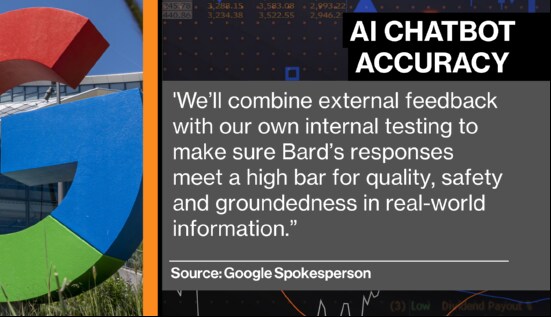
Google said in a statement that Bard's response “highlights the importance of a rigorous testing process.” The company said it will combine external feedback with its own internal testing to ensure Bard's responses “meet a high bar for quality, safety and groundedness in real-world information.”
Read More: ChatGPT Reignites the Search Wars Between Google and Microsoft
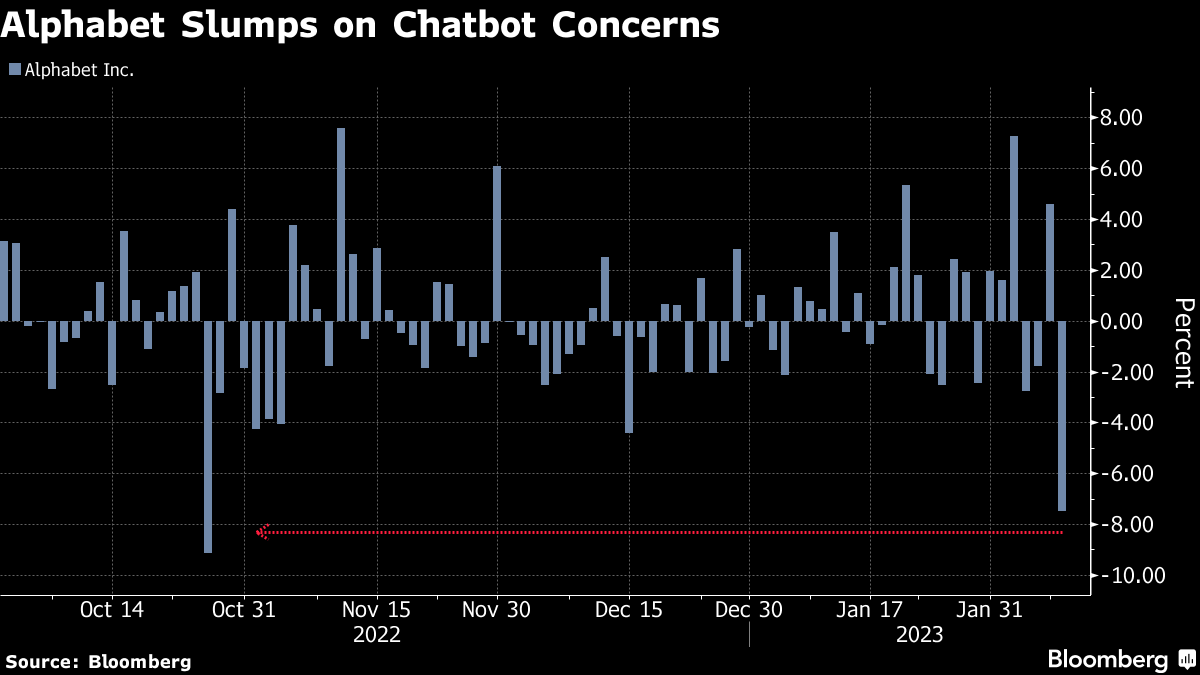
Alphabet declined 7.4% to $99.67 at 1:09 p.m. New York time on Wednesday. Earlier, the shares fell as much as 8.9%, the biggest drop since Oct. 26.
Last year, Google declared a “code red” in response to ChatGPT's release — a move akin to pulling a fire alarm internally, which sent the company's AI engineers scrambling for a response. Bard's imperfect performance on the public stage suggests the company may have felt pressure to show off the technology before it was ready, Singh said.
“They did this in haste,” Singh said. “You don't expect it from a company that is so dominant, and really has always been able to fend off any challenges as far as their core search business.”
While Microsoft won the narrative this week, Google's longstanding investments in artificial intelligence will ultimately pay off, said Gene Munster, co-founder and managing partner at Deepwater Asset Management.
“Right now the snapshot is: advantage Microsoft,” Munster said. “However, we still think the long-term advantage should go to Alphabet given the resources it has put into AI over the past six years.”
--With assistance from and .
(Updates with additional context on AI chatbots starting in fourth paragraph.)
More stories like this are available on bloomberg.com
©2023 Bloomberg L.P.

-
Gold Is Rs 22,000 Cheaper Than A Month Ago. Should You Buy Amid The Wedding Season?

Gold's potential slide to $3,500 could save around Rs 4,700 per 10 grams, but a soft inflation print could just as easily push prices back up. One way to split the risk is to buy in parts, some now and the rest after the Fed's Dec. 9 decision.
-
AI Agents Are Gaining Power. Who Governs Them?
Artificial intelligence agents promise to transform productivity by moving machines from assisting decisions to executing them. But as organisations delegate greater authority to these AI-agents, they must first establish who controls that authority and who remains accountable when things go wrong.
-
Why Swapping Your Old Gold Can Trigger A Rs 5 Lakh Tax Bill, And How You Can Avoid It Legally
Swapping old gold for new is taxed as a sale and a fresh purchase. Getting your own gold remade can cut most of that bill, though it has its own costs.
-
The AI Trade is Done. The Real Opportunity for Investors Starts in 2027 | Unhedged Position
As pureplay AI stocks plunge and circular, capex-led financing unwinds, 2027 is set to be a year of reckoning for AI companies. Yet the bust clears the way for a better opportunity for investors in 2027 -- shifting the spotlight from AI builders to the companies using AI.
-
Leadership As Mission: Why The Age Of AI Demands More Human Leadership
Debjani Ghosh examines how AI is changing leadership, arguing that its success must be measured by its impact on people and the accountability of those guiding its use.
-
We May Need Another Tukaram Mundhe To Fight Air Pollution | The Reason Why
Developers may install basic measures such as sprinklers and green nets, resume work, and continue violating rules when this equipment stops working.
-
Extracting Value From Battery Scrap Could Be Challenging For India | The Reason Why
A discarded lithium-ion battery still contains valuable materials such as lithium, nickel and cobalt. These can be recovered and reused. When such batteries are crushed and shredded, they produce a dark powder called black mass.
-
One El Nino, India Can Handle. Two Could Break The Granary
India's grain stocks can absorb one bad year, but a second El Nino could drain the buffer in two to three years, economists say.
-
India's Troika Of Good Luck | Joining The Dots
As Jensen Huang's exit drags Nvidia down, a cooling AI trade and resilient earnings have revived investor interest in India. A likely RBI rate hike looms.
-
Talking Points This Week: Leadership Shock At Nvidia, Earnings Strength, And The Fog Over Hormuz
The Anthropic IPO pricing and first trading day, Nvidia's upcoming earnings, and any fresh signals from Iran will set the tone for the following week.









