India’s Only Profitable Shipbuilder’s IPO Opens Today
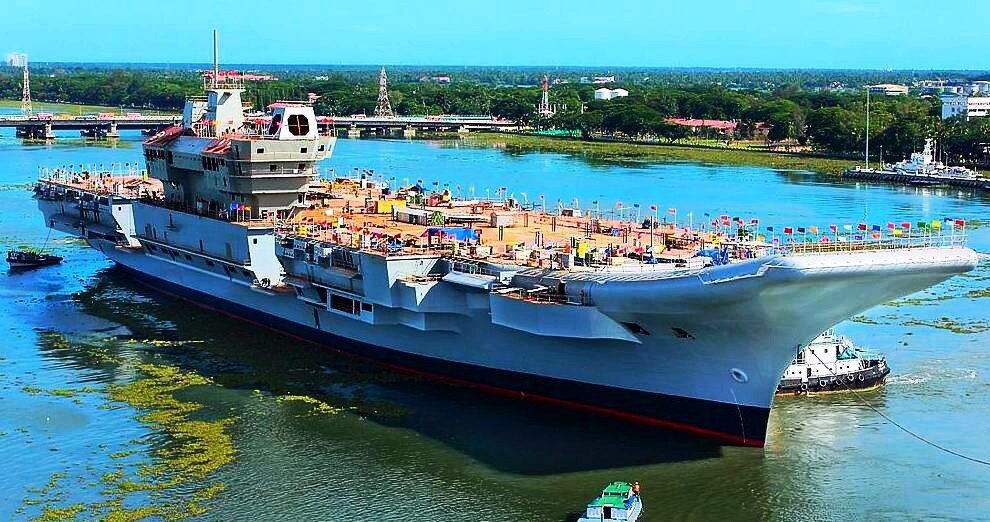
The initial public offering of Cochin Shipyard Ltd., the first by a state-owned shipbuilder, opened on Tuesday. The company plans to raise Rs 1,468 crore via the share sale and will use the proceeds to set up a new facility.
Cochin Shipyard, which built India's first indigenous aircraft carrier, the INS Vikrant, will sell shares at Rs 424-432 apiece. If the IPO sails through, it will make the company India's only profitable shipbuilder in the listed space.
Here's all you need to know about India's largest public sector shipyard and its maiden offer…

Shareholding Pattern
The government will pare its stake by 10 percent (1.13 crore shares) and the company will issue fresh 2.3 crore equity shares. The government's holding in the company will come down to 75 percent after the IPO.

Business
Cochin Shipyard is engaged in shipbuilding and repair and also offers marine engineering training. It has two docks – a shipbuilding dock, which can accommodate vessels with a capacity of 1,10,000 deadweight tonnage (DWT), and one of the largest repair docks in India with a capacity of 1,25,000 DWT.
The company caters to the Indian defence sector and commercial sector worldwide. The company has built and repaired some of the largest ships in India.
Market Share
It has the second-largest shipbuilding capacity in India and the highest market share in ship repairs.

Revenue
Cochin Shipyard's revenue grew at a compounded annual growth rate of 7 percent to Rs 2,227 crore in the last three years, with most of its coming from defence shipbuilding, according to its draft red herring prospectus.
The contribution of ship repairs to total revenue doubled to 26 percent in the financial year 2014-15.

Peer Comparison
Its peers include listed companies like ABG Shipyard Ltd., Reliance Defence and Engineering Ltd. and Bharati Defence and Infrastructure Ltd. — which are all loss-making.

The company cannot be compared to international peers because of different operational and market dynamics.
Financials Highlights
Cochin Shipyard's net worth was close to Rs 2,031 crore as of March 31, translating into a book value of Rs 149 per share after the IPO.
At the upper end of the price band – Rs 432 apiece – the earnings per share and price-earnings ratio for the year ended March, after issuing new shares, stands at Rs 23 and 18.8 times, respectively, according to BloombergQuint's calculations.
At the lower end – Rs 424 apiece – the price-earnings ratio for the year ended March 2017, after issuing new shares (post issue basis) stands at 18.4 times, respectively, according to BloombergQuint's calculations.
Cochin Shipyard's revenue grew at a CAGR of 8 percent and net profit rose at 15 percent over five years to March.
Earnings before interest, tax and depreciation and amortisation grew at a CAGR of 13 percent, while the EBITDA margins expanded by 300 basis points to 17 percent during the period.
Order book stood at Rs 3,306 crore and it has bid for three major tenders of the Indian Navy amounting to Rs 12,000 crore. Shipbuilding order book stood at Rs 2,936 crore and repairs at Rs 370 crore.
The company has been consistently paying dividends over the last five years. Debt stood at Rs 123 crore, mostly in tax-free infrastructure bonds, and it has a cash of Rs 2,003 crore as of June 30.
Brokerage Take
All the brokerages have a ‘subscribe' rating for the IPO on the back of defence orders, a strong order book and cheaper valuations.
Cochin Shipyard is a good proxy play on the Indian defence sector. Strong net cash balance sheet, strong order pipeline and option value of bagging further Air craft carriers could provide multiyear visibility of earnings.Prabhudas Lilladher
Cochin Shipyard has strong presence in both shipyard and ship repair segment and has delivered strong revenue/EBITDA /profit growth. At higher end of price band, the issue is priced at 18.8 times its earnings for the year ended March post issue, which we believe is attractive. We recommend ‘subscribe' for long-term investment.Motilal Oswal
Recommend ‘subscribe' on the offering based on robust order book, strong order inflow visibility, best-in-class execution capabilities and leverage free balance sheet.ICICI Direct
Cochin Shipyard has consistently delivered goods, even during the slowdown phase in shipbuilding industry. The IPO provides good retail exposure to the promising defence sector at attractive valuations.IIFL

-
The Economic Imperative: Analysing The Material Driving Force Behind India-Canada Strategic Reset

This economic complementarity is further reinforced by deep institutional investment ties and talent mobility, which form the bedrock of the bilateral framework.
-
Medicine Pricing: Where Must Profit Stop?
India must confront excessive margins, hidden incentives and regulatory gaps that threaten the integrity of medicine.
-
Why Amazon And Flipkart Are Struggling To Beat Meesho In India's Smaller Cities
With 274 million users and lowest-cost logistics, Meesho is defending its value commerce crown against giants like Amazon and Flipkart.
-
High US Salaries, No Green Card Certainty: The Financial Calculation Facing Indian H-1B Families
The suspension of PERM processing at eight technology employers does not cancel existing H-1B visas. What it does is force a question many Indian families have been avoiding: is the US salary worth tying your career and family plans to one employer?
-
Swiggy vs Eternal: Food Delivery's Two Rivals Are No Longer In The Same Race
Eternal is building a private AI assistant, dark.ai. Swiggy is still working out how to make Instamart pay, with an operating loss of Rs 895 crore in the July-September quarter while Blinkit stayed profitable.
-
Where You Live Shapes How You Get To Work | The Reason Why
Two-wheelers are the most popular way to get to work in India, accounting for nearly 43% of workplace commutes.
-
Unhedged Position: Can India See An Indonesia-Style Time Correction?
The Nifty is trading below levels it first clocked in 2024. Is there, then, as I have suggested in the headline, potential that the current time correction drags on painfully for the next three-five, even ten years?
-
Navigating Friction And Energy Realities: An Analysis Of Marco Rubio's October Visit To India
Occurring at a critical juncture marked by stalled trade negotiations and escalating geopolitical pressures over global energy supplies, the visit offers a profound window into modern US-India relations.
-
India Exports Capital. Why Not Export Trusteeship?
The big question, then, is whether India can build an institution that global borrowers, investors, banks, and lawyers can trust, even without an Indian connection.
-
France's Economy & Politics Are In Crisis | The Reason Why
Let's look at how the French economy and politics evolved under Nicolas Sarkozy, Franois Hollande and Emmanuel Macron.










