Why Uttar Pradesh Trumps Gujarat In E-Rickshaw Adoption
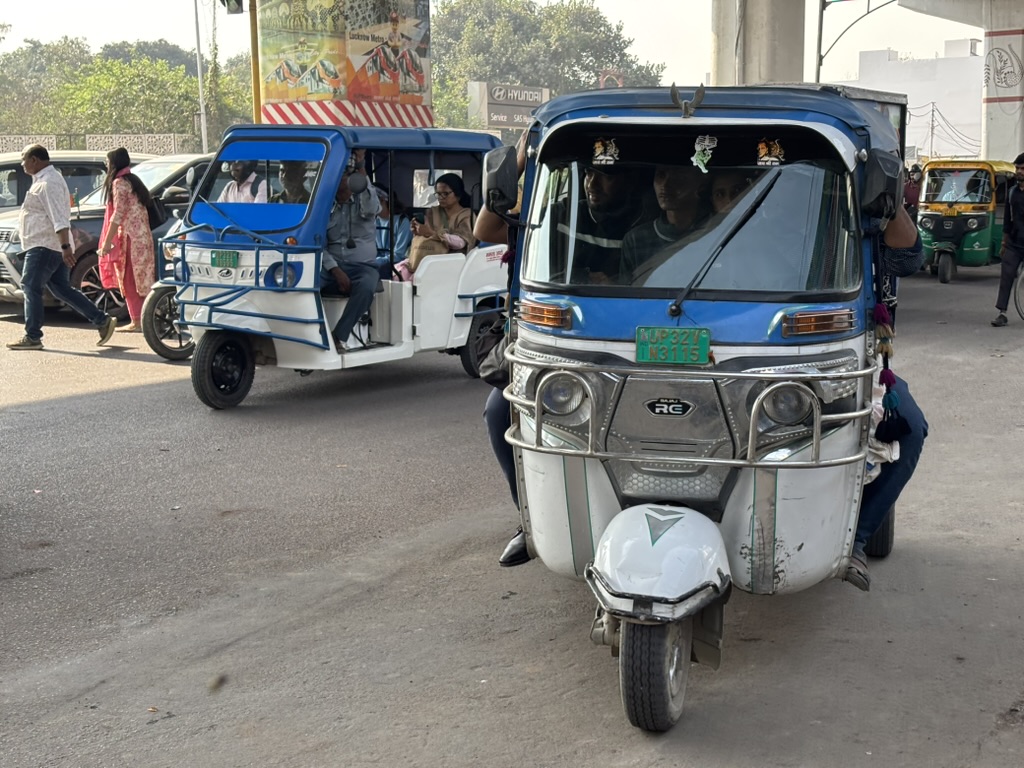
Fahim, an auto-rickshaw driver in Transport Nagar, Lucknow, spends about Rs 100 daily to recharge his Bajaj RE E-TEC 9.0. He drives about 160 km daily. He charges his EV once a day, just to be safe. In Ahmedabad's Vastrapur, Maheshbhai refuels his Bajaj RE CNG auto for Rs 300 daily. That's good enough for daily driving of 180-200 km.
The earnings per km are the same for an e-rickshaw and a CNG auto.
Essentially, an e-rickshaw has similar range as a CNG auto, but a “refuel” costs a third. Still, Gujarat hasn't really warmed up to electric mobility but Uttar Pradesh has—in a big way.
In 2024, as many as 40,142 electric autorickshaws were sold in Uttar Pradesh. That figure stood at 1,070 for Gujarat—the EV penetration stood at 53.82% and 1.69%, according to VAHAN data collated and sourced from Clean Mobility Shift. That, when total passenger three-wheeler sales were comparable at 74,581 units in UP and 63,244 units in Gujarat.

Electric and CNG autos jostle for space outside the Transport Nagar metro station in Lucknow. (Credit: Tushar Deep Singh/NDTV Profit)
According to industry watchers, company officials and auto drivers themselves, there are several factors at play when it comes to higher EV adoption in Uttar Pradesh.
1. Regulatory Framework: Gujarat, and as a matter of fact even Maharashtra, was quick to jump onto the CNG bandwagon when the technology first appeared in three-wheelers over two decades ago. The respective state governments pushed for the adoption of cleaner mobility. That wasn't the case with Northern India, including Uttar Pradesh.
“So, while a Bombay was always open to CNG, in Uttar Pradesh towns, both ICE and CNG three-wheelers were regulated heavily in terms of the number of units you can sell every month,” Samardeep Subandh, president - intracity business unit at Bajaj Auto, told NDTV Profit in Lucknow on Tuesday.
“But the demand for (last-mile) commute in a city like Lucknow was exploding with the growth of the city. An electric three-wheeler doesn't have that regulatory cap. And that's how this market converted rapidly to EV.”
Subandh's rationale is spot-on.
The regional transport office in Lucknow has stopped issuing permits to operate CNG autos in the city. At the same time, there is no such permit for e-rickshaws. Meaning, a driver can walk into a showroom, buy the e-rickshaw, get it registered and start ferrying commuters immediately. The process is very similar to how you and I buy cars.

2. Hard(er to) Switch: The early-mover advantage that Gujarat enjoyed in CNG-powered last-mile connectivity has translated into the biggest network of CNG fueling stations in India. As of 2023, the state accounted for one out five CNG pumps in India.
The CNG network in Uttar Pradesh is half of what's in Gujarat.
Essentially, Gujarat's auto drivers have found it hard to switch to electric mobility, due to easy availability of CNG. UP had no choice but to.
3. Per Capita Income: Auto drivers and commuters in the western state could absorb the higher costs associated with operating a CNG auto better. According to government data, Gujarat's per capita income stood at Rs 2.75 lakh in 2023 while that of Uttar Pradesh was less than Rs 1 lakh.
So drivers in Uttar Pradesh jumped at the prospect of higher savings with e-rickshaws.
“The total cost of operations of an electric three-wheeler is comparable to the best of ICE. In fact, it's slightly lower, which is creating this wave of adoption,” Subandh said.
It's worth mentioning here that Bajaj Auto's CNG auto-rickshaw costs less than Rs 2.90 lakh, excluding registration and permit charges. The EV variant is priced at Rs 3.25 lakh onwards, but attracts less road tax and even a subsidy.

4. Social Factors: Uttar Pradesh has four times the population of Gujarat, the state is the largest three-wheeler market in the country. Additionally, it's a bigger tourism destination than Gujarat—Agra, Ayodhya, Prayagraj and Varanasi bring in crores of domestic and international tourists. A frugal last-mile connectivity is a no brainer.
In Gujarat, meanwhile, most households have more than one two-wheeler—which is more often than not a scooter for younger family members. Electric scooters are being adopted more than rickshaws in the state. Ahmedabad is the second largest two-wheeler market in India, following Pune.

-
Indians Are Travelling, But Not Every Journey Is A Holiday | The Week In Whys

Pilgrims, patients and working women are the real travellers, and the system hasn't quite caught up with them.
-
Getting To Work Costs Women More | The Reason Why
It is not just about women paying more than men. It is about women paying much more in cities than in villages.
-
AI Bias In Investing Cannot Be Eliminated, But It Can Be Governed
Framing is a particularly important example as identical financial information presented in terms of gains rather than losses can lead an LLM to reach a different assessment.
-
Joining The Dots | Dark Skies, Steady Diya: Why Hope Holds This Diwali
With war, a weak rupee and foreign outflows weighing on sentiment, policymakers at the NDTV World Summit and market veterans at NDTV Profit Ignite: Diwali Edition offered the same advice: stay invested and filter out the noise.
-
The Curious Case of Equitas Small Finance Bank And A CEO Who Quit For Stock
PN Vasudevan believes persistent investor concerns over a perceived conflict of interest had become a governance overhang on Equitas Small Finance Bank's stock, even as the lender improved profitability and asset quality.
-
Talking Points This Week: AI Cash Burn, A Tiger Comeback And An India That Still Finds Its Own Path
India is not immune to higher oil or tighter global liquidity, yet its earnings base is broader, its domestic policy levers are still available.
-
Foreign Investors Own Half Of HDFC Bank and ICICI Bank. An LTCG Cut Could Matter Most Here
Foreign portfolio investors have US$115 billion parked in HDFC Bank, ICICI Bank. If the government cuts long-term capital gains tax, Jefferies says returning foreign money could land here first.
-
'Never Seen This Level Of Negativity': Sandeep Tandon Says The Next Rally May Be Closer Than You Think
Veteran investor Sandeep Tandon says foreign selling is easing, large-caps are due a comeback and mid-caps are crowded, while he turns positive on gold, power and pharma this Diwali.
-
Indians Stay With Family, Not In Hotels | The Reason Why
India still lacks enough clean, reliable and affordable hotels for budget-conscious travellers.
-
The Economic Imperative: Analysing The Material Driving Force Behind India-Canada Strategic Reset
This economic complementarity is further reinforced by deep institutional investment ties and talent mobility, which form the bedrock of the bilateral framework.










