Book Excerpt: Beating Burnout – Don’t Be A Victim, Hold Yourself Accountable

Excerpted from Burnout, beat fatigue to thrive in an overworked world, by Anju Jain, with permission from Penguin Random House India.
Are you a victim or are you accountable? Several years ago, this was a popular tagline in my company's strategy rollout. All our offices were strewn with ‘accountable–victim' charts as on the following page.1 The bottom of the ladder depicts a victim's mindset, and the top an accountable one. The intent was to hone a culture of accountability, to take ownership rather than blame others or be passive about our inefficiencies.
Needless to say, the company wanted us to be at the top end of the ladder rather than the bottom.
One of the examples used to drive home the importance of this message was personal safety.
No one else was accountable for this or could do it for us.
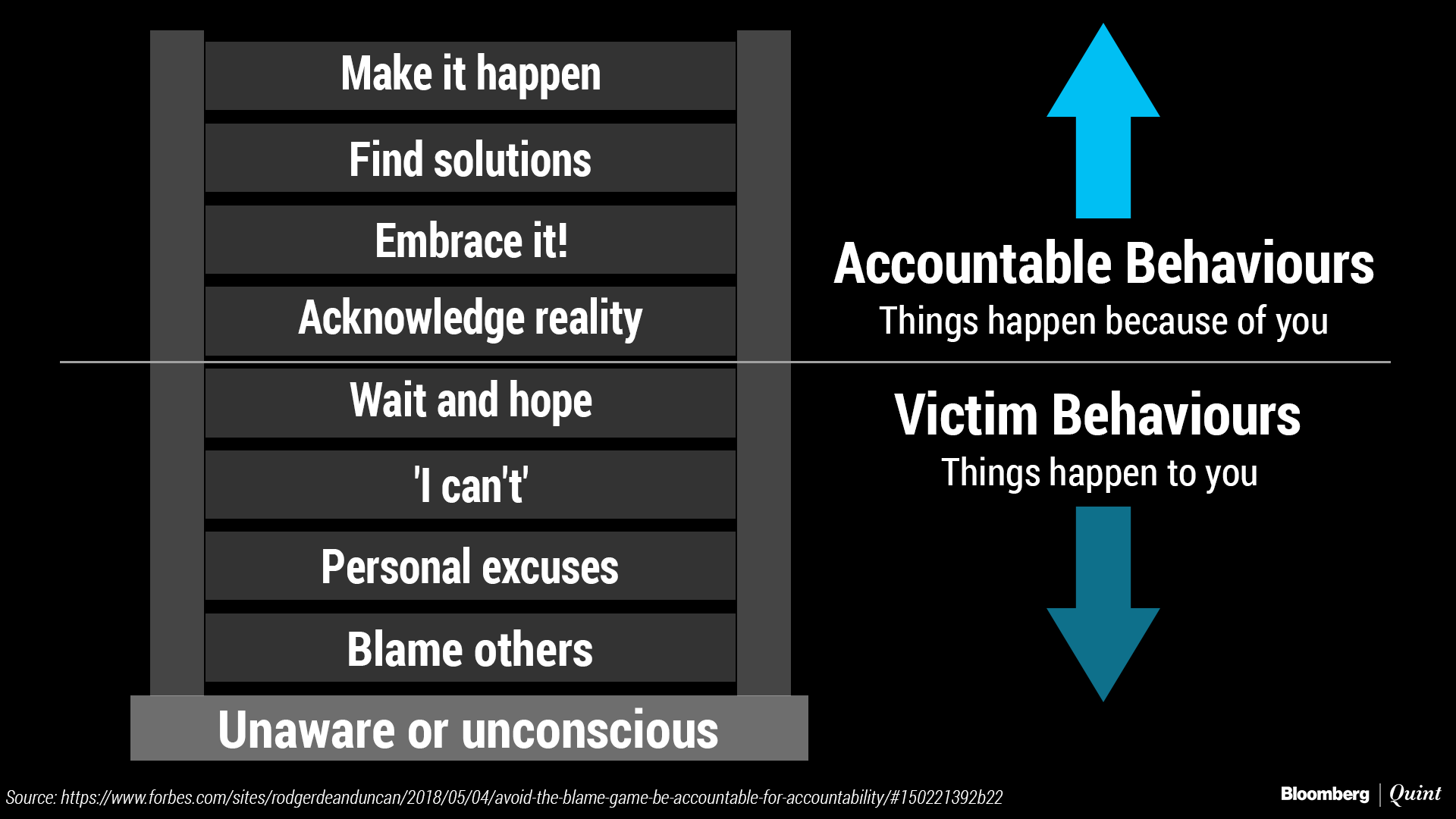
Not the boss, the company or anyone else. Downstream, this very mindset of owning our safety translated into zero accidents, high quality work and on-time product delivery.
In 1986, a study was done with a sample of elderly nursing home residents to assess the relationship between exercising control and health. Professor Judith Rodin from Yale University found that those who believed they didn't have control over their activities showed greater stress, worry and self-blame compared to those who exercised control. In fact, 93 percent of those encouraged to exert more control became more alert, active and happy.
The positive connect between control and outcome is attributed to the fact that giving up or perceiving lack of control on the environment evokes an outpouring of stress hormones, raises blood pressure and lowers immune responses, thereby impacting overall health and performance.
Burnout too can be looked at through this lens. As a victim, you can blame the environment for your state. You can wallow in the belief that your boss, job, technology, society, etc. are responsible for your condition. Or you can take charge and acknowledge that only you are responsible for your condition, no one else is, despite the external challenges.
Recognize that:
- If you are swamped with work, you made the choice to accept it.
- If the work you do doesn't offer any excitement, it is a choice you made.
- If there are issues between you and your boss, you made a choice to stick around.
- If you don't like the organization you work for, again, it is a choice you made.
- If you are burned out, you made the choice to fall into it.
Because the decision to opt out or not rests with you; no one is forcibly keeping you there.
Geoff Turk, a senior leader in one of the organisations where I worked, observed, ‘Burnout only happens to those who let it happen to them. Who ignore the pain they are going through. I know of many who are burned out, hate their jobs and yet they stick around. They believe their boss will change or work will shrink one fine day. These people are victims and refuse to take responsibility for resolving their issues. They only continue to sink deeper and deeper. Then there are others, who at the very first instance, recognize that this isn't the place they want to be. They engage in self-renewal, reframe their perspective, or exit, for they know what is more important to them and why. They hold themselves accountable.'
Recognising that the primary solution rests in your hands and not in someone else's is a start in embracing an accountable mindset.
As Geoff stated, this could mean two things: removing the environmental triggers that act as obstacles or removing yourself from that very situation.
Marshall Goldsmith, a renowned leadership coach, once told me, ‘If you are in a situation where you are not happy, try to find something to like about it. Look at the positives; don't focus on the negatives. Maybe the work is good, or maybe the salary is, even though the boss isn't your type. This realization may free your mind from negativity and help you accept the present with peace. However, if the going gets tough, exit that situation. That call is in your hands. And once made, be happy about it.'
But we also know that taking responsibility is easier said than done. It requires courage and commitment to follow through. It is far easier to blame others and absolve yourself from taking any action.
Master Experiences
This is about building a repertoire of successful experiences, along the lines of ‘success begets success'. Past wins or successful experiences can motivate and heighten your belief in yourself.
For example, if you were successful in doing a specific task before, you can recall that experience and convince yourself saying, ‘If I could do it then, I can do it now.' This reminder will give you the confidence to take a chance yet again.
Here's an example. With all the typical time constraints as a mother of two demanding children under the age of five, Amy decided to integrate a meditation routine into her day. ‘There was never a window of free time on my calendar. I started doing it for five minutes, just before my kids woke up in the morning. Those five minutes made such a big difference not only in terms of keeping me collected, but also heightening my confidence that I could do this every day. That motivated me to stretch my limits. I started getting up fifteen minutes earlier so I could extend my meditation duration. It has been over five months since I started this regimen. I have never felt better.'
When it comes to beating burnout, start out by winning with small changes.
Observe Others
Observing others succeed in streamlining their lives can encourage you to take charge of yourself. For example, if your co-worker, despite his or her usual busyness, is able to make time for exercise, this may increase your confidence in believing: ‘If she can do it, I can too.'
This learning is most effective when you observe someone who is similar to you. For example, watching Michael Jordan dunk a basketball might not increase your confidence in being able to dunk as well if you are only 5 feet 2 inches tall. But if you observe a basketball player with physical characteristics similar to yourself, that can be quite persuasive.
Find someone similar to you—in job profile, experience or age—who has been successful in changing their behaviour. Study how they succeed: the tactics and skills they leverage to perform well, how they continue to manage their time, focus on health or anything else that matters to you. Integrate those strategies into your interactions and routines. This is one place where you can copy and paste!
Ask For Feedback
Family, friends and colleagues can also help boost your accountability. Notice how you feel when someone says, ‘You can do it,' or ‘You are so good at it.' These positive affirmations make you believe in yourself. They give you the confidence that you are capable of succeeding.
Keep Upbeat Moods
Given the mind games you play with yourself, it is in your best interests to pump yourself up when you begin to doubt yourself. Engage in activities or surround yourself with people who can elevate your mood. And as you take on a challenge and deliver successfully on it, that will only add to your ‘mastery list' or inventory of successful experiences.
Additionally, writing out your SMART goals can also enhance your accountability. The acronym stands for Specific, Measurable, Attainable, Realistic, Timely goals.
When you believe in yourself, you hold yourself accountable.
And when you hold yourself accountable, you heighten your selfefficacy. View burnout as a challenge; acknowledge it and find solutions to beat it. Hold yourself accountable to fighting it.
Anju Jain is a psychologist and a senior human resources executive who has worked with leading multinational organisations.
The views expressed here are those of the author and do not necessarily represent the views of BloombergQuint or its editorial team.

-
The Curious Case of Equitas Small Finance Bank And A CEO Who Quit For Stock

PN Vasudevan believes persistent investor concerns over a perceived conflict of interest had become a governance overhang on Equitas Small Finance Bank's stock, even as the lender improved profitability and asset quality.
-
Talking Points This Week: AI Cash Burn, A Tiger Comeback And An India That Still Finds Its Own Path
India is not immune to higher oil or tighter global liquidity, yet its earnings base is broader, its domestic policy levers are still available.
-
Foreign Investors Own Half Of HDFC Bank and ICICI Bank. An LTCG Cut Could Matter Most Here
Foreign portfolio investors have US$115 billion parked in HDFC Bank, ICICI Bank. If the government cuts long-term capital gains tax, Jefferies says returning foreign money could land here first.
-
'Never Seen This Level Of Negativity': Sandeep Tandon Says The Next Rally May Be Closer Than You Think
Veteran investor Sandeep Tandon says foreign selling is easing, large-caps are due a comeback and mid-caps are crowded, while he turns positive on gold, power and pharma this Diwali.
-
Indians Stay With Family, Not In Hotels | The Reason Why
India still lacks enough clean, reliable and affordable hotels for budget-conscious travellers.
-
The Economic Imperative: Analysing The Material Driving Force Behind India-Canada Strategic Reset
This economic complementarity is further reinforced by deep institutional investment ties and talent mobility, which form the bedrock of the bilateral framework.
-
Medicine Pricing: Where Must Profit Stop?
India must confront excessive margins, hidden incentives and regulatory gaps that threaten the integrity of medicine.
-
Why Amazon And Flipkart Are Struggling To Beat Meesho In India's Smaller Cities
With 274 million users and lowest-cost logistics, Meesho is defending its value commerce crown against giants like Amazon and Flipkart.
-
High US Salaries, No Green Card Certainty: The Financial Calculation Facing Indian H-1B Families
The suspension of PERM processing at eight technology employers does not cancel existing H-1B visas. What it does is force a question many Indian families have been avoiding: is the US salary worth tying your career and family plans to one employer?
-
Swiggy vs Eternal: Food Delivery's Two Rivals Are No Longer In The Same Race
Eternal is building a private AI assistant, dark.ai. Swiggy is still working out how to make Instamart pay, with an operating loss of Rs 895 crore in the July-September quarter while Blinkit stayed profitable.










