EWS Reservation: Supreme Court Upholds Constitutional Amendment
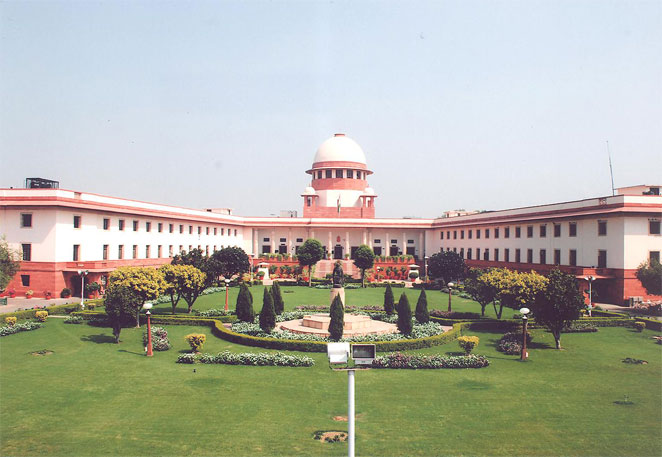
The Supreme Court upheld the 103rd Constitutional amendment on Monday, which enabled the government to make special provisions for advancement of economically weaker sections.
The EWS reservation provides 10% reservation of seats in public and private educational institutions as well as in public employment for ‘'economically weaker sections''.
The 10% reservation is in addition to the quota for Scheduled Castes, Scheduled Tribes, and educationally backward classes of citizens. These categories cannot avail the EWS quota.
Three out of the five judge constitution bench upheld the EWS quota as constitutional.
This majority view was given by Justices Dinesh Maheshwari, Bela Trivedi and JB Pardiwala. Justice Ravindra Bhatt and Chief Justice UU Lalit gave a dissenting opinion.
One of the issues that was considered by the court was whether exclusion of those who are granted reservation under categories such as Scheduled Castes and Scheduled Tribes will amount to violation of basic structure of the Constitution. The majority judgements said 'it won't'.
"EWS amendment does not violate the basic structure as it is based on economic criteria... the state forming special provision for EWS quota does not violate the basic structure.Justice Maheshwari
Justice Trivedi in her judgement emphasised that the legislature understands the needs of the people. And that a special provision, which excludes pre-existing beneficiaries of reservation, does not amount to violation of basic structure doctrine.
Impugned amendment needs to be treated as affirmative action. EWS, as a separate class, is reasonable classification.Justice Trivedi
Writing the dissenting opinion, Justice Ravindra Bhatt said that exclusion of those with access to pre-existing reservations is a form of discrimination and cannot stand the test of constitutionality.
Justice Bhatt also highlighted that 48% of the Scheduled Tribe population and 38% of the Scheduled Caste population in India live below the poverty line. Thereby, excluding this population cannot be held to be constitutional.
Chief Justice UU Lalit agreed with Justice Bhatt's reasoning. A detailed judgement is awaited.
The decision to extend the benefits affirmative action to economically weaker sections was taken in January 2019. Soon after, multiple petitions were filed in the apex court opposing the decision. In August 2020, the apex court had decided to refer the case to a Constitution bench.
The case did not come up for hearing for about two years, before Chief Justice UU Lalit decided to form a bench last August. The hearings started on Sept. 13 and concluded on Sept. 27.
The primary question before the apex court was whether the new quota was a violation of the basic structure of the Constitution. The petitioners had argued that reservation is not the right response to economic backwardness and framers of the Constitution did not envision economic backwardness as a criteria for reservation.
Providing economic reservation cannot be limited to general categories, they said. Doing so will be a violation of the equality code, which is a well-established basic feature of the Constitution. The principle of equality as per the petitioners would be violated as the EWS reservation excludes Scheduled Castes and Scheduled Tribes from availing the benefit.
Among those who had defended the amendment was former Attorney General KK Venugopal and Solicitor General Tushar Mehta.
The government lawyers argued that this 10% quota is over and above the reservation already accorded and thereby not a violation of the basic structure of the Constitution.
The state is bound to look out for the weaker sections of the society and has defended the EWS reservation on that ground. Only violation of basic structure can be a ground for setting aside a constitutional amendment, the government lawyers had argued.

-
Getting To Work Costs Women More | The Reason Why

It is not just about women paying more than men. It is about women paying much more in cities than in villages.
-
AI Bias In Investing Cannot Be Eliminated, But It Can Be Governed
Framing is a particularly important example as identical financial information presented in terms of gains rather than losses can lead an LLM to reach a different assessment.
-
Joining The Dots | Dark Skies, Steady Diya: Why Hope Holds This Diwali
With war, a weak rupee and foreign outflows weighing on sentiment, policymakers at the NDTV World Summit and market veterans at NDTV Profit Ignite: Diwali Edition offered the same advice: stay invested and filter out the noise.
-
The Curious Case of Equitas Small Finance Bank And A CEO Who Quit For Stock
PN Vasudevan believes persistent investor concerns over a perceived conflict of interest had become a governance overhang on Equitas Small Finance Bank's stock, even as the lender improved profitability and asset quality.
-
Talking Points This Week: AI Cash Burn, A Tiger Comeback And An India That Still Finds Its Own Path
India is not immune to higher oil or tighter global liquidity, yet its earnings base is broader, its domestic policy levers are still available.
-
Foreign Investors Own Half Of HDFC Bank and ICICI Bank. An LTCG Cut Could Matter Most Here
Foreign portfolio investors have US$115 billion parked in HDFC Bank, ICICI Bank. If the government cuts long-term capital gains tax, Jefferies says returning foreign money could land here first.
-
'Never Seen This Level Of Negativity': Sandeep Tandon Says The Next Rally May Be Closer Than You Think
Veteran investor Sandeep Tandon says foreign selling is easing, large-caps are due a comeback and mid-caps are crowded, while he turns positive on gold, power and pharma this Diwali.
-
Indians Stay With Family, Not In Hotels | The Reason Why
India still lacks enough clean, reliable and affordable hotels for budget-conscious travellers.
-
The Economic Imperative: Analysing The Material Driving Force Behind India-Canada Strategic Reset
This economic complementarity is further reinforced by deep institutional investment ties and talent mobility, which form the bedrock of the bilateral framework.
-
Medicine Pricing: Where Must Profit Stop?
India must confront excessive margins, hidden incentives and regulatory gaps that threaten the integrity of medicine.










