Why Top Lawyers Don’t Buy Rajasthan’s Arguments To Protect Its Officials
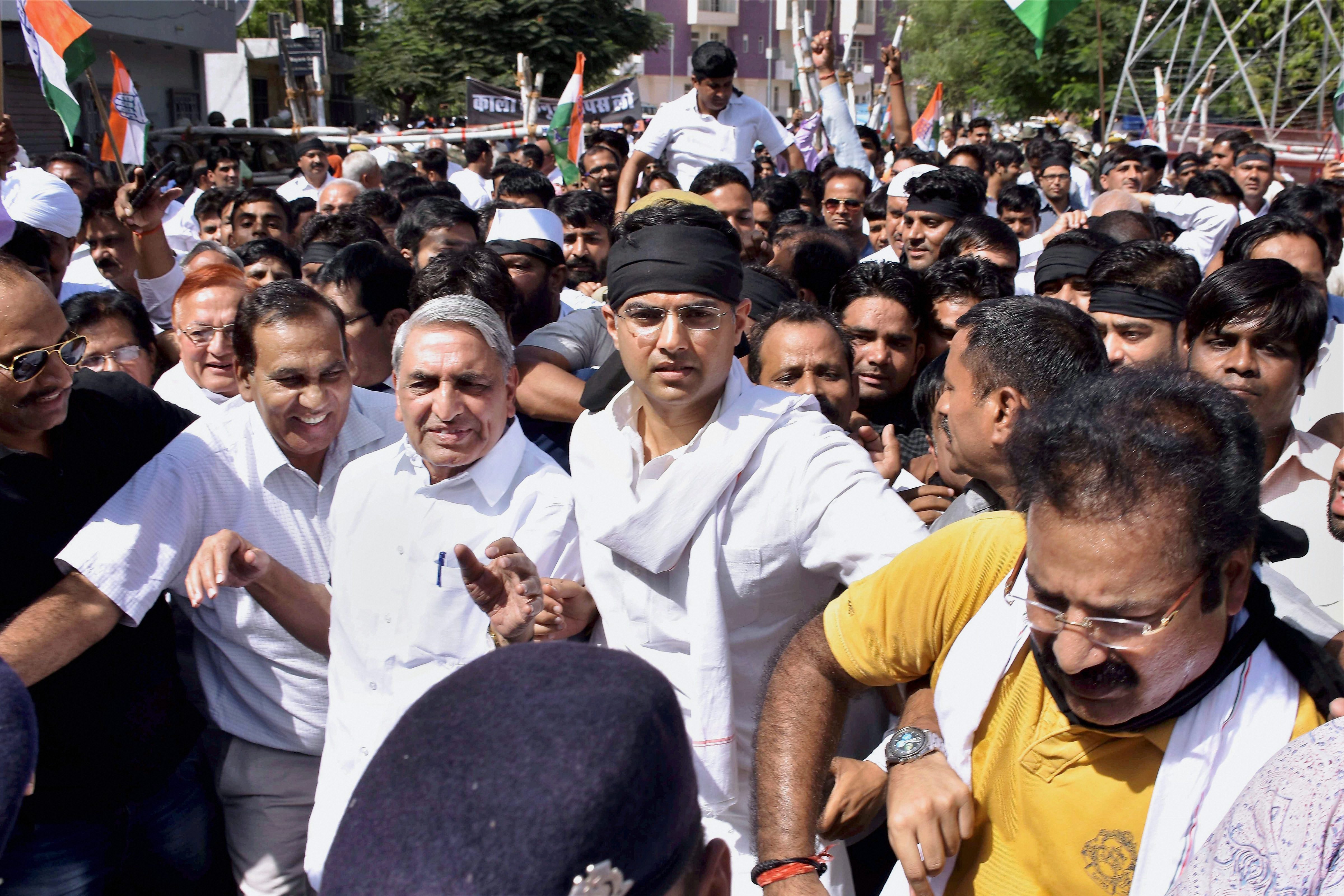
Rajasthan sent the controversial Bill to protect government officials from prosecution without its sanction to a select committee of the assembly after drawing criticism.
The September 7 ordinance and the Criminal Laws (Rajasthan Amendment) Bill, 2017 that followed introduces amendments to the Code of Criminal Procedure and Indian Penal Code. These protect both retired and serving officials from prosecution and investigation for on-duty acts without the state's sanction. It also bars the media and any other person from publicising information that could disclose the identity of such officials without its permission. The Bill provides for a prison term of up to two years and a fine.
As it drew flak, the Bharatiya Janata Party government in the state, in a clarification, cited reasons for its decision. A statement on its website said...
- Rajasthan is not the first one to pass such amendments to the criminal laws; Maharashtra implemented similar amendments in 2015.
- 73 percent of cases filed under Section 156(3) of the CrPC, which allows a magistrate to order registration of a first information report, are false.
- The amendment seeks to protect honest officers.
- The government will continue to take actions against those found corrupt.
- The state government is serious about corruption cases and has registered 1,158 cases under anti-corruption laws in the last three-and-a-half years.
None of these reasons merit any serious thought, Senior Advocate Aryama Sundaram told BloombergQuint in a video interview. The purpose of an investigation is to determine whether a complaint should progress to the next stage of filing a case, he said.
Also Read: Controversial Rajasthan Ordinance Sent To State Assembly's Select Committee
Many investigations find that the person who is accused is not guilty, he said. “In more than 50 percent of cases, the accused are acquitted. Does it mean it should not be investigated at all because there is a chance that these persons have been wrongly implicated?”
If they have been wrongly implicated, the law will take its course, but the answer is not to say that don't even lodge a complaint – don't even investigate into the matter.Aryama Sundaram, Senior Advocate
The BJP-led central government defended the move by Rajasthan. Union Law Minister Ravi Shankar Prasad said the Bill was aimed at preventing motivated complaints. “Officers were feeling harassed in discharging their duties,” Prasad told reporters at a press conference at the BJP headquarters.
Yet, legal experts are unanimous in their opinion that the amendments were unconstitutional.
Activist Bhagwat Gour has already challenged the ordinance that preceded the Bill in the Jaipur bench of the Rajasthan high, calling it "arbitrary and mala fide", newswire PTI had reported. It's “in contravention of fundamental rights as enshrined under Part-III of the Constitution of India”, his counsel A K Jain said.
Ranji Thomas, senior advocate of the Supreme Court and former standing counsel for the Rajasthan government at the top court, agreed that it was “absolutely unconstitutional”. Yet, it might be premature to challenge it while the Bill is being deliberated by the state assembly as the court will “require a cause of action”, he said.
People's Union for Civil Liberties, a human rights organisation, said it's prepared to challenge the amendments on constitutional grounds, if passed by the state assembly.
“The government is trying to slash the powers of a magistrate and gag the media – we are not going to accept that,” Kavita Srivastava, president of the PUCL, told BloombergQuint over the phone. “The new law is undemocratic and unconstitutional, and we hope it will be struck down as violative of Article 14, 19 and 21 of the Constitution.”
Thomas said Rajasthan has gone way beyond what is expected of a government in a democratic country. “The intention behind this ill-advised ordinance is to prevent exposing corruption in the government and prevent media from interfering or initiating investigative journalism.”
Also Read: Rajasthan Ordinance: Unconstitutional Immunity And An Attack On Free Speech
The amendments in the Bill are also contrary to an existing judgement of the Supreme Court, according to a statement by the PUCL. In a 2014 verdict, the top court had clarified that if a complaint against a public servant alleges a cognisable offence—that allows the police to arrest without a warrant—an FIR must be lodged. But if it's about a non-cognisable offence or corrupt acts, a preliminary enquiry may be initiated, the statement said.
Even Rajasthan follows the procedure. In August 2015, the state's additional chief secretary issued a circular that stated…
- Before registering a case for investigation against a public servant under Section 156 of the CrPC, a preliminary inquiry must be carried out by the officer in charge of the police station concerned.
- Even in cases where the magistrate has ordered investigation under Section 156(3) of the CrPC, the above process must be complied with.
Watch this conversation with Senior Supreme Court Advocate KTS Tulsi, Senior Advocate Aryama Sundaram on the Criminal Laws (Rajasthan Amendment) Bill, 2017.

-
Indians Are Travelling, But Not Every Journey Is A Holiday | The Week In Whys

Pilgrims, patients and working women are the real travellers, and the system hasn't quite caught up with them.
-
Getting To Work Costs Women More | The Reason Why
It is not just about women paying more than men. It is about women paying much more in cities than in villages.
-
AI Bias In Investing Cannot Be Eliminated, But It Can Be Governed
Framing is a particularly important example as identical financial information presented in terms of gains rather than losses can lead an LLM to reach a different assessment.
-
Joining The Dots | Dark Skies, Steady Diya: Why Hope Holds This Diwali
With war, a weak rupee and foreign outflows weighing on sentiment, policymakers at the NDTV World Summit and market veterans at NDTV Profit Ignite: Diwali Edition offered the same advice: stay invested and filter out the noise.
-
The Curious Case of Equitas Small Finance Bank And A CEO Who Quit For Stock
PN Vasudevan believes persistent investor concerns over a perceived conflict of interest had become a governance overhang on Equitas Small Finance Bank's stock, even as the lender improved profitability and asset quality.
-
Talking Points This Week: AI Cash Burn, A Tiger Comeback And An India That Still Finds Its Own Path
India is not immune to higher oil or tighter global liquidity, yet its earnings base is broader, its domestic policy levers are still available.
-
Foreign Investors Own Half Of HDFC Bank and ICICI Bank. An LTCG Cut Could Matter Most Here
Foreign portfolio investors have US$115 billion parked in HDFC Bank, ICICI Bank. If the government cuts long-term capital gains tax, Jefferies says returning foreign money could land here first.
-
'Never Seen This Level Of Negativity': Sandeep Tandon Says The Next Rally May Be Closer Than You Think
Veteran investor Sandeep Tandon says foreign selling is easing, large-caps are due a comeback and mid-caps are crowded, while he turns positive on gold, power and pharma this Diwali.
-
Indians Stay With Family, Not In Hotels | The Reason Why
India still lacks enough clean, reliable and affordable hotels for budget-conscious travellers.
-
The Economic Imperative: Analysing The Material Driving Force Behind India-Canada Strategic Reset
This economic complementarity is further reinforced by deep institutional investment ties and talent mobility, which form the bedrock of the bilateral framework.










