What Happens During A COVID-19 Test
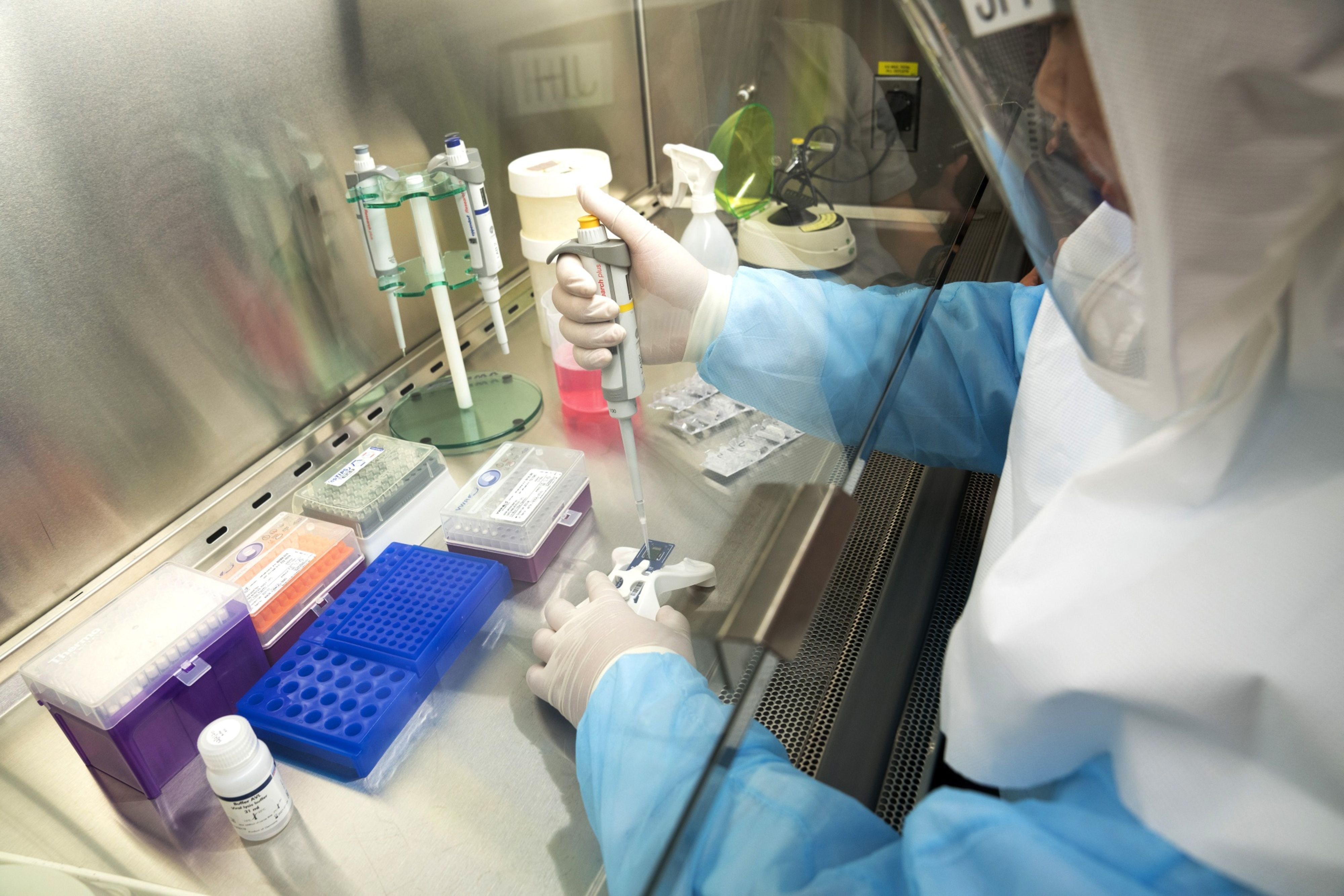
A test for Covid-19 uses a ‘reverse transcription polymerase chain reaction' (RT-PCR). The RNA in the sample is extracted and converted to DNA, which is then amplified using 'primers' - short, synthesised fragments of nucleic acid. A fluorescent dye (called probe) is introduced, and the sample illuminates only in the presence of DNA.
IndiaSpend spoke to V Ravi, Senior Professor and Head, public health virology, with the National Institute of Mental Health and Neurosciences (NIMHANS), Bengaluru, to understand how this test works.
As of March 21, 2020, India has 283 confirmed cases of Covid-19, a novel coronavirus that has affected more than 275,000 people and killed more than 11,000 globally. About 8.1 percent (23 of 283) patients in India have been discharged, while four people have died, according to Coronavirus Monitor, a HealthCheck database.
Indian government officials said on March 19 that India does not have community transmission of Covid-19, which means only those who travelled to an affected country or had contact with a confirmed case have contracted the disease. But experts told IndiaSpend that the government is testing too few to know whether the disease has reached the stage of community transmission, as it reported on March 19, 2020.
The Indian Council of Medical Research (ICMR) has on March 20, expanded the testing criteria to include: All symptomatic contacts of confirmed patients, all symptomatic healthcare workers, all hospitalised patients with severe acute respiratory illness (fever and cough and/or shortness of breath), and asymptomatic direct and high-risk contacts of confirmed patients (once between day 5 and day 14 of coming in their contact.)
All individuals who have undertaken international travel in the last 14 days should stay in home quarantine for 14 days, and only be tested if they show symptoms of fever, cough and difficulty in breathing, ICMR said. All family members living with a confirmed case should be home quarantined.
Here's how a COVID-19 test is conducted:
Step 1: Sample Collection
The specimen is collected through throat and nasal swabs, and inserted into a virus-transposing medium and sent to the lab.
Step 2: Extracting RNA
The genetic material in the coronavirus, which originates in animals, is an RNA - Ribonucleic Acid and not DNA (Deoxyribonucleic Acid) like in humans. The next step is to separate the RNA from everything else in the sample - human cells, proteins, enzymes, that would chew up that viral genetic code. This is done using a centrifugal process by adding chemicals, where the RNA collects at the bottom of the sample. This process is also automated when large samples are to be tested.
Step 3: Conversion To DNA
The RT enzyme is used to convert the RNA into DNA, going from one strand to two. In order to set up this reaction, you need a 'master mix', which usually contains nucleotides (to make new DNA), taq DNA polymerase (an enzyme to amplify the DNA), PCR buffers (to create optimal conditions for taq DNA polymerase) and magnesium salts.
Step 4: Amplifying the DNA
Primers - short synthesised fragments of nucleic acid are added to help define the area to be amplified. This mixture is then added to the PCR machine, which raises and decreases the temperature alternately for 15-20 seconds. In one cycle, temperature is raised to separate the DNA strand and cool it down. “Usually, the temperature is raised to between 55 and 60 degrees Celsius, and at this time, the primers will bind,” Ravi said.
The next step is to raise the temperature to 72 degrees celsius at which the new strand will be synthesised. This whole thing is called one cycle. For RT-PCR, one has to do 40 such cycles and this approximately takes an hour, and each cycle is about one one-and-a-half minutes.V Ravi, National Institute of Mental Health and Neurosciences (Bengaluru)
Step 5: Results
Once enough DNA is produced in the PCR machine, it is ready to be detected. A fluorescent dye or ‘probe' is added to the test-tube. If there is DNA present, it starts to glow. “As the number of copies of DNA increases, so does the amount of light emitted," Ravi said. A special light-measuring instrument in the PCR machine reads these fluorescence patterns to determine which samples have the virus in them and which don't.
Step 6: Ensuring Accuracy
Controls are introduced to ensure that the test is accurate. There is a positive control (a known Covid-Positive sample), a negative control (known as a negative sample) and an internal control, which is usually a housekeeping gene or genes required for the maintenance of basic cellular function.
“In one hour, PCR will be over and then the machine will figure out whether the required DNA has been amplified or not,” Ravi added. Whenever you run a test, you need to know that it was working properly. You will have to have several controls. The purpose of control is to know that every process in the test is working.
India Will Need More Testing Labs
Right now, most labs give reports after 24 hours, Ravi said. Each test takes about six hours. “They don't run the test only for a single sample,” he added. “All the samples that are collected at one time, for example 12 noon, are batched together to run the test and do the quality control check, and then the report is released.”
The number of batches tested depends on the machine used and its capacity. “You have machines that run thermal cycles with 24 blocks (samples), 48 blocks and 96 and so on,” Ravi said. “We also have robotic machines that do these tests.”
Scientists from the University of Oxford's engineering science department and the Oxford Suzhou Center for Advanced Research have developed a rapid testing technology, which reduces the time taken for each test to 30 minutes. The test can help identify patients in early stages of infection, and only requires a heat-block which maintains a constant temperature for RNA reverse transcription and DNA amplification, according to an article published on the university's website. The results can be read by the naked eye, making it potentially useful in rural areas or community healthcare centers.
About 72 government laboratories were testing for Covid-19 in India, as of March 18. These labs have a capacity of 9,000 tests a day, Lokesh Sharma from the ICMR told IndiaSpend on March 19. In addition, the government has set up two new testing locations, one in the National Capital Region and one in Bhubaneshwar, each with a capacity to test 1,400 per day, the official said. This takes India's testing capacity to 11,800 each day. The ICMR also plans to have 49 more functioning labs, according to this press release from March 17.
South Korea, which has been able to stabilise the spread of the disease, with a low fatality rate of 0.9 percent, had tested 2,95,647 people until March 18 that is 5,729.6 per million and is continuing to mass test 20,000 people every day, for free, we reported in the story cited above.
When asked what India should do to reach that capacity, Ravi said India would need more testing labs, with private sector involvement. “The government is looking at 50-60 private labs that are already accredited for flu testing,” he added. “This test is very similar to flu testing.”
“The greatest limitation to scaling up testing will be the cost of the testing process,” Ravi said. It currently costs Rs 6,000 to process each sample, excluding human effort or current voltage ranges, etc. he said. “The private sector will factor in the time spent on it, and if you factor these in, it will be Rs 10,000 per test.”
“All the private labs have been asked to provide these tests for free,” Ravi said. “Now, it is up to the private sector to decide.”
India has the capability to manufacture RT enzymes and the exact polymerase. “We just don't have the probes which have been imported,” said Rajni Kant, Head for Research Management, Policy, Planning and Co-ordination cell at the ICMR. “Everything else is being produced by Indian companies, also private companies.”
This copy was published in a special arrangement with IndiaSpend.

-
We May Need Another Tukaram Mundhe To Fight Air Pollution | The Reason Why

Developers may install basic measures such as sprinklers and green nets, resume work, and continue violating rules when this equipment stops working.
-
Extracting Value From Battery Scrap Could Be Challenging For India | The Reason Why
A discarded lithium-ion battery still contains valuable materials such as lithium, nickel and cobalt. These can be recovered and reused. When such batteries are crushed and shredded, they produce a dark powder called black mass.
-
One El Nino, India Can Handle. Two Could Break The Granary
India's grain stocks can absorb one bad year, but a second El Nino could drain the buffer in two to three years, economists say.
-
India's Troika Of Good Luck | Joining The Dots
As Jensen Huang's exit drags Nvidia down, a cooling AI trade and resilient earnings have revived investor interest in India. A likely RBI rate hike looms.
-
Talking Points This Week: Leadership Shock At Nvidia, Earnings Strength, And The Fog Over Hormuz
The Anthropic IPO pricing and first trading day, Nvidia's upcoming earnings, and any fresh signals from Iran will set the tone for the following week.
-
Signature Play: The Classic Cocktail Is Dead. Or Is It?
Classic cocktails are disappearing from India's cocktail menus. But they're still being ordered, taught to bartenders and borrowed from. So, who's really having the last drink?
-
A New Samvat Wishlist: Inclusive Prosperity And Human Development
India has strengthened its economic foundations through infrastructure, digital access and enterprise. Its next growth chapter must deepen productivity, create better livelihoods and widen participation in prosperity.
-
Love, Sex Aur Dhokha: The Audacious Plot To Spy On Jensen Huang
A Taipei dinner, a Singapore chip buyer and a suspected Chinese asset: inside the alleged spy operation that got close to NVIDIA's Jensen Huang.
-
Ten Things I Learnt This Samvat
Patience can be a trap. Cheap stocks can stay cheap. Leverage can wipe you out. What did Samvat 2082 teach us? Niraj Shah writes on 10 lessons from the year gone by.
-
Talking Points This Week: Tech Nerves, FII Buying, And A Faraway Banking Shock
The global markets are not shining this Diwali. The exception in the large markets is, India.









