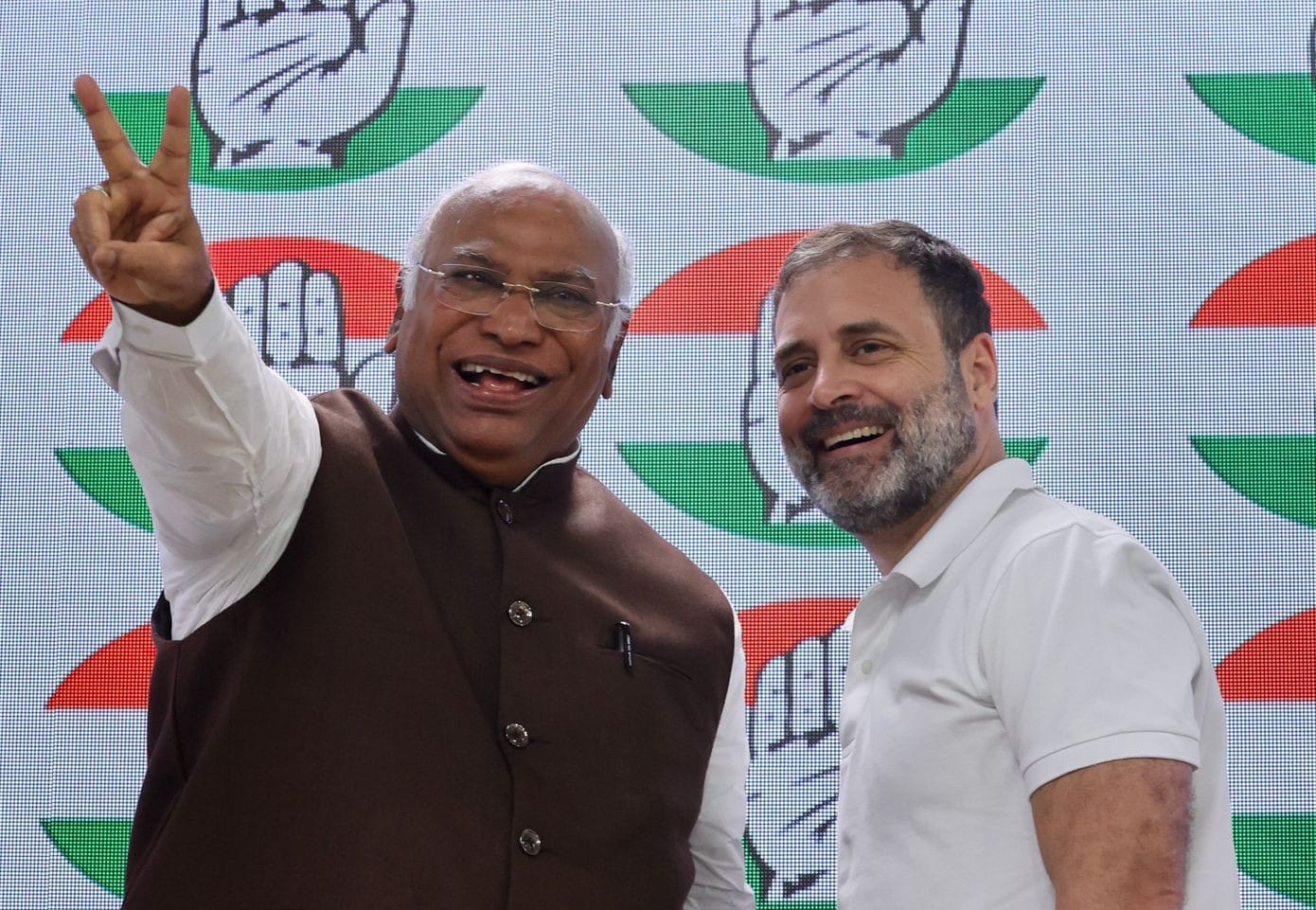
The Supreme Court on Friday stayed the conviction of Congress leader Rahul Gandhi in the 'Modi' surname defamation case.
While staying the conviction, the top court observed that the trial judge had given no reasons for imposing the maximum sentence of two years for an offence which is non-cognisable, bailable and compoundable.
It was further pointed out that only because the trial judge imposed a maximum sentence on Gandhi, did the disqualification provisions of the Representation of People's Act come into play.
The court observed that the ramifications of the provision under which Gandhi was convicted are very wide, as it affects the rights of the electorate which has elected Gandhi as a representative.
The court also stated that it is not going into the merits of the case, which are pending before the appellate court.
Arguing for Gandhi, senior advocate Abhishek Manu Singvhi said that there has never been an instance where a non cognisable, bailable, and compoundable offence, which is not against society at large, like rape or murder, become an offence of moral turpitude.
The premise on which the whole conviction is based, he said, is the speech which Gandhi had made at a public rally. However, there is no evidence of that speech itself.
Responding to this, senior advocate Mahesh Jethmalani said that the impugned speech is a part of the election commission records. The speech was widely reproduced throughout the country and its existence was never denied, he said.
Jethmalani categorically stated that Gandhi's intention was to defame every person with 'Modi' surname, because it matches with the surname of the Prime Minister.
In March, Rahul Gandhi was convicted by a Surat court in a criminal defamation case, wherein he was accused of insulting the entire OBC community, by comparing them to fugitives like Lalit Modi and Nirav Modi, while speaking at a Lok Sabha election rally at Kolar in 2019.
The court sentenced him to two years in jail.
"How come all thieves have Modi as the common surname?" was the remark which landed the Congress leader in trouble.
Following his conviction, Gandhi was disqualified as an MP from the Wayanad Lok Sabha seat in Kerala, under the provisions of the Representation of the People Act, which prohibits MPs from holding office if they are convicted for two years or more.
Gandhi had filed an appeal before the Gujarat High Court hoping to get a stay on his conviction, but to no avail. This prompted the congress leader to approach the apex court to seek relief in the matter.
Essential Business Intelligence, Sharp Market Insights, Practical Personal Finance Advice, Daily Fuel, Gold and Silver Prices and Latest Stories — On NDTV Profit.