Supreme Court Refuses To Stay NOTA Option In Rajya Sabha Polls
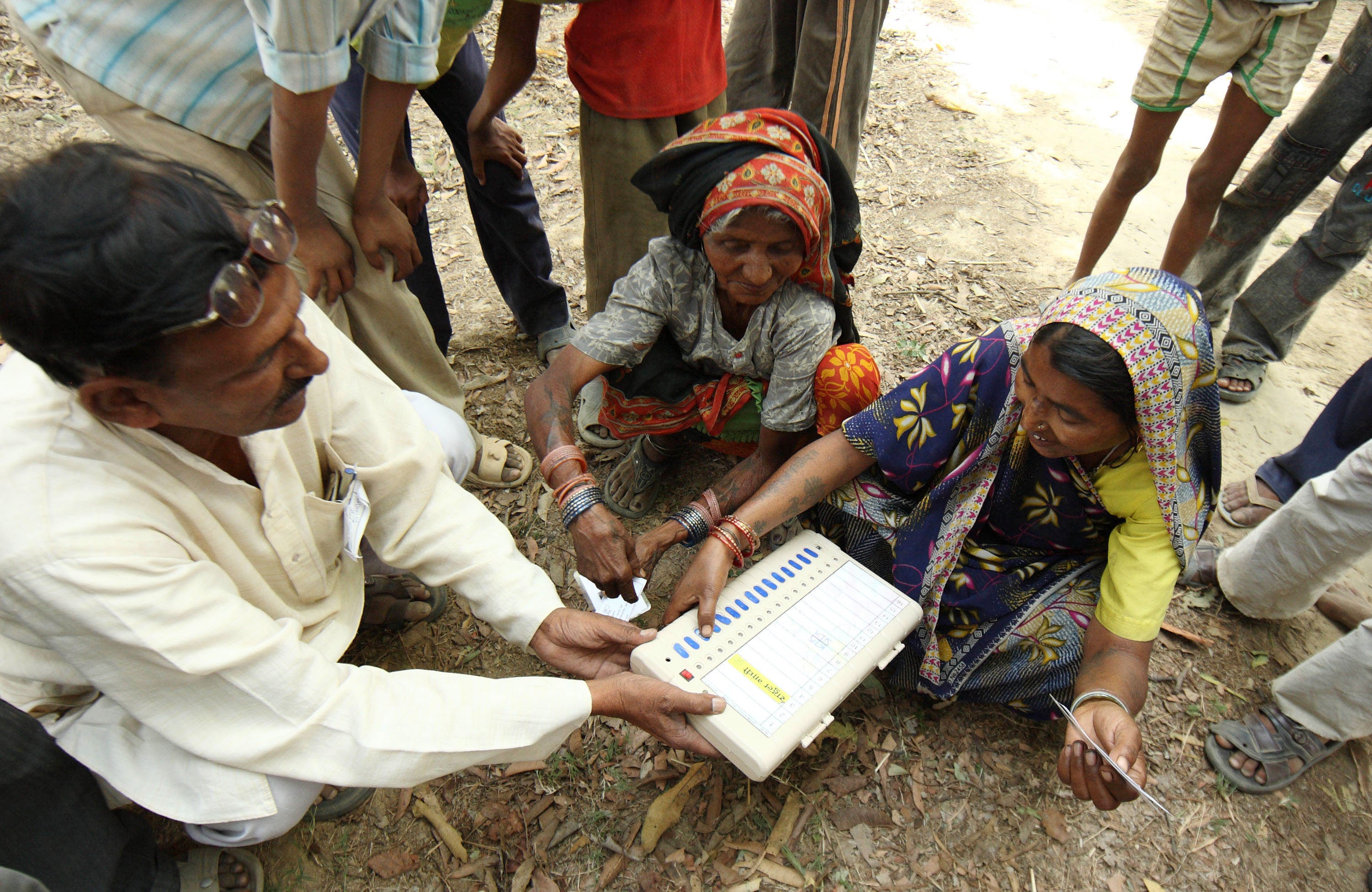
The Supreme Court on Thursday refused to stay the Election Commission's notification allowing none of the above (NOTA) option in the ballot paper for the upcoming Rajya Sabha polls on a plea of the Congress which has fielded sitting MP Ahmed Patel from Gujarat.
Sixty-eight-year-old Patel, a seven-time MP from Gujarat and political advisor of Congress president Sonia Gandhi, is fighting for a Rajya Sabha berth from the state where four candidates are in fray for three seats.
The BJP has named its national president Amit Shah, Union minister Smriti Irani and Balwantsinh Rajput for the polls which are scheduled on August 8.
In what could be a setback for the party, the court rejected the contention of Congress's chief whip in the Gujarat Assembly, Shailesh Manubhai Parmar that the notification be stayed, otherwise it would "encourage corruption" and the MLAs might opt the NOTA option.
The apex court said that the party had not challenged it earlier because the notification suited it.
A bench, headed by Justice Dipak Misra, however, agreed to examine the Constitutional validity of the NOTA provision in Rajya Sabha polls, saying that the issue needed to be debated. "The Election Commission of India had enabled the NOTA provision in 2014, which came into effect in 2015. You (Congress) did not challenge the provision when it suited you," the bench, also comprising Justices Amitava Roy and AM Khanwilkar, said and issued notice to the poll panel.
The bench said it was not going to stay the EC's notification and would like to test the constitutional validity of NOTA in the present context. "We are not going to stay the notification. Even after the elections and results are declared as per the schedule, the matter will be heard on the Constitutional issue," it said.
It listed the matter for detailed arguments on September 18 and directed the EC to file its reply within two weeks on the plea.
The bench said that since the Centre has nothing to do with the notification, it was deleted from the list of the respondents. It, however, asked Attorney General KK Venugopal, the highest law officer of the central government, to assist the court during the hearing.
At the outset, senior advocate Kapil Sibal, representing the Gujarat Congress leader, sought a stay on the notification, saying that if the NOTA provision was allowed in the Rajya Sabha polls, it would encourage "horse-trading and corruption".
"It is for the first time there are four candidates for three Rajya Sabha seats in Gujarat. If NOTA is not disabled in the state, which is witnessing a close contest, it will be a recipe for corruption and the MLAs may exercise the option to make their votes invalid," Sibal said.
"Are you afraid of losing?" the bench asked.
Sibal replied that he was not afraid but, if the notification was not stayed, then the MLAs might exercise the provision and take money from the other side.
The apex court said that the poll panel's notification was not a state-centric one.
On being denied the stay, Sibal said, "Then it will make our pleas infructuous."
The bench then said it meant that the Congress MLA was not "genuinely concerned" about the legal issue.
Another senior advocate Abhishek Manu Singhvi, appearing for the Gujarat leader, said that it was a peculiar case where both the Congress and the BJP were on the same page.
Another senior advocate Ashok Desai, representing the EC, said that NOTA was first introduced in 2014 following an apex court verdict a year earlier and they (Congress) did not have any objection in subsequent polls as it suited them.
Desai told the bench that senior advocate and Congress leader Vivek Tankha, who was in the courtroom, should assist it on the issue whether there was a NOTA provision when he contested the Rajya Sabha polls from Madhya Pradesh.
"How would I know? I was a candidate then, I was not a voter," Tankha, also representing the Gujarat leader, said.
Sibal intervened and said that it was an indirect election with proportionate representation and there was no scope for the NOTA provision as it was meant for direct elections.
"I am not concerned with subsequent elections after 2014 notification enabling the NOTA option as no one had challenged it then. I am a legislator and I am a facing problem now and, therefore, I challenged it," he said.
The court said that the ECI's notification was not state- oriented and whether was it right or wrong needed to be debated as to whether NOTA will apply in the Upper House polls.
"The notification of the EC is for Gujarat, West Bengal and Madhya Pradesh. The election should be taken in the widest sense. It has been already notified. Any interference will totally disrupt the polls," the bench said.
It said, "Since 2014-15, you (Congress) did not say anything, but in 2017 you are saying it is unconstitutional.
The EC's notification is in a general sense and it will be for everyone (other political parties, individuals)."

-
The Economic Imperative: Analysing The Material Driving Force Behind India-Canada Strategic Reset

This economic complementarity is further reinforced by deep institutional investment ties and talent mobility, which form the bedrock of the bilateral framework.
-
Medicine Pricing: Where Must Profit Stop?
India must confront excessive margins, hidden incentives and regulatory gaps that threaten the integrity of medicine.
-
Why Amazon And Flipkart Are Struggling To Beat Meesho In India's Smaller Cities
With 274 million users and lowest-cost logistics, Meesho is defending its value commerce crown against giants like Amazon and Flipkart.
-
High US Salaries, No Green Card Certainty: The Financial Calculation Facing Indian H-1B Families
The suspension of PERM processing at eight technology employers does not cancel existing H-1B visas. What it does is force a question many Indian families have been avoiding: is the US salary worth tying your career and family plans to one employer?
-
Swiggy vs Eternal: Food Delivery's Two Rivals Are No Longer In The Same Race
Eternal is building a private AI assistant, dark.ai. Swiggy is still working out how to make Instamart pay, with an operating loss of Rs 895 crore in the July-September quarter while Blinkit stayed profitable.
-
Where You Live Shapes How You Get To Work | The Reason Why
Two-wheelers are the most popular way to get to work in India, accounting for nearly 43% of workplace commutes.
-
Unhedged Position: Can India See An Indonesia-Style Time Correction?
The Nifty is trading below levels it first clocked in 2024. Is there, then, as I have suggested in the headline, potential that the current time correction drags on painfully for the next three-five, even ten years?
-
Navigating Friction And Energy Realities: An Analysis Of Marco Rubio's October Visit To India
Occurring at a critical juncture marked by stalled trade negotiations and escalating geopolitical pressures over global energy supplies, the visit offers a profound window into modern US-India relations.
-
India Exports Capital. Why Not Export Trusteeship?
The big question, then, is whether India can build an institution that global borrowers, investors, banks, and lawyers can trust, even without an Indian connection.
-
France's Economy & Politics Are In Crisis | The Reason Why
Let's look at how the French economy and politics evolved under Nicolas Sarkozy, Franois Hollande and Emmanuel Macron.










