Supreme Court Puts Use Of Sedition Provision On Hold
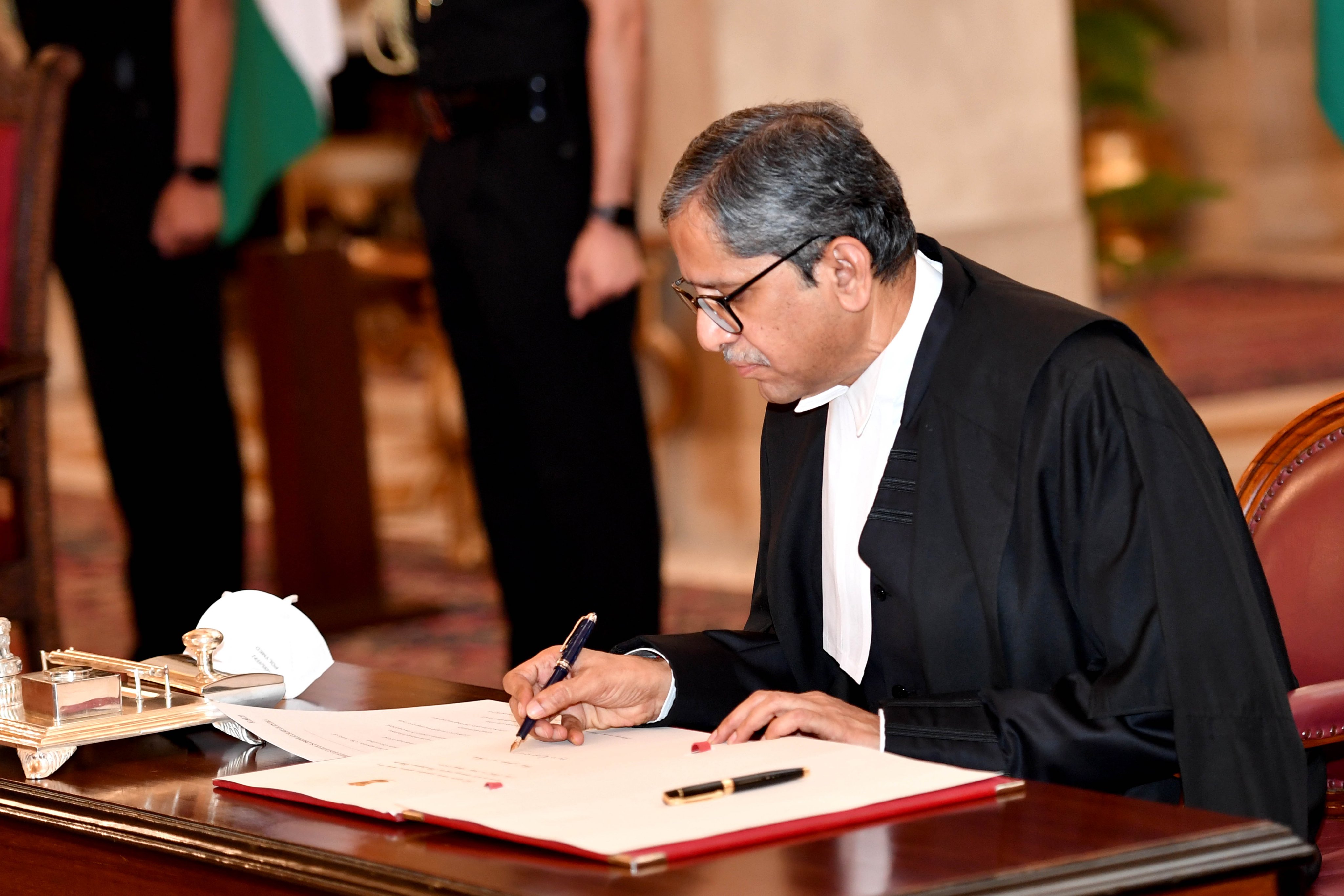
The Supreme Court of India has put on hold the use of sedition provision under India's criminal statute. A bench presided by Chief Justice of India NV Ramana on Tuesday also put pending cases in abeyance as the central government begins the exercise of reconsidering the provision.
Constitutional law experts have welcomed the apex court's ruling.
It's an important ruling and a step in the right direction, says Senior Advocate Navroz Seervai.
A view shared by Senior Advocate Rakesh Dwivedi. It's a historic order, and now the review process must narrowly tailor the law in light of its misuse, Dwivedi says.
The court correction is timely. In view of the order, now no one can be prosecuted under Section 124A, and no new FIR can be registered. Recent abuse of 124A by various governments in India stress the need for relook and a narrowly tailored law in accordance with the doctrine of proportionality and fundamental nature of personal liberty under Article 21 of the Constitution.Rakesh Dwivedi, Senior Advocate
Section 124A of the Indian Penal Code defines the offence of sedition and seeks to punish those who excite or attempt to excite disaffection towards the government through spoken or written words or visible representation. The offence carries a punishment of life imprisonment and fine or a three-year imprisonment with fine.
The top court was examining a batch of petitions challenging the provision, which has attracted attention and criticism over its misuse.
In an affidavit this week, the central government agreed to reconsider the sedition provision. This prompted the apex court to ask the government what happens in the interim.
On Wednesday, the government proposed that while the sedition law is being re-examined, new cases will be registered only upon the satisfaction of an officer not below the rank of superintendent of police.
The top court, however, went a step further and directed that no new cases be registered while the review was in process. It also allowed parties to approach the court if any cases are registered.
We expect that till the re-examination of the provision is complete, it will be appropriate not to continue the usage of the aforesaid provision by the governments.Supreme Court
The observations of the court cannot be read as constituting a prohibition or a bar, said Seervai, in response to a query if the ruling means an automatic bar on filing fresh sedition cases.
"But at a practical level, with these strong observations of the Supreme Court, I think it would effectively put a halt to the filing of further cases under 124A," he said.
The apex court passed the following directions in the interest of justice:
The central and state governments will restrain from registering any FIR, continuing any investigation or taking any coercive measures by invoking Section 124A while the provision is under reconsideration.
If any case is registered, the affected parties are at liberty to approach the courts concerned for appropriate relief. The courts are requested to examine the relief sought taking into account the present order passed as well as the clear stand taken by the central government.
All pending trials, appeals and proceedings with respect to charge framed under Section 124A IPC be kept in abeyance.
The central government is at liberty to issue any directions to prevent misuse.
The order will not result in an automatic bail for people charged under the offence and if they are facing other charges then the trial under those provisions will go on, Seervai points out.
Most courts to which an application for bail would be made in a case where the only charge is sedition under 124A would probably grant bail. Even for cases where the several offences are alleged,but most serious offence is sedition, there is an increased possibility for grant of bail.Navroz Seervai, Senior Advocate
These directions will continue until further orders, the apex court said, while listing the matter for July.

-
Indians Are Travelling, But Not Every Journey Is A Holiday | The Week In Whys

Pilgrims, patients and working women are the real travellers, and the system hasn't quite caught up with them.
-
Getting To Work Costs Women More | The Reason Why
It is not just about women paying more than men. It is about women paying much more in cities than in villages.
-
AI Bias In Investing Cannot Be Eliminated, But It Can Be Governed
Framing is a particularly important example as identical financial information presented in terms of gains rather than losses can lead an LLM to reach a different assessment.
-
Joining The Dots | Dark Skies, Steady Diya: Why Hope Holds This Diwali
With war, a weak rupee and foreign outflows weighing on sentiment, policymakers at the NDTV World Summit and market veterans at NDTV Profit Ignite: Diwali Edition offered the same advice: stay invested and filter out the noise.
-
The Curious Case of Equitas Small Finance Bank And A CEO Who Quit For Stock
PN Vasudevan believes persistent investor concerns over a perceived conflict of interest had become a governance overhang on Equitas Small Finance Bank's stock, even as the lender improved profitability and asset quality.
-
Talking Points This Week: AI Cash Burn, A Tiger Comeback And An India That Still Finds Its Own Path
India is not immune to higher oil or tighter global liquidity, yet its earnings base is broader, its domestic policy levers are still available.
-
Foreign Investors Own Half Of HDFC Bank and ICICI Bank. An LTCG Cut Could Matter Most Here
Foreign portfolio investors have US$115 billion parked in HDFC Bank, ICICI Bank. If the government cuts long-term capital gains tax, Jefferies says returning foreign money could land here first.
-
'Never Seen This Level Of Negativity': Sandeep Tandon Says The Next Rally May Be Closer Than You Think
Veteran investor Sandeep Tandon says foreign selling is easing, large-caps are due a comeback and mid-caps are crowded, while he turns positive on gold, power and pharma this Diwali.
-
Indians Stay With Family, Not In Hotels | The Reason Why
India still lacks enough clean, reliable and affordable hotels for budget-conscious travellers.
-
The Economic Imperative: Analysing The Material Driving Force Behind India-Canada Strategic Reset
This economic complementarity is further reinforced by deep institutional investment ties and talent mobility, which form the bedrock of the bilateral framework.










