Supreme Court Collegium Defers Decision On Justice KM Joseph’s Elevation
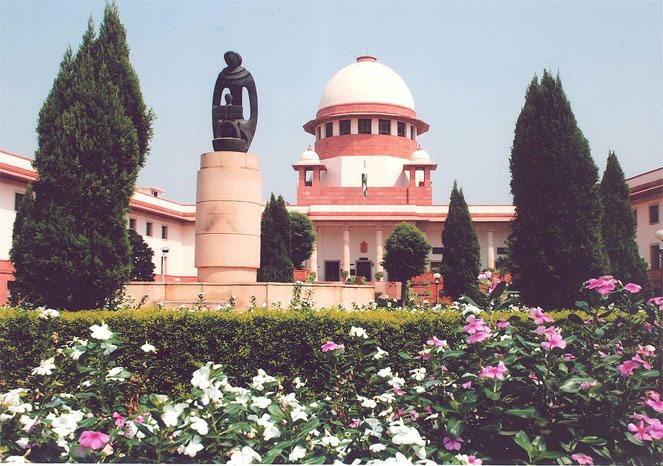
The Supreme Court Collegium today deferred a decision on the issue of reconsidering its recommendation to elevate Uttarakhand Chief Justice KM Joseph as the judge of the apex court, after it was sent back by the government last week.
The five-member Collegium comprising Chief Justice Dipak Misra and justices J Chelameswar, Ranjan Gogoi, Madan B Lokur and Kurian Joseph met after the top court's working hours, but no decision was taken. There was no official word on when the Collegium would meet next.
Besides Justice Jospeph, the agenda of the Collegium was to deliberate on the names of some judges from Calcutta, Rajasthan and Telangana and Andhra Pradesh high courts for elevation as apex court judges.
Justice Joseph's name was recommended along with then senior advocate Indu Malhotra on Jan. 10 for their elevation as apex court judges. The government had on April 26 declined to accept the recommendation of the Collegium and asked it to reconsider Justice Joseph's name.
Justice Joseph, who had headed the bench that had quashed the Narendra Modi government's decision to impose President's rule in the Congress-ruled hill state in 2016, was not considered to be elevated as a Supreme Court judge by the Centre. The government had said that the proposal for his name was not in accordance with the top court's parameters and there was adequate representation of Kerala in the higher judiciary from where he hails.
His seniority was also questioned by the Centre which had said "he stands at Sl. No.45 in the combined seniority of High Court Judges on all-India basis." Justice Joseph, who turns 60 this June, has been the Chief Justice of the Uttarakhand High Court since July 2014. He was appointed a permanent judge of the Kerala High Court on October 14, 2004 and assumed charge of the Uttarakhand High Court on July 31, 2014.
The members of the collegium including Justices Chelameswar, Gogoi, Lokur and Kurian Joseph had expressed concern over the delay of the government in clearing the name of the Uttarakhand Chief Justice as the apex court judge.
Notwithstanding the letters written by the collegium members to the CJI which had come into the public domain, the Centre disregarded the recommendation about Justice Joseph.

-
The Economic Imperative: Analysing The Material Driving Force Behind India-Canada Strategic Reset

This economic complementarity is further reinforced by deep institutional investment ties and talent mobility, which form the bedrock of the bilateral framework.
-
Medicine Pricing: Where Must Profit Stop?
India must confront excessive margins, hidden incentives and regulatory gaps that threaten the integrity of medicine.
-
Why Amazon And Flipkart Are Struggling To Beat Meesho In India's Smaller Cities
With 274 million users and lowest-cost logistics, Meesho is defending its value commerce crown against giants like Amazon and Flipkart.
-
High US Salaries, No Green Card Certainty: The Financial Calculation Facing Indian H-1B Families
The suspension of PERM processing at eight technology employers does not cancel existing H-1B visas. What it does is force a question many Indian families have been avoiding: is the US salary worth tying your career and family plans to one employer?
-
Swiggy vs Eternal: Food Delivery's Two Rivals Are No Longer In The Same Race
Eternal is building a private AI assistant, dark.ai. Swiggy is still working out how to make Instamart pay, with an operating loss of Rs 895 crore in the July-September quarter while Blinkit stayed profitable.
-
Where You Live Shapes How You Get To Work | The Reason Why
Two-wheelers are the most popular way to get to work in India, accounting for nearly 43% of workplace commutes.
-
Unhedged Position: Can India See An Indonesia-Style Time Correction?
The Nifty is trading below levels it first clocked in 2024. Is there, then, as I have suggested in the headline, potential that the current time correction drags on painfully for the next three-five, even ten years?
-
Navigating Friction And Energy Realities: An Analysis Of Marco Rubio's October Visit To India
Occurring at a critical juncture marked by stalled trade negotiations and escalating geopolitical pressures over global energy supplies, the visit offers a profound window into modern US-India relations.
-
India Exports Capital. Why Not Export Trusteeship?
The big question, then, is whether India can build an institution that global borrowers, investors, banks, and lawyers can trust, even without an Indian connection.
-
France's Economy & Politics Are In Crisis | The Reason Why
Let's look at how the French economy and politics evolved under Nicolas Sarkozy, Franois Hollande and Emmanuel Macron.










