Hum Saath Saath Hain: Congress, BJP and Vedanta’s Sterlite
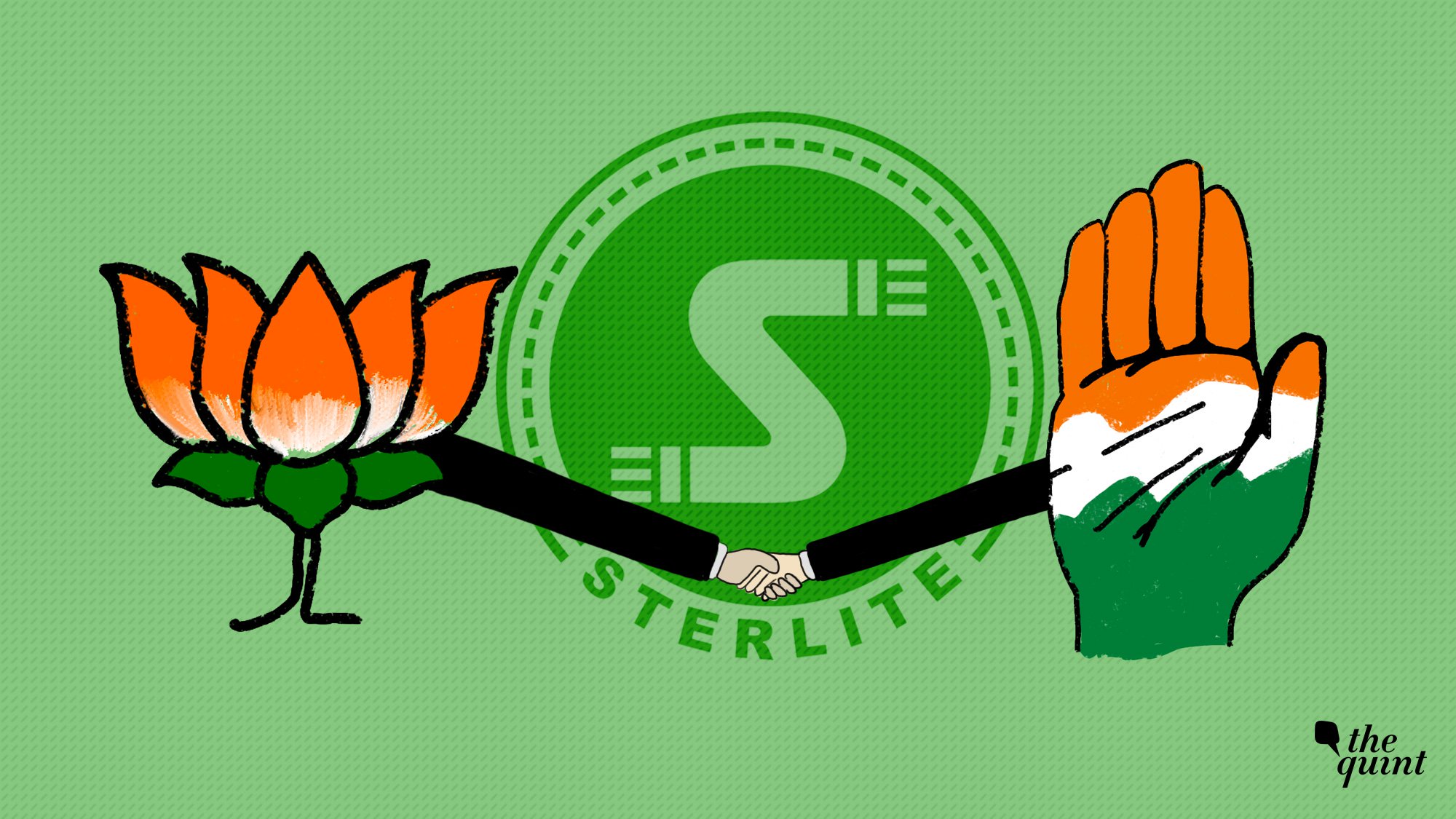
(On 2 July 2018, the Supreme Court of India issued notice to the Centre on a petition challenging the retrospective amendments made to the Foreign Contribution Regulation Act via the Finance Acts of 2016 and 2018. The Central Government now has to respond to the arguments by the Association for Democratic Reforms and EAS Sarma that the amendments, which validate contributions received by political parties from foreign companies like Vedanta, are illegal and unconstitutional. In light of this news, The Quint is republishing this article from its archives.)
At least 11 people have died in police firing after protesters rallied against the expansion plans of Sterlite Copper in Thoothukudi (Tuticorin). Sterlite Copper is a subsidiary of the UK-based Vedanta Group. The disproportionate use of force by the Tamil Nadu police, including ‘sniper-style shooting' using semi-automatic rifles, has been met with nationwide criticism.
In an unusually strong response, Rahul Gandhi called the deaths “a brutal example of state-sponsored terrorism”, targeting the AIADMK government, which the Congress sees as a proxy for the Narendra Modi administration.
What's being glossed over in this political rhetoric, however, is the fact that both the Congress and the BJP have benefited monetarily from Vedanta's Sterlite Copper and that both parties appear to have worked in tandem to shield themselves from punitive action under what was once a stringent Foreign Contributions Regulation Act (FCRA).
Here's how.
In January 2013, former Secretary to the Government of India, EAS Sarma, and the Association for Democratic Reforms (ADR), filed a Public Interest Litigation (PIL) in the Delhi High Court claiming that the Indian National Congress (INC) and the Bharatiya Janata Party (BJP) had accepted donations from the UK-based Vedanta Group in violation of the Representation of People's Act 1951 and the FCR Act of 1976 and 2010.


This made the Vedanta Group the single largest donor to both the Congress and the BJP during that period.
The petitioners pointed out that the rationale of the FCR Act was to prevent any interference from foreign elements in our internal electoral processes.
In March 2014, after ten hearings, the Delhi High Court pronounced its verdict – the court held the INC and the BJP guilty of violating the FCRA and directed the government of India (UPA at the time) and the Election Commission to take action against the two political parties within a period of six months.
In June 2014, the Congress that had just been booted out filed a special leave petition (SLP) against the Delhi High Court decision. Two months later, the BJP also filed an SLP in the Supreme Court against the Delhi High Court verdict.
With the proceedings on in the Supreme Court, the six-month deadline set by the Delhi High Court lapsed in September without any action being initiated against either party.
Curiously, in several no-holds-barred election campaigns that followed since 2014, neither the BJP nor the Congress brought up the issue of them accepting political donations from Vedanta that were in violation of FCRA.
The First ‘Helpful' Amendment
In February 2016, when the Modi government presented its first Budget in the Lok Sabha, the contentious Finance Bill was passed that amended the FCR Act of 2010 with retrospective effect.
Essentially, the amendment changed the very definition of ‘foreign contributions' to include money donated by Indian subsidiaries of foreign companies, so that there would no longer be a violation.
But there was a problem.
Donations by Vedanta's subsidiaries to INC and BJP were made between 2004 to 2009. The Amendment was made to the FCR Act 2010, and applied retrospectively only until 2010.
But the parties were held guilty under the FCR Act 1976, a fact that was highlighted during the Supreme Court hearing that took place on 22 November 2016. It was argued that since the Delhi High Court held the INC and the BJP guilty under the 1976 FCR Act, the retrospective amendment to the 2010 FCR Act would have no bearing on its verdict.
On 29 November 2016, the Congress and the BJP sought permission to withdraw their appeals and the Supreme Court records show the matter “Dismissed as withdrawn”.
In March 2017, the original petitioners – EAS Sarma and ADR – filed a contempt petition in the Delhi High Court against the Union of India for not implementing the Court's 28 March 2018 order which was to be implemented within six months.

The Second Convenient Amendment
While the hearings continued through the year with lawyers seeking adjournments, in February 2018, the Modi government once again affected a controversial amendment to the Finance Bill. Among other things, it changed the date from whereon the FCRA violations could be scrutinised, with retrospective effect, of course. So, 26 September 2010 was rewound to 5 August 1976.
So any legal proceedings against the Congress or the BJP for violating Indian law, are now redundant.

-
The Curious Case of Equitas Small Finance Bank And A CEO Who Quit For Stock

PN Vasudevan believes persistent investor concerns over a perceived conflict of interest had become a governance overhang on Equitas Small Finance Bank's stock, even as the lender improved profitability and asset quality.
-
Talking Points This Week: AI Cash Burn, A Tiger Comeback And An India That Still Finds Its Own Path
India is not immune to higher oil or tighter global liquidity, yet its earnings base is broader, its domestic policy levers are still available.
-
Foreign Investors Own Half Of HDFC Bank and ICICI Bank. An LTCG Cut Could Matter Most Here
Foreign portfolio investors have US$115 billion parked in HDFC Bank, ICICI Bank. If the government cuts long-term capital gains tax, Jefferies says returning foreign money could land here first.
-
'Never Seen This Level Of Negativity': Sandeep Tandon Says The Next Rally May Be Closer Than You Think
Veteran investor Sandeep Tandon says foreign selling is easing, large-caps are due a comeback and mid-caps are crowded, while he turns positive on gold, power and pharma this Diwali.
-
Indians Stay With Family, Not In Hotels | The Reason Why
India still lacks enough clean, reliable and affordable hotels for budget-conscious travellers.
-
The Economic Imperative: Analysing The Material Driving Force Behind India-Canada Strategic Reset
This economic complementarity is further reinforced by deep institutional investment ties and talent mobility, which form the bedrock of the bilateral framework.
-
Medicine Pricing: Where Must Profit Stop?
India must confront excessive margins, hidden incentives and regulatory gaps that threaten the integrity of medicine.
-
Why Amazon And Flipkart Are Struggling To Beat Meesho In India's Smaller Cities
With 274 million users and lowest-cost logistics, Meesho is defending its value commerce crown against giants like Amazon and Flipkart.
-
High US Salaries, No Green Card Certainty: The Financial Calculation Facing Indian H-1B Families
The suspension of PERM processing at eight technology employers does not cancel existing H-1B visas. What it does is force a question many Indian families have been avoiding: is the US salary worth tying your career and family plans to one employer?
-
Swiggy vs Eternal: Food Delivery's Two Rivals Are No Longer In The Same Race
Eternal is building a private AI assistant, dark.ai. Swiggy is still working out how to make Instamart pay, with an operating loss of Rs 895 crore in the July-September quarter while Blinkit stayed profitable.










