Smartphones For Women In Rural Chhattisgarh Could Transform Lives–If Men Do Not Interfere
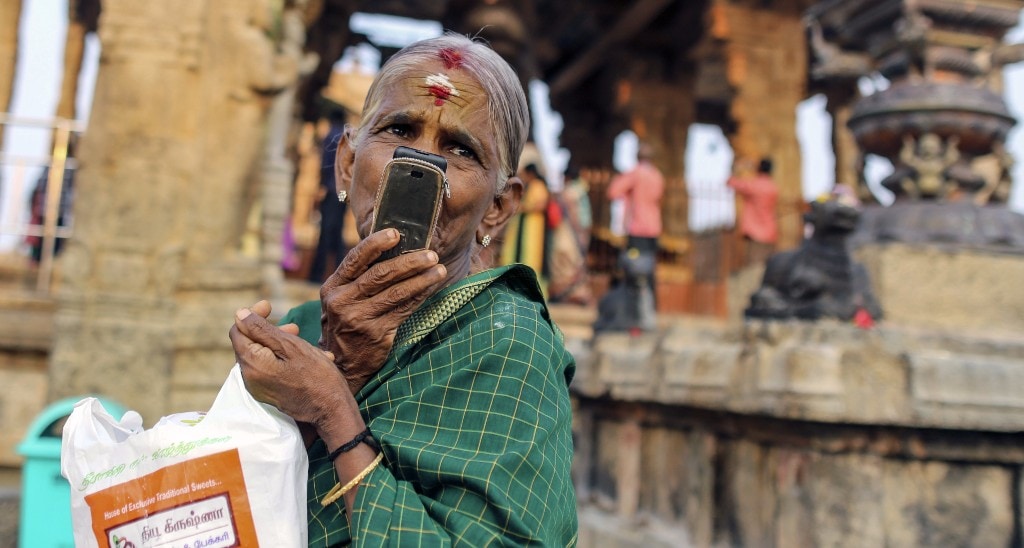
In a remote village in Chhattisgarh, over 200 women lined up outside a government office, each holding a small, orange ticket. One by one, they shuffled into and out of the office, replacing their ticket with a smartphone. Excited new phone owners gathered in groups outside the hall talking about how they would use the phone.
This scene was not unique to one village. All across Chhattisgarh through September, the state government was giving a smartphone to one woman in each rural household. The programme, entitled Sanchaar Kranti Yojana (SKY), or the Telecommunications Revolution Scheme, covered 2.3 million rural women by the end of September. As if that weren't ambitious enough, SKY also gave smartphones to three lakh college students and 3.5 lakh urban women—and will increase network coverage by building just under 1,500 towers, thus encouraging even more phone use and ownership beyond the beneficiary pool.
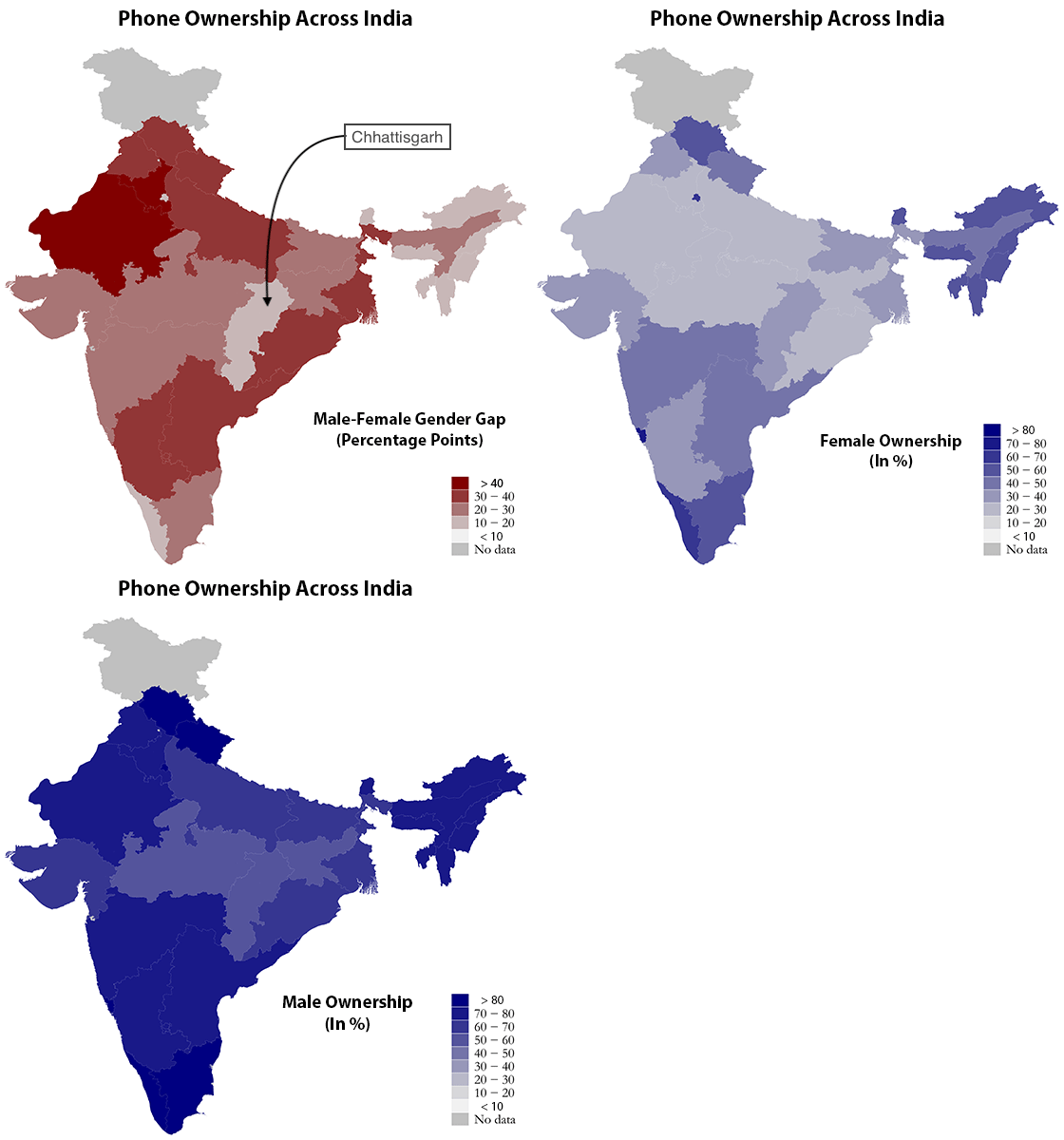
The main purpose behind programme SKY is to address low phone ownership in Chhattisgarh and to empower women in the process. As evident from the heat maps below, Chhattisgarh has India's fourth-lowest mobile phone ownership rate—45.6 percent—which is five percentage points lower than the overall average.
 Financial Inclusion Insights, 2015-2016. Estimates pool years.) ">
At the same time, Chhattisgarh's gender gap in phone ownership is the lowest in India at 14.3 percentage points: 52 percent of men own a phone compared with 38 percent of women. At 32.7 percentage points, India's overall average gap is more than twice that amount. Yet a relatively smaller gender gap in ownership doesn't necessarily mean the gap won't grow over time—many states with higher male phone ownership also have larger gender gaps.
In this way, programme SKY is a timely nudge that encourages a narrowing rather than enlargement of the mobile gender gap. (For more insights on the causes and effects of the gap, see a new report by our team, led by Rohini Pande and Charity Troyer Moore of Evidence for Policy Design at Harvard Kennedy School, Erica Field of Duke University and Simone Schaner of University of Southern California.)
The Benefits Of Mobile Phones
The potential impacts of SKY go beyond female mobile engagement. Ample research already shows that mobile phones encourage economic development. Phones help producers and consumers access the best price for market goods and learn about job opportunities. In Kenya, mobile money has reduced households' vulnerability to economic shocks. “Behavioral messaging” through SMS and voice calls have improved behavior in domains like finance, health, and education.
A few studies highlight the value of women's mobile phone access, both for themselves and others. One study found that M-PESA, Kenya's mobile money platform, has lifted 2 percent of Kenyan households out of poverty. Increases in consumption were concentrated among female-headed households, suggesting that women had more to gain from mobile money. A study from Niger found that when women took cash transfers through mobile money application rather than as cash, household dietary diversity improved, a result attributed to women's increased bargaining power within the household.
This result echoes a broader finding in current research: Empowering women with assets is valuable to economic development. Studies show that when women have access to resources, they use them for children. For example, greater access to pension benefits among female-headed households in South Africa led to improved nutrition for girls. There are similar patterns among households in Brazil, where studies show that higher female income leads to greater chance of child survival, higher nutrition investments in girls, and larger relative investments in human capital and leisure.
Similarly, we might expect women to use their SKY phones to improve their children's lives in some way. While empowering women with technology is a noble pursuit in its own right, this further highlights the value of SKY targeting female beneficiaries rather than male.
A Problem: The Male Monopoly
The success of SKY's targeting of female beneficiaries comes with a caveat: Transfers are only as effective insofar as the beneficiary perceives them as useful and relevant. Recent experience with the Pradhan Mantri Jan Dhan Yojana, or Prime Minister's People's Wealth Scheme, illustrates this.
The intent of PMJDY was to open a bank account for at least one member in every household. Yet PMJDY alone wasn't enough to achieve full financial inclusion, as many accounts remained dormant after being opened. For the economy to see the downstream impacts of the scheme, beneficiaries needed to understand what a bank account could do for them and how to use one. In other words, the relevant metric for measuring financial inclusion lies not in the number of people with an account but the number of people who use accounts.
In a similar way, if SKY beneficiaries do not find phones useful or obtain the skill to use them, then the initiative will fail to close the mobile phone gender gap and women will not reap these benefits. The issue is further complicated by the fact that unlike bank accounts, phones can be easily transferred, and men often control asset ownership within households in South Asian cultures.
Thus, even if a woman sees her new phone as useful, if she does not know how to use it, then her husband may use his monopoly on technological know-how to justify taking it. This underscores the potential added value of digital literacy training to the SKY programme and, more broadly, highlights the importance of providing training alongside programmes that give assets to the poor.
(Savannah Noray is a Research Fellow at Evidence for Policy Design at Harvard Kennedy School.)
This copy has been published in arrangement with IndiaSpend.

-
Getting To Work Costs Women More | The Reason Why

It is not just about women paying more than men. It is about women paying much more in cities than in villages.
-
AI Bias In Investing Cannot Be Eliminated, But It Can Be Governed
Framing is a particularly important example as identical financial information presented in terms of gains rather than losses can lead an LLM to reach a different assessment.
-
Joining The Dots | Dark Skies, Steady Diya: Why Hope Holds This Diwali
With war, a weak rupee and foreign outflows weighing on sentiment, policymakers at the NDTV World Summit and market veterans at NDTV Profit Ignite: Diwali Edition offered the same advice: stay invested and filter out the noise.
-
The Curious Case of Equitas Small Finance Bank And A CEO Who Quit For Stock
PN Vasudevan believes persistent investor concerns over a perceived conflict of interest had become a governance overhang on Equitas Small Finance Bank's stock, even as the lender improved profitability and asset quality.
-
Talking Points This Week: AI Cash Burn, A Tiger Comeback And An India That Still Finds Its Own Path
India is not immune to higher oil or tighter global liquidity, yet its earnings base is broader, its domestic policy levers are still available.
-
Foreign Investors Own Half Of HDFC Bank and ICICI Bank. An LTCG Cut Could Matter Most Here
Foreign portfolio investors have US$115 billion parked in HDFC Bank, ICICI Bank. If the government cuts long-term capital gains tax, Jefferies says returning foreign money could land here first.
-
'Never Seen This Level Of Negativity': Sandeep Tandon Says The Next Rally May Be Closer Than You Think
Veteran investor Sandeep Tandon says foreign selling is easing, large-caps are due a comeback and mid-caps are crowded, while he turns positive on gold, power and pharma this Diwali.
-
Indians Stay With Family, Not In Hotels | The Reason Why
India still lacks enough clean, reliable and affordable hotels for budget-conscious travellers.
-
The Economic Imperative: Analysing The Material Driving Force Behind India-Canada Strategic Reset
This economic complementarity is further reinforced by deep institutional investment ties and talent mobility, which form the bedrock of the bilateral framework.
-
Medicine Pricing: Where Must Profit Stop?
India must confront excessive margins, hidden incentives and regulatory gaps that threaten the integrity of medicine.










