Six States Oppose Terms Of Reference Of 15th Finance Commission
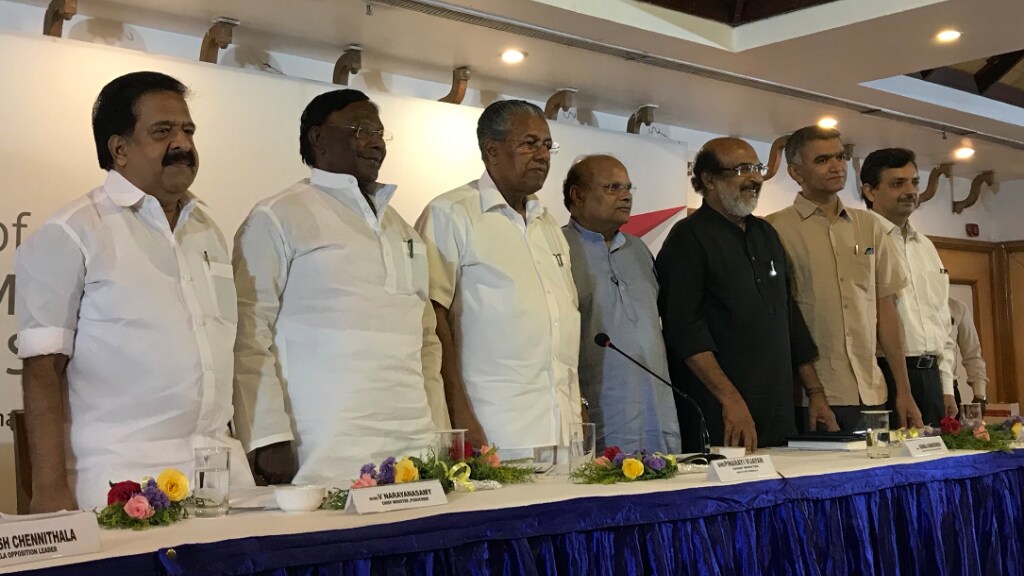
Chief ministers and finance ministers of six states and union territories ruled by non-NDA governments today wrote to the President, urging that some of the terms of reference set by the 15th Finance Commission be re-framed.
At a conclave held at Amaravati, representatives from Andhra Pradesh, West Bengal, Delhi, Punjab, Kerala and Puducherry raised concerns on some of the terms set by the Commission, claiming these would infringe on provisions of the Constitution and disrupt the existing federal-fiscal arrangements. The event followed a workshop held at Trivandrum last month where finance ministers of southern state had discussed the matter.
The three southern states – Kerala, Karnataka and Andhra Pradesh – were the first to express opposition to the ToR issued for the Commission, which they said left them worse off.
The ministers recommended amendments to the existing terms, which they said penalises progressive and performing states, according to the draft memorandum sent to the President. The 14th Finance Commission's move to put a 10 percent weightage on population while splitting tax revenue and the current commission's steps to increase this weightage, rewards states with high fertility rates and poor family planning programs, Andhra Pradesh Finance Minister Y Ramakrishnudu said.
He added that the division of powers between the Centre and states for tax collection and borrowings already leaves states short of resources. “The attempt is to reduce the borrowing power of state governments from 3 percent of GDP to 1.75 percent. This will be disastrous for states,” Kerala Finance Minister Thomas Isaac told BloombergQuint in an interview.
States have to incur capital expenditure to provide adequate infrastructure to attract private investment, Ramakrishnudu said, adding that relying on the population to determine states' share of taxes will widen both fiscal and revenue deficits.
The group of minsters recommended going back to using the population census of 1971 for devolution of taxes between the Centre and states, Issac said.
Other areas of dissent included the need to determine tax devolution on the basis of current tax and non-tax revenue over future estimates, reinstating the need for revenue deficit grants and reversal of some performance-based incentives. The recommendations also included the need to move towards fiscal autonomy instead of relying on the Centre's discretion for the release of funds.
Andhra Pradesh Chief Minister N Chandrababu Naidu said that the Commission was also studying if state expenditure was controlled by populist measures. The Centre should be assessed on such parameters as well, he added.
“These are not the proper domain of the Finance Commission...We are clear that this kind of incentivisation should be removed from the terms of reference,” Isaac said.

-
The Economic Imperative: Analysing The Material Driving Force Behind India-Canada Strategic Reset

This economic complementarity is further reinforced by deep institutional investment ties and talent mobility, which form the bedrock of the bilateral framework.
-
Medicine Pricing: Where Must Profit Stop?
India must confront excessive margins, hidden incentives and regulatory gaps that threaten the integrity of medicine.
-
Why Amazon And Flipkart Are Struggling To Beat Meesho In India's Smaller Cities
With 274 million users and lowest-cost logistics, Meesho is defending its value commerce crown against giants like Amazon and Flipkart.
-
High US Salaries, No Green Card Certainty: The Financial Calculation Facing Indian H-1B Families
The suspension of PERM processing at eight technology employers does not cancel existing H-1B visas. What it does is force a question many Indian families have been avoiding: is the US salary worth tying your career and family plans to one employer?
-
Swiggy vs Eternal: Food Delivery's Two Rivals Are No Longer In The Same Race
Eternal is building a private AI assistant, dark.ai. Swiggy is still working out how to make Instamart pay, with an operating loss of Rs 895 crore in the July-September quarter while Blinkit stayed profitable.
-
Where You Live Shapes How You Get To Work | The Reason Why
Two-wheelers are the most popular way to get to work in India, accounting for nearly 43% of workplace commutes.
-
Unhedged Position: Can India See An Indonesia-Style Time Correction?
The Nifty is trading below levels it first clocked in 2024. Is there, then, as I have suggested in the headline, potential that the current time correction drags on painfully for the next three-five, even ten years?
-
Navigating Friction And Energy Realities: An Analysis Of Marco Rubio's October Visit To India
Occurring at a critical juncture marked by stalled trade negotiations and escalating geopolitical pressures over global energy supplies, the visit offers a profound window into modern US-India relations.
-
India Exports Capital. Why Not Export Trusteeship?
The big question, then, is whether India can build an institution that global borrowers, investors, banks, and lawyers can trust, even without an Indian connection.
-
France's Economy & Politics Are In Crisis | The Reason Why
Let's look at how the French economy and politics evolved under Nicolas Sarkozy, Franois Hollande and Emmanuel Macron.










