Short-Selling: Indian And US Regulators Are Turning Up The Heat

Short-selling, a trading strategy where investors speculate on a stock's decline thereby creating volatility, is gaining further scrutiny from regulators in India and the United States.
On Friday, US authorities charged renowned short-seller Andrew Left with committing fraud through his stock trades, social media activity, and research reports, Bloomberg reported. This marks a significant escalation in the ongoing crackdown on traders who promote negative stock positions in America.
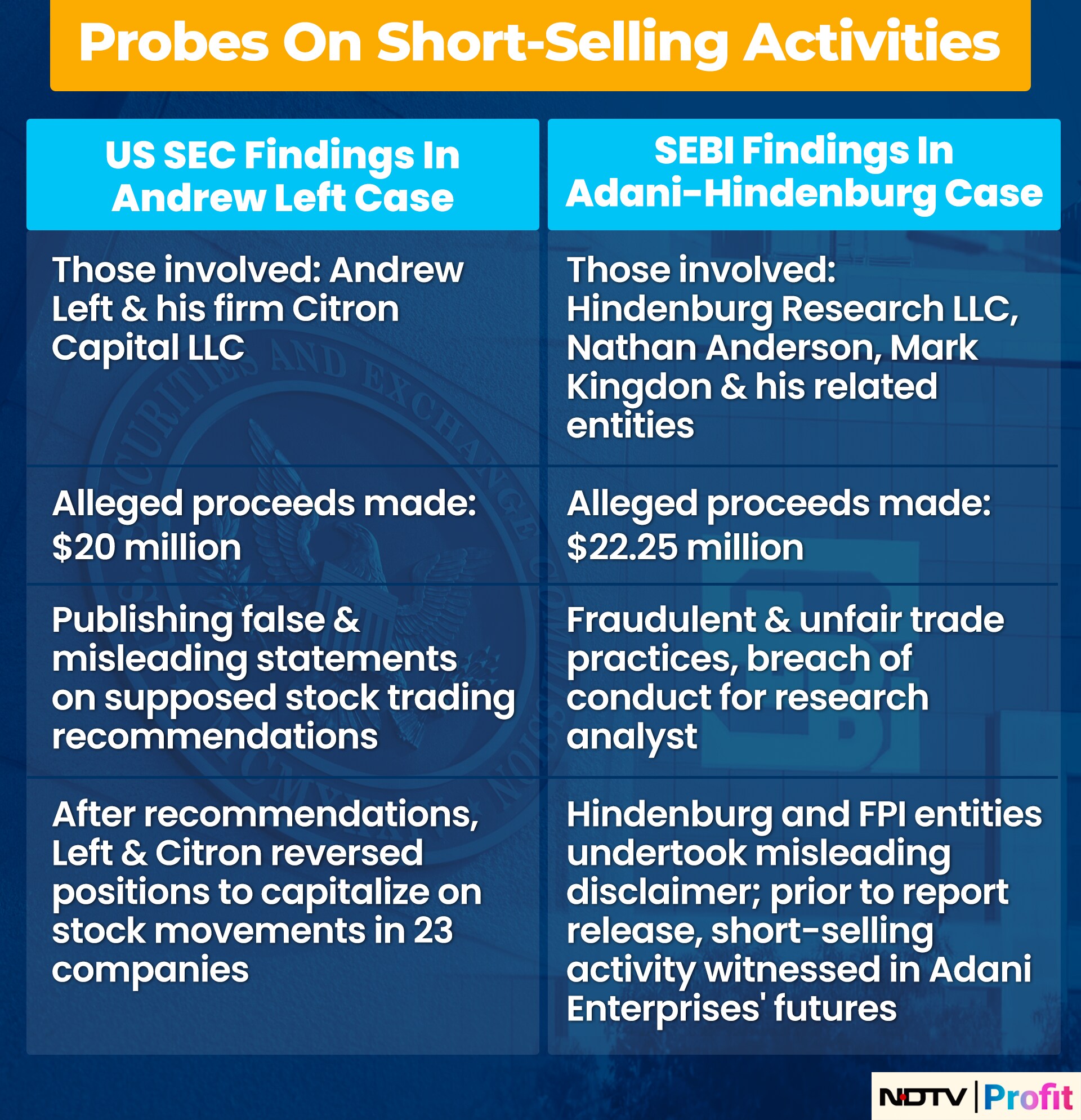
The Securities and Exchange Commission alleged that Left, operating through his firm Citron, illegally generated approximately $20 million in profits from trading activities involving nearly two dozen companies. Additionally, the Justice Department has brought criminal charges against Left, accusing him of securities fraud and of allegedly misleading investigators about his compensation from hedge funds.
Prosecutors claim that Left would rapidly close his positions after publishing a research report or making public comments. This strategy allowed him to capitalize on short-term price fluctuations.
"The SEC reminds investors to be skeptical and never make investment decisions based solely on information from social media or other unverified platforms," the regulator said.
Source: NDTV Profit
SEBI's Eye On Hindenburg Saga
Earlier this month, the Securities and Exchange Board of India issued a show cause notice to Hindenburg Research, Nathan Anderson and the entities of Mauritius-based foreign portfolio investor Mark Kingdon for trading violations in the scrip of Adani Enterprises Ltd. leading up to Hindenburg Report and thereafter.
The regulator has alleged that Hindenburg and Anderson have violated regulations related to fraudulent and unfair trade practices, and the code of conduct for research analyst.
SEBI pointed out the Hindenburg and the FPI entities undertook misleading disclaimer that the report was solely for the valuation of securities traded outside India when it clearly pertained to listed entities in India. The regulator said Kingdon aided Hindenburg to indirectly participate in Adani Enterprises by collaborating with the short seller to trade in the company's futures in the Indian derivatives market and shared profits with the research firm.
According to the show cause notice, SEBI has alleged that prior to report release, short-selling activity was witnessed in the futures of Adani Enterprises and after the report the share lost 59% between Jan. 24, 2023 and Feb. 22, 2023.
The SEBI investigation revealed that K-India Opportunities Fund – Class F opened a trading account and started trading in the scrip of Adani Enterprises before the release of report. The FPI then squared off the positions in February making a profit of $22.25 million or Rs 183.24 crore.
Hindenburg continues to defend its January 2023 report. The Adani Group has denied allegations leveled by the short seller.
The Supreme Court this month dismissed a review petition that was filed against its Jan. 3 judgement in the Adani Group-Hindenburg Research case, wherein the court reposed confidence in SEBI's regulatory powers and ruled that petitioners could not provide enough material to transfer the probe to a special investigation team.
Short-selling profits can be minimal, even if a well-researched report significantly impacts the market. Moreover, these modest gains can quickly be offset by the expenses associated with lawsuits and, more recently, government investigations.
Hindenburg Researh for example, claimed that it earned only $4.1 million through the Adani short.
Disclaimer: NDTV is a subsidiary of AMG Media Networks Limited, an Adani Group Company.

-
Indians Are Travelling, But Not Every Journey Is A Holiday | The Week In Whys

Pilgrims, patients and working women are the real travellers, and the system hasn't quite caught up with them.
-
Getting To Work Costs Women More | The Reason Why
It is not just about women paying more than men. It is about women paying much more in cities than in villages.
-
AI Bias In Investing Cannot Be Eliminated, But It Can Be Governed
Framing is a particularly important example as identical financial information presented in terms of gains rather than losses can lead an LLM to reach a different assessment.
-
Joining The Dots | Dark Skies, Steady Diya: Why Hope Holds This Diwali
With war, a weak rupee and foreign outflows weighing on sentiment, policymakers at the NDTV World Summit and market veterans at NDTV Profit Ignite: Diwali Edition offered the same advice: stay invested and filter out the noise.
-
The Curious Case of Equitas Small Finance Bank And A CEO Who Quit For Stock
PN Vasudevan believes persistent investor concerns over a perceived conflict of interest had become a governance overhang on Equitas Small Finance Bank's stock, even as the lender improved profitability and asset quality.
-
Talking Points This Week: AI Cash Burn, A Tiger Comeback And An India That Still Finds Its Own Path
India is not immune to higher oil or tighter global liquidity, yet its earnings base is broader, its domestic policy levers are still available.
-
Foreign Investors Own Half Of HDFC Bank and ICICI Bank. An LTCG Cut Could Matter Most Here
Foreign portfolio investors have US$115 billion parked in HDFC Bank, ICICI Bank. If the government cuts long-term capital gains tax, Jefferies says returning foreign money could land here first.
-
'Never Seen This Level Of Negativity': Sandeep Tandon Says The Next Rally May Be Closer Than You Think
Veteran investor Sandeep Tandon says foreign selling is easing, large-caps are due a comeback and mid-caps are crowded, while he turns positive on gold, power and pharma this Diwali.
-
Indians Stay With Family, Not In Hotels | The Reason Why
India still lacks enough clean, reliable and affordable hotels for budget-conscious travellers.
-
The Economic Imperative: Analysing The Material Driving Force Behind India-Canada Strategic Reset
This economic complementarity is further reinforced by deep institutional investment ties and talent mobility, which form the bedrock of the bilateral framework.










