Section 377 Verdict: History Owes An Apology To The LGBT Community, Says Supreme Court
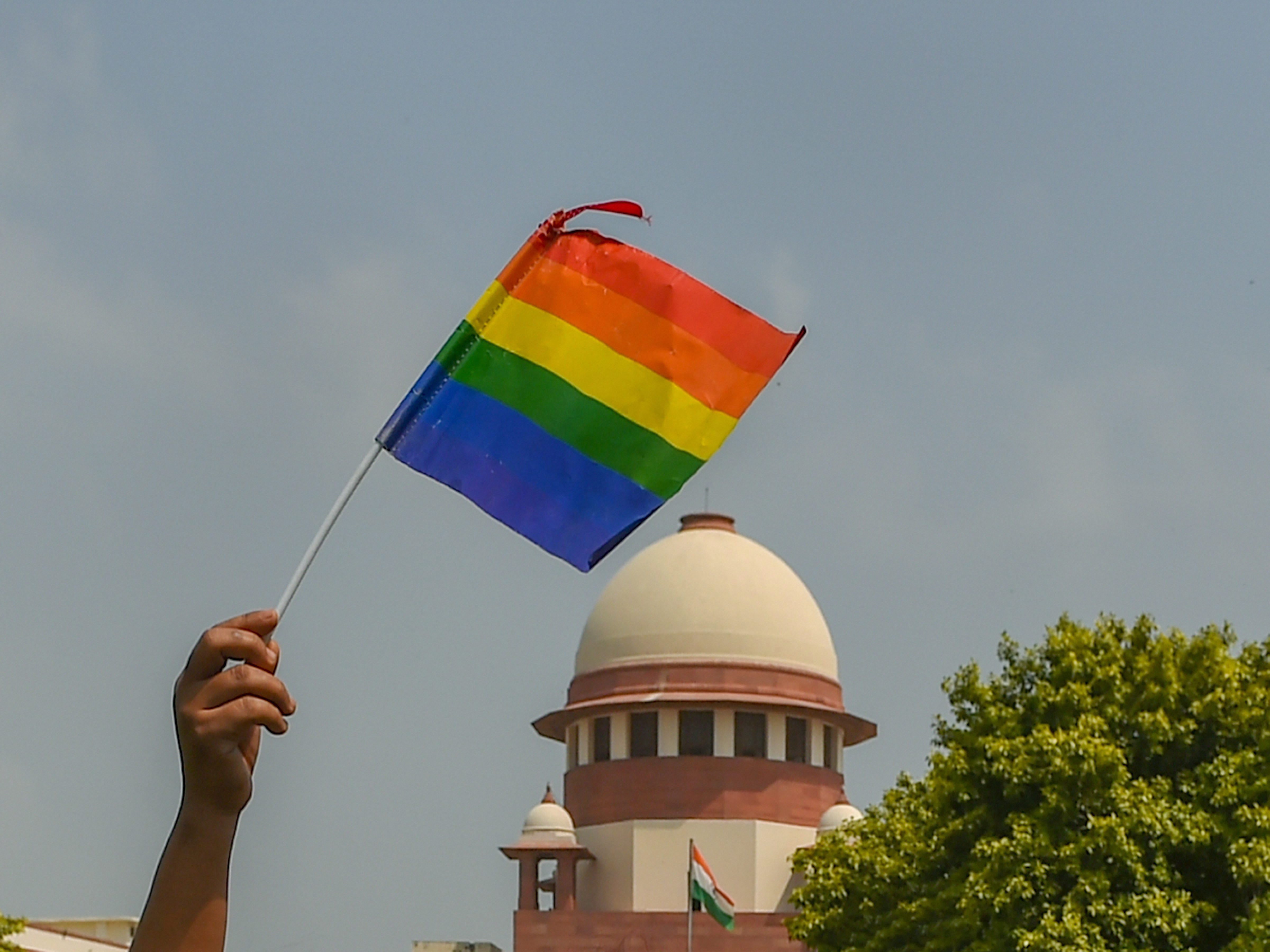
Five years after making homosexuality illegal again, the Supreme Court today by a 5-0 unanimous verdict decriminalised consensual sex between homosexuals. The top court, while reading down Section 377 of the Indian Penal Code, said it violates the LGBT community's right to equality, right to dignity and privacy.
Chief Justice of India Justice Dipak Misra, who read the first opinion, highlighted that social morality is different from constitutional morality.
In the garb of social morality, the members of the LGBT community must not be outlawed or given a step-motherly treatment of malefactor by the society. If this happens or if such a treatment to the LGBT community is allowed to persist, then the constitutional courts, which are under the obligation to protect the fundamental rights, would be failing in the discharge of their duty. A failure to do so would reduce the citizenry rights to a cipher.Dipak Misra, Chief Justice of India, In His Judgement
The Chief Justice rejected the notion that there is anything unnatural among homosexual adults. “Respect for individual choice is the very essence of liberty under law and, thus, criminalizing carnal intercourse under Section 377 IPC is irrational, indefensible and manifestly arbitrary.”
Justice AM Khanwilkar, who didn't write a separate verdict, concurred with the Chief Justice's opinion.
The five-judge constitution bench's ruling came on petitions filed against the colonial-era law by, among others, Keshav Suri, the executive director of The Lalit Suri Hospitality Group, and the Naz Foundation. They had filed a review petition against the Supreme Court's 2013 ruling that re-criminalised homosexuality, overturning Delhi High Court's 2009 verdict that had held Section 377 “illegal”.
Justice DY Chandrachud began his verdict by highlighting as to how a colonial-era law has deprived a large section of population equality from other citizens of the country seven decades after Independence. “It is difficult to right the wrongs of history. But we can certainly set the course for the future. That we can do by saying, as I propose to say in this case, that lesbians, gays, bisexuals and transgenders have a constitutional right to equal citizenship in all its manifestations,” he wrote, supporting partial striking down of Section 377 .
Section 377 rests on deep rooted gender stereotypes. In the quest to assert their liberties, people criminalized by the operation of the provision, challenge not only its existence, but also a gamut of beliefs that are strongly rooted in majoritarian standards of what is ‘normal'.Justice DY Chandrachud In His Judgment
Justice Indu Malhotra, the junior-most judge on the bench, joined the other four in reading down the law that criminalised homosexuality.
History owes an apology to the members of this community and their families, for the delay in providing redressal for the ignominy and ostracism that they have suffered through the centuries. The members of this community were compelled to live a life full of fear of reprisal and persecution.Justice Indu Malhotra In Her Judgment
The top court directed that the judgment be given wide publicity. Justice Rohinton Nariman, the fifth judge on the bench, highlighted the need to sensitise members of the public and especially police officials in their dealings with the members of the LGBT community.
Justice Nariman, finding Section 377 arbitrary, rejected the argument that change in society can only be reflected if elected representatives amend laws and the Supreme Court should “not indulge in taking upon itself the guardianship of changing societal mores”. He wrote that the very purpose of the fundamental rights chapter in the Constitution is to place them beyond the reach of majoritarian governments so that constitutional morality can be applied by this court “to give effect to the rights, among others, of ‘discrete and insular' minorities”.
One such minority has knocked on the doors of this court as this court is the custodian of the fundamental rights of citizens. These fundamental rights do not depend upon the outcome of elections.Justice Rohinton Nariman In His Judgment
Here's the full judgment of the Supreme Court:

-
AI Bias In Investing Cannot Be Eliminated, But It Can Be Governed

Framing is a particularly important example as identical financial information presented in terms of gains rather than losses can lead an LLM to reach a different assessment.
-
Joining The Dots | Dark Skies, Steady Diya: Why Hope Holds This Diwali
With war, a weak rupee and foreign outflows weighing on sentiment, policymakers at the NDTV World Summit and market veterans at NDTV Profit Ignite: Diwali Edition offered the same advice: stay invested and filter out the noise.
-
The Curious Case of Equitas Small Finance Bank And A CEO Who Quit For Stock
PN Vasudevan believes persistent investor concerns over a perceived conflict of interest had become a governance overhang on Equitas Small Finance Bank's stock, even as the lender improved profitability and asset quality.
-
Talking Points This Week: AI Cash Burn, A Tiger Comeback And An India That Still Finds Its Own Path
India is not immune to higher oil or tighter global liquidity, yet its earnings base is broader, its domestic policy levers are still available.
-
Foreign Investors Own Half Of HDFC Bank and ICICI Bank. An LTCG Cut Could Matter Most Here
Foreign portfolio investors have US$115 billion parked in HDFC Bank, ICICI Bank. If the government cuts long-term capital gains tax, Jefferies says returning foreign money could land here first.
-
'Never Seen This Level Of Negativity': Sandeep Tandon Says The Next Rally May Be Closer Than You Think
Veteran investor Sandeep Tandon says foreign selling is easing, large-caps are due a comeback and mid-caps are crowded, while he turns positive on gold, power and pharma this Diwali.
-
Indians Stay With Family, Not In Hotels | The Reason Why
India still lacks enough clean, reliable and affordable hotels for budget-conscious travellers.
-
The Economic Imperative: Analysing The Material Driving Force Behind India-Canada Strategic Reset
This economic complementarity is further reinforced by deep institutional investment ties and talent mobility, which form the bedrock of the bilateral framework.
-
Medicine Pricing: Where Must Profit Stop?
India must confront excessive margins, hidden incentives and regulatory gaps that threaten the integrity of medicine.
-
Why Amazon And Flipkart Are Struggling To Beat Meesho In India's Smaller Cities
With 274 million users and lowest-cost logistics, Meesho is defending its value commerce crown against giants like Amazon and Flipkart.










