Supreme Court Okays Centre’s Graded Response System On Air Pollution
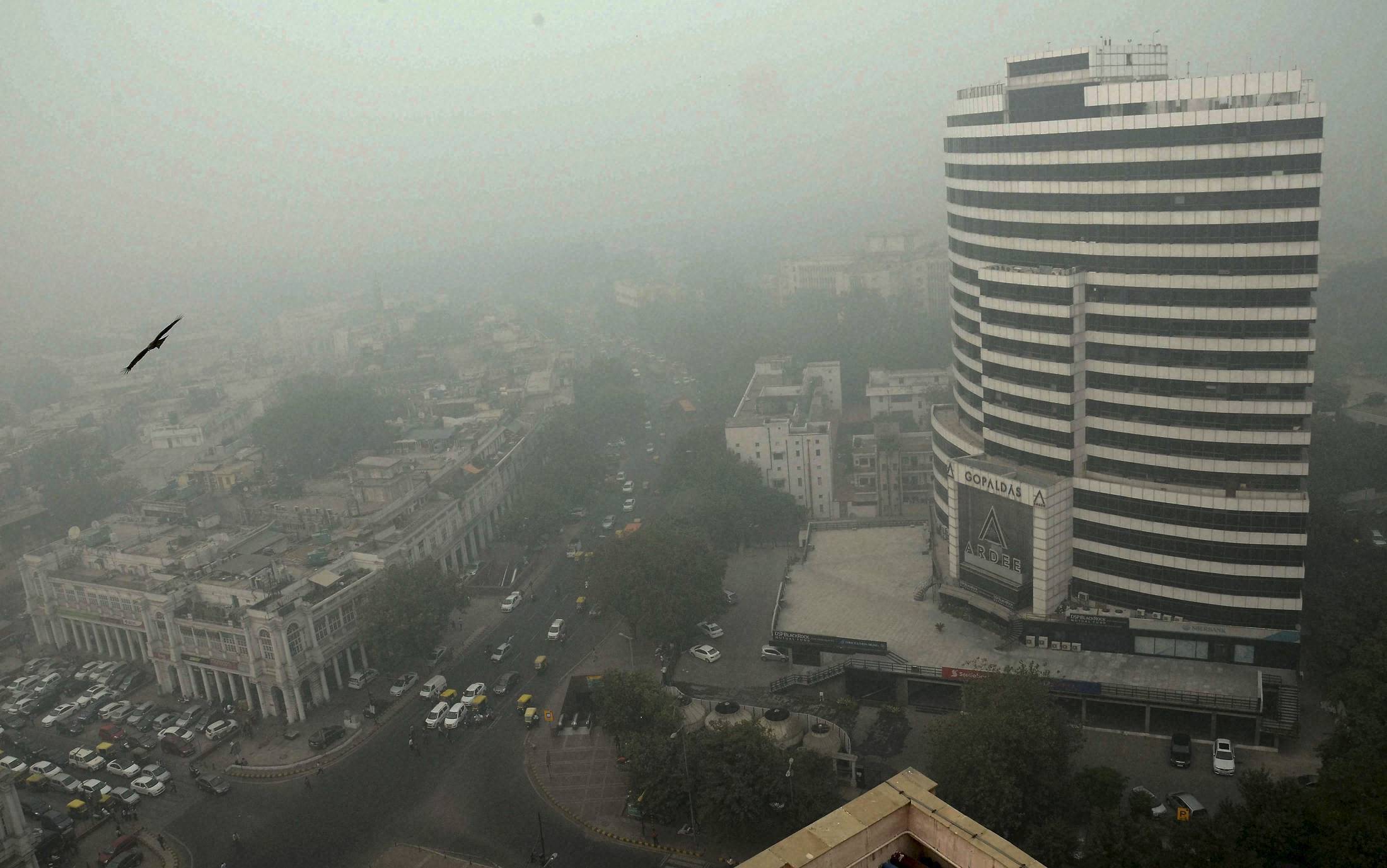
The Supreme Court on Friday gave its nod to the Centre's graded response action plan to tackle different levels of pollution and asked the Central Pollution Control Board (CPCB) to upgrade its existing infrastructure and set up additional monitoring stations in Delhi-NCR within six months.
Terming as "severe" levels of pollution when particulate matter (PM) 2.5 levels are above 250 to 430 micrograms per cubic metre in the ambient air, the Centre told a bench headed by Chief Justice T S Thakur that when air pollution reaches such alarming proportion, immediate steps are needed to be taken including ban on construction activities and implementation of odd-even scheme. The sanction came after environmentalist Sunita Narain from the Centre for Science and Environment told the bench that the Centre's graded response action plan to tackle different levels of pollution was "acceptable" and can be put into operation.
"Enforcement of graded response action plan shall be under the orders of Environment Pollution (Control and Prevention) Authority (EPCA) and all other authorities should act in aid of such direction," the bench said.
The court directed the apex pollution monitoring body to file a status report on setting up additional monitoring stations in Delhi-NCR within six months. It also directed the Centre to examine within four weeks about harmful effects of petroleum coke and furnace oil used in industries and power generation plants in NCR and issue appropriate directions in this regard.
Solicitor General (SG) Ranjit Kumar told the bench that CPCB proposed to upgrade its centralised control room with modern equipment's at an estimated cost of Rs 57 lakhs on hardware, internet and optical fibre. CPCB also plans to set up 12 real time air monitoring stations in Uttar Pradesh, nine in Haryana, two in Rajasthan besides 20 new stations in Delhi apart from 28 existing ones, he said.
The Solicitor General also filed a compilation before the bench stating details about the system of issuing pollution under control certificates to vehicle owners and the mechanism of licensing such centres where pollution checks are carried out and certificates issued in the form of stickers.
At the outset, senior advocate Harish Salve, who is the amicus curiae in a 1985 PIL filed by environmentalist M C Mehta, told the bench also comprising Justices A K Sikri and S A Bobde that the Centre has classified three levels of pollution based on different levels of PM namely -- moderate to poor, very poor and severe.
Salve said that the Centre has recommended that whenever air pollution reaches "severe" levels, immediate action including ban on power plants and construction activities should be imposed in the national capital. He also highlighted the ill-effects of petroleum coke and furnace oil used in industries on ambient air and told the court that the emissions from such units were highly toxic as these release high sulphur.
"Delhi has already banned use of pet coke and furnace oil in industries. But, the problem has only been transferred to the neighbouring states, where these industries still use these fuel to operate which release high sulphur which greatly contributes to pollution in the region," Salve said while referring to EPCA report.
The Centre's Graded Response Action Plan for reducing air pollution has enumerated a number of measures which include closing brick kilns, hot mix plants, stone crushers, intensifying public transport services besides increase in frequency of mechanised cleaning of road and sprinkling of water on roads.
The matter would now come up for hearing in third week of January.
The court had earlier slammed CPCB for not having an action plan ready to deal with the "emergency" smog situation and asked the Centre to come out with time-bound measures to tackle the graded level of worsening air quality.

-
Navigating Friction And Energy Realities: An Analysis Of Marco Rubio's October Visit To India

Occurring at a critical juncture marked by stalled trade negotiations and escalating geopolitical pressures over global energy supplies, the visit offers a profound window into modern US-India relations.
-
India Exports Capital. Why Not Export Trusteeship?
The big question, then, is whether India can build an institution that global borrowers, investors, banks, and lawyers can trust, even without an Indian connection.
-
France's Economy & Politics Are In Crisis | The Reason Why
Let's look at how the French economy and politics evolved under Nicolas Sarkozy, Franois Hollande and Emmanuel Macron.
-
You May Inherit The Business. You Must Earn Its Credibility.
Succession tests the founder's ability to share authority as much as it tests the next generation's readiness to assume it.
-
Signing Deals Is One Thing; Making Them Work Is Another | The Week In Whys
Sometimes, things don't turn out as planned. Indian companies have lost some bids to rivals, some projects won't produce until 2030.
-
FOMC Wall, PERM Suspension, Hospital Stocks | Talking Points This Week
A PERM suspension would directly affect green-card sponsorship rather than H-1B visas, so the near-term earnings impact could remain relatively limited. The key question is whether this marks a new phase in US scrutiny of Indian IT.
-
Everything, Everywhere, All At Once: Dalal Street's Week To Forget | Joining The Dots
Visa curbs, a Starlink spat and cancer drug caps: what connects this week's shocks for Indian markets
-
India Is Going Abroad For Critical Minerals. But It May Take Years To Pay Off | The Reason Why
Although India's steps are in the right direction, they remain modest compared with India's growing dependence.
-
When Everyone Has AI, What Gives You An Edge?
India's young workforce is entering an uncertain world of work where powerful AI tools are becoming widely accessible. The advantage will belong to those who combine deep expertise with digital fluency, and the distinctly human capabilities that technology cannot manufacture.
-
Wrong Labels, High Pesticide Residues Holding Back Agri Exports | The Reason Why
India needs stronger domestic food-safety and labelling standards, with best practices becoming part of everyday business for farmers, traders and food companies.










