Bhima-Koregaon Case: Supreme Court Extends House Arrest Of Human Rights Activists
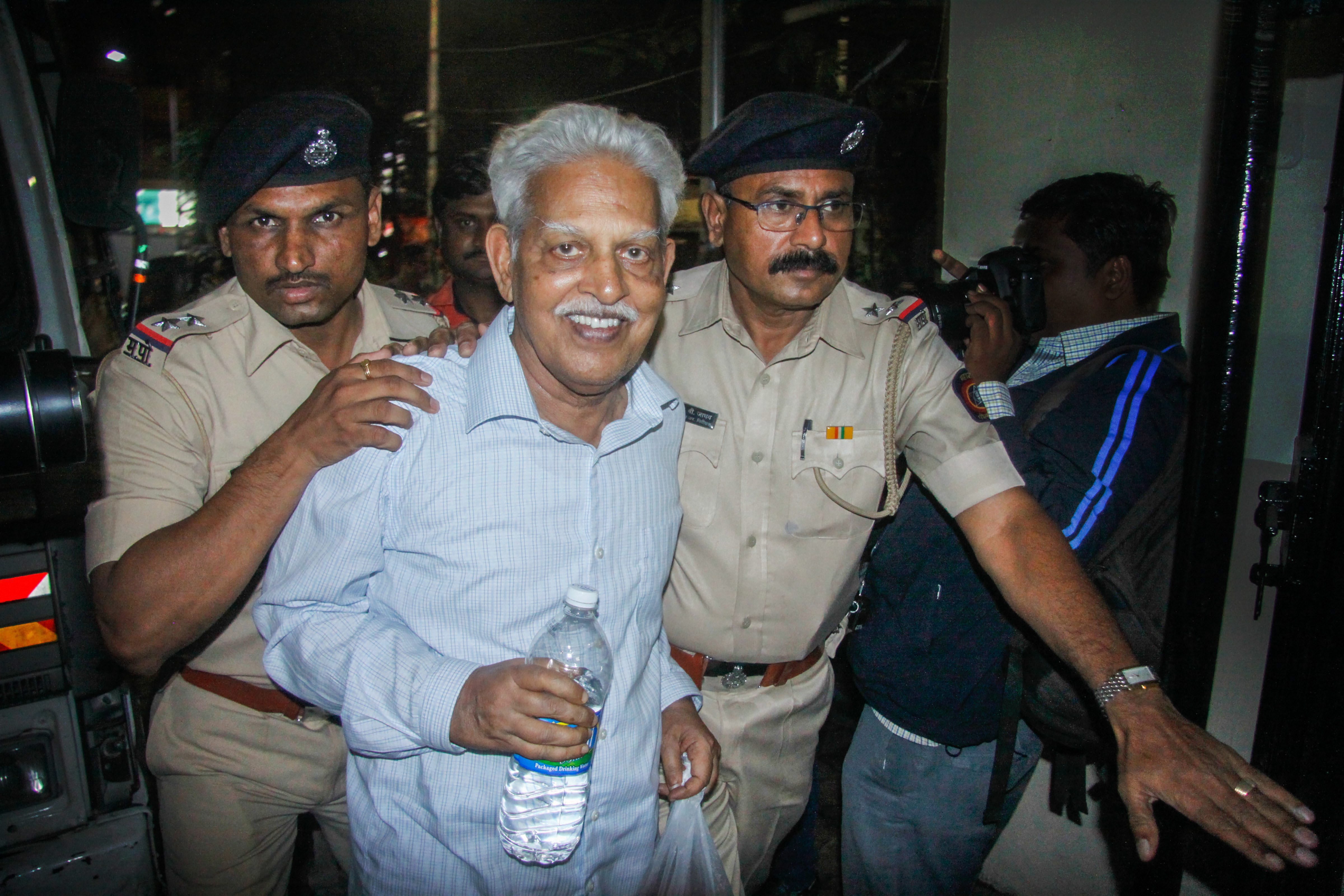
The Supreme Court today said that it would examine two days later whether there is material supporting the arrest of the five rights activists in connection with the Koregaon-Bhima violence.
A bench headed by Chief Justice Dipak Misra extended till Sept. 19 the house arrest of the five rights activists—Varavara Rao, Arun Ferreira, Vernon Gonsalves, Sudha Bharadwaj and Gautam Navlakha at their respective homes.
“Every criminal investigation is based on allegations and we have to see whether there is some material,” the bench, also comprising Justices AM Khanwilkar and DY Chandrachud said.
The bench said if there are some grave lapses, it may consider prayers like the investigation by a Special Investigating Team into the case.
The plea by Thapar and others has sought an independent probe into the arrests and the immediate release of the five activists.
The bench fixed the plea by Thapar, economists Prabhat Patnaik and Devaki Jain, sociology professor Satish Deshpande and human rights lawyer Maja Daruwala for final hearing on Wednesday. The court had on Sept. 12 extended the house arrest of the activists till today.
Additional Solicitor General Tushar Mehta, appearing for Maharashtra government, said the court should make it clear that after adjudication by it, the arrested accused cannot avail remedies simultaneously on similar issues at other judicial fora.
The Maharashtra police had arrested the rights activists on Aug. 28 in connection with an FIR lodged following a conclave—'Elgaar Parishad' held on Dec. 31 last year that later triggered violence at Koregaon-Bhima village.
Prominent Telugu poet Rao was arrested on Aug. 28 in Hyderabad, while activists Gonsalves and Ferreira were nabbed in Mumbai, trade union activist Sudha Bharadwaj in Faridabad, Haryana, and civil liberties activist Navlakha in Delhi.
The Supreme Court had on Sept. 06 taken strong exception to the statement of a senior police officer on the arrest of the activists, saying he had cast aspersions on the top court.
An irked court had referred to the statements made to the media by an Assistant Commissioner of Police of Pune and said he was casting aspersions on the apex court by saying it should not have entertained the petition against the arrests.
The Maharashtra government had told the court that the petitioners were strangers to the mater and questioned their locus. Its counsel had said there was enough evidence including the materials taken from the activists' computers and other sources which belied the perception of the petitioners about those arrested.
Senior advocate Harish Salve, the counsel for Tushar Damgude who had filed the FIR in the Koregaon-Bhima violence, had opposed the plea of Thapar and said it could have been raised in the magistrate's court by the affected parties.
Earlier, the Maharashtra government had filed its response to the plea claiming the five activists were arrested due to the cogent evidence linking them with the banned CPI (Maoist) and not because of their dissenting views.
The state's response had come in the backdrop of the apex court, while ordering the house arrest of the five activists on Aug. 29, categorically stating that dissent is the safety valve of democracy.
The court had questioned the state police's move to arrest these activists nine months after the incident and said all of them were reputed citizens and "stifling the dissent" was not good.

-
Signature Play: The Classic Cocktail Is Dead. Or Is It?

Classic cocktails are disappearing from India's cocktail menus. But they're still being ordered, taught to bartenders and borrowed from. So, who's really having the last drink?
-
A New Samvat Wishlist: Inclusive Prosperity And Human Development
India has strengthened its economic foundations through infrastructure, digital access and enterprise. Its next growth chapter must deepen productivity, create better livelihoods and widen participation in prosperity.
-
Love, Sex Aur Dhokha: The Audacious Plot To Spy On Jensen Huang
A Taipei dinner, a Singapore chip buyer and a suspected Chinese asset: inside the alleged spy operation that got close to NVIDIA's Jensen Huang.
-
Ten Things I Learnt This Samvat
Patience can be a trap. Cheap stocks can stay cheap. Leverage can wipe you out. What did Samvat 2082 teach us? Niraj Shah writes on 10 lessons from the year gone by.
-
Talking Points This Week: Tech Nerves, FII Buying, And A Faraway Banking Shock
The global markets are not shining this Diwali. The exception in the large markets is, India.
-
Midterm Rally Lasted A Day. The Hard Reality Of A Divided US May Last Two Years | Opinion
Between a contested AI boom, a debt ceiling that arrives in 2027 and a president with every incentive to act alone, the next two years may prove more volatile than the first day's rally suggests.
-
Blue Wave Will Derail the AI Trade but Won't Dismantle the AI Era | Unhedged Position
The Democrats' sweep of the US Congress will see politics collide with economic forces both over the long and short term.
-
It's Time To Take The GST Council's Bet On Trust Global
Payment records can prove India's services exports, and clear, proportionate rules can bring foreign digital sellers into the tax net.
-
Opinion | India at 38: From Innovation Overperformer to Innovation Powerhouse
India now has 453 VC-backed deep science startups, 18 of them late-stage, after 117 percent growth since 2020. Laurus Labs, at USD 9.3 billion, is the most valuable deep science company in any middle-income economy outside China.









