Gas Wars Deepen as Russia Curbs Supplies to More European Buyers
(Bloomberg) -- Russia cut off gas supplies to more European buyers, stepping up its use of energy as a weapon and sowing further division in the continent.
Gazprom PJSC halted pipeline shipments to the Netherlands and Denmark this week, and then surprised markets by also cutting off a small contract supplying Germany. Shell Plc and wind giant Orsted A/S refused to comply with President Vladimir Putin's demand for payments to be made in rubles, and Gazprom responded by halting flows.
Russia is keeping its grip on the European Union's gas market just as the bloc moved to impose its harshest energy sanctions so far in response to the invasion of Ukraine. Moscow has been sowing division in Europe for months by demanding payments in rubles for the key resource the continent can't live without.
“Putin's decision to cut gas deliveries to Denmark is pure blackmailing and completely unacceptable,” Danish Prime Minister Mette Frederiksen said on her Instagram account.
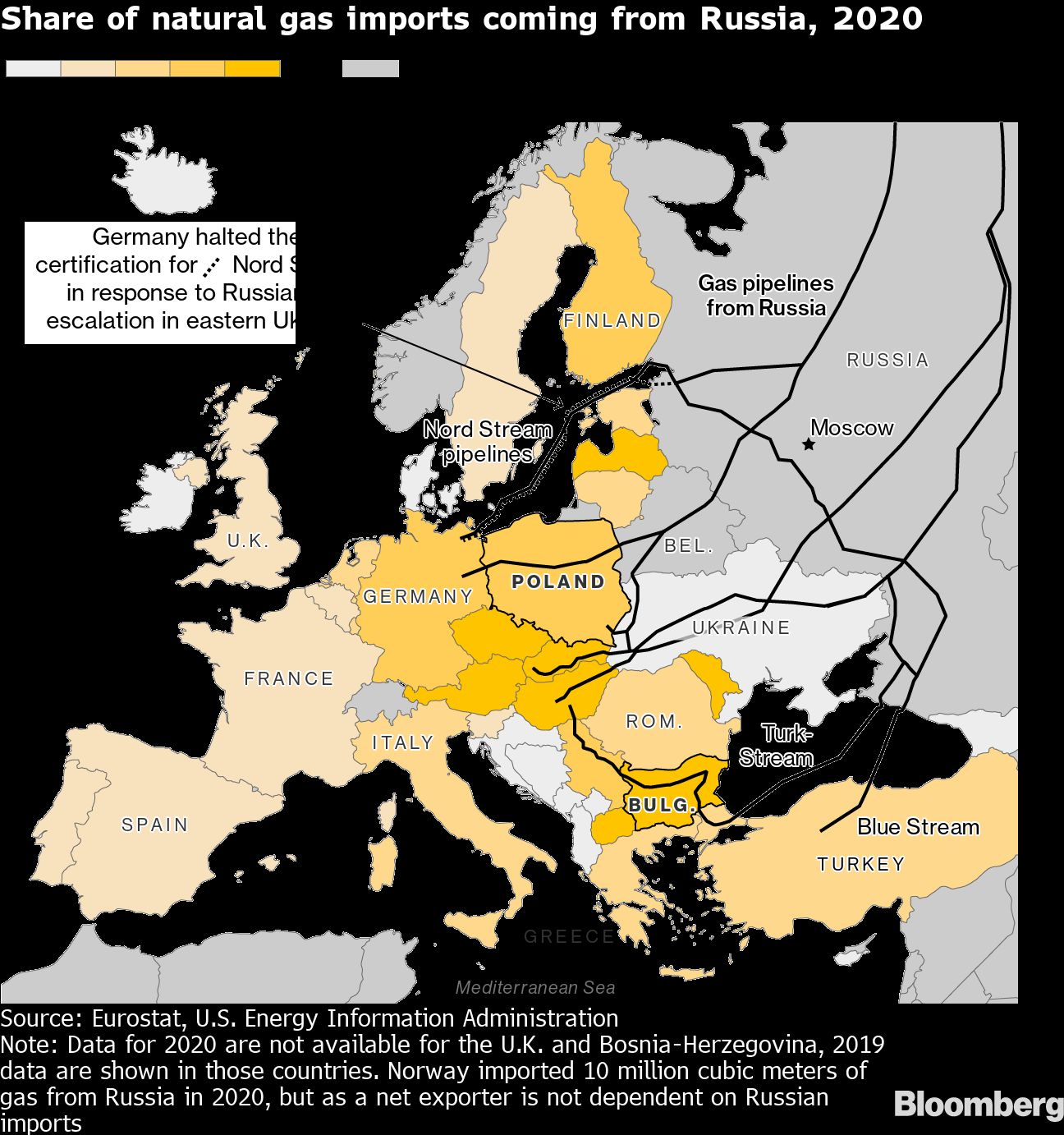
Some countries stood firm, refused to engage with the new terms that risked breaching the bloc's own sanctions, and saw their gas cut off. Poland and Bulgaria were the first to go. Elsewhere, companies such as Italy's Eni SpA and Germany's Uniper SE instead scrambled to find a way to satisfy Putin's demands without falling foul of sanctions. Their gas is uninterrupted.

Italian Prime Minister Mario Draghi said on Tuesday that Russia is treating individual countries differently. But a person familiar with Gazprom's contracts told Bloomberg that the bloc's top buyers have paid according to the new terms, and that after Shell and Orsted, no more companies will get cut off.
Read: Draghi Says Some EU Gas Buyers Get Different Treatment by Russia
After weeks of wrangling over the terms, the pattern has emerged that major buyers of Russian gas found a way to keep paying, while smaller buyers with more alternatives -- and in some cases a more hawkish approach to Moscow -- refused to cave. About 20 billion cubic meters of gas supplies have been cut off, about 15% of Europe's pipeline imports from Russia.
“This is clearly important but contracts with the majority of these buyers were either terminating this year anyway or are for relatively small volumes,” said Jonathan Stern, a distinguished research fellow at the Oxford Institute for Energy Studies. “The decisions of these buyers have not – yet – impacted the majority of Russian gas exports to Europe under long term contracts.”
The Danish cut comes just as the nation is set to vote on Wednesday on the EU military pact, a referendum the government has called in response to the invasion of Ukraine. Polls suggest the country, which has traditionally shunned deeper EU integration, will join and thereby move closer to the bloc.
Likewise, Finland saw its power exports from Russia cut two days after its leaders said they would back an application to join NATO, and gas flows ended three days after it submitted its application.
Gazprom's export arm said on Wednesday it stopped sending gas to Shell Energy Europe, impacting supplies to Germany. The Russian gas giant also cut off Denmark's Orsted on Wednesday and Dutch energy firm GasTerra BV on Tuesday.
Shell Energy Europe has a contract with Gazprom for gas supplies to Germany of as much as 1.2 billion cubic meters a year, according to the Russian exporter. That's less than 0.8% of what the Russian company supplied to the European Union last year. Germany's biggest Russian gas buyer is Uniper, which continues to receive Russian gas.
Shell said it will work to keep supplying customers in Europe through its “diverse portfolio of gas supply,” according to an emailed statement. The company “continues to work on a phased withdrawal from Russian hydrocarbons, in compliance with applicable laws and regulations.”
Orsted's long-term contract is for 20 terawatt-hours a year, or about 1.9 billion cubic meters a year. While that's just a fraction of EU's gas imports, it accounts for more than 80% of the 24 terawatt-hours Denmark imported last year.
“We stand firm in our refusal to pay in rubles, and we've been preparing for this scenario,” Orsted Chief Executive Officer Mads Nipper said in a statement. “The situation underpins the need of the EU becoming independent of Russian gas by accelerating the build-out of renewable energy.”
More stories like this are available on bloomberg.com
©2022 Bloomberg L.P.

-
Talking Points This Week: Leadership Shock At Nvidia, Earnings Strength, And The Fog Over Hormuz

The Anthropic IPO pricing and first trading day, Nvidia's upcoming earnings, and any fresh signals from Iran will set the tone for the following week.
-
Signature Play: The Classic Cocktail Is Dead. Or Is It?
Classic cocktails are disappearing from India's cocktail menus. But they're still being ordered, taught to bartenders and borrowed from. So, who's really having the last drink?
-
A New Samvat Wishlist: Inclusive Prosperity And Human Development
India has strengthened its economic foundations through infrastructure, digital access and enterprise. Its next growth chapter must deepen productivity, create better livelihoods and widen participation in prosperity.
-
Love, Sex Aur Dhokha: The Audacious Plot To Spy On Jensen Huang
A Taipei dinner, a Singapore chip buyer and a suspected Chinese asset: inside the alleged spy operation that got close to NVIDIA's Jensen Huang.
-
Ten Things I Learnt This Samvat
Patience can be a trap. Cheap stocks can stay cheap. Leverage can wipe you out. What did Samvat 2082 teach us? Niraj Shah writes on 10 lessons from the year gone by.
-
Talking Points This Week: Tech Nerves, FII Buying, And A Faraway Banking Shock
The global markets are not shining this Diwali. The exception in the large markets is, India.
-
Midterm Rally Lasted A Day. The Hard Reality Of A Divided US May Last Two Years | Opinion
Between a contested AI boom, a debt ceiling that arrives in 2027 and a president with every incentive to act alone, the next two years may prove more volatile than the first day's rally suggests.
-
Blue Wave Will Derail the AI Trade but Won't Dismantle the AI Era | Unhedged Position
The Democrats' sweep of the US Congress will see politics collide with economic forces both over the long and short term.
-
It's Time To Take The GST Council's Bet On Trust Global
Payment records can prove India's services exports, and clear, proportionate rules can bring foreign digital sellers into the tax net.
-
Opinion | India at 38: From Innovation Overperformer to Innovation Powerhouse
India now has 453 VC-backed deep science startups, 18 of them late-stage, after 117 percent growth since 2020. Laurus Labs, at USD 9.3 billion, is the most valuable deep science company in any middle-income economy outside China.









