Russia Is in Topsy-Turvy World Where Belarus Tops German Exports
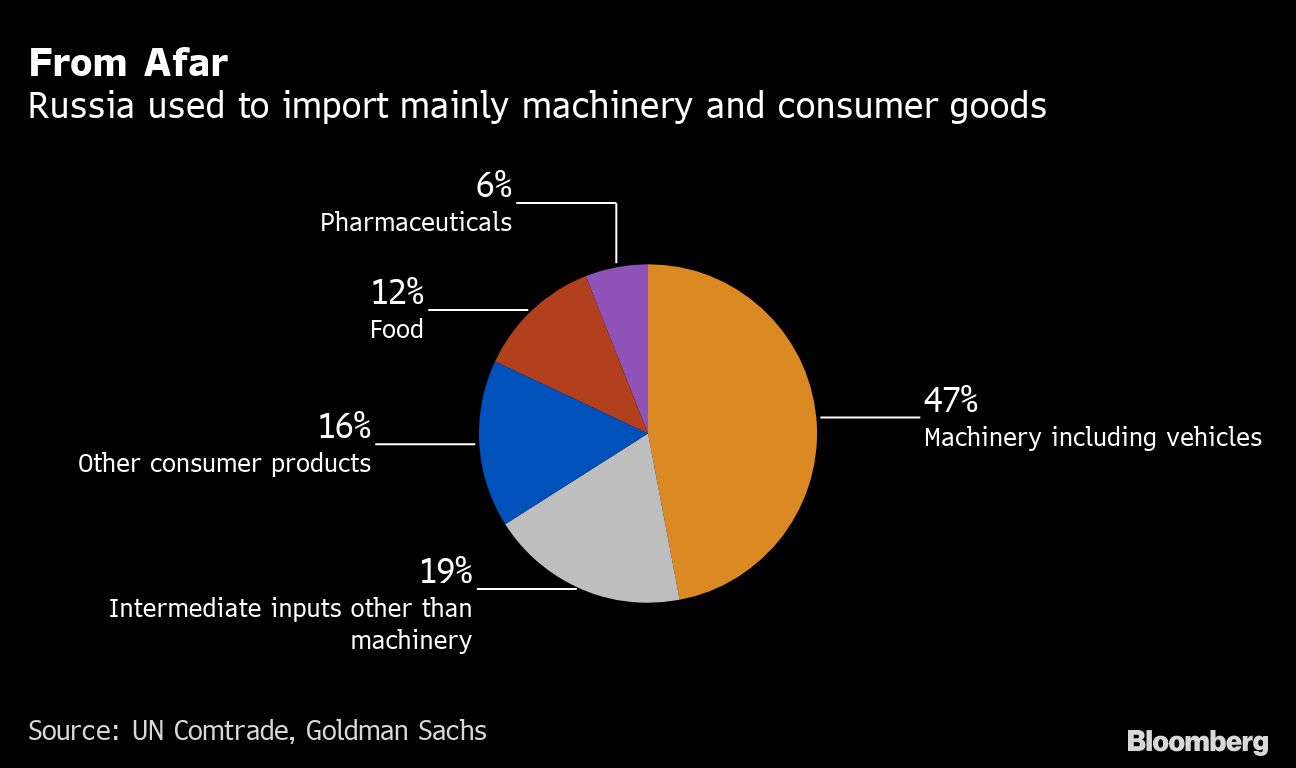
(Bloomberg) -- Russian efforts to rewire trade flows and bypass sanctions for the war in Ukraine can't make up for the collapse in imports that's crippling its economy.
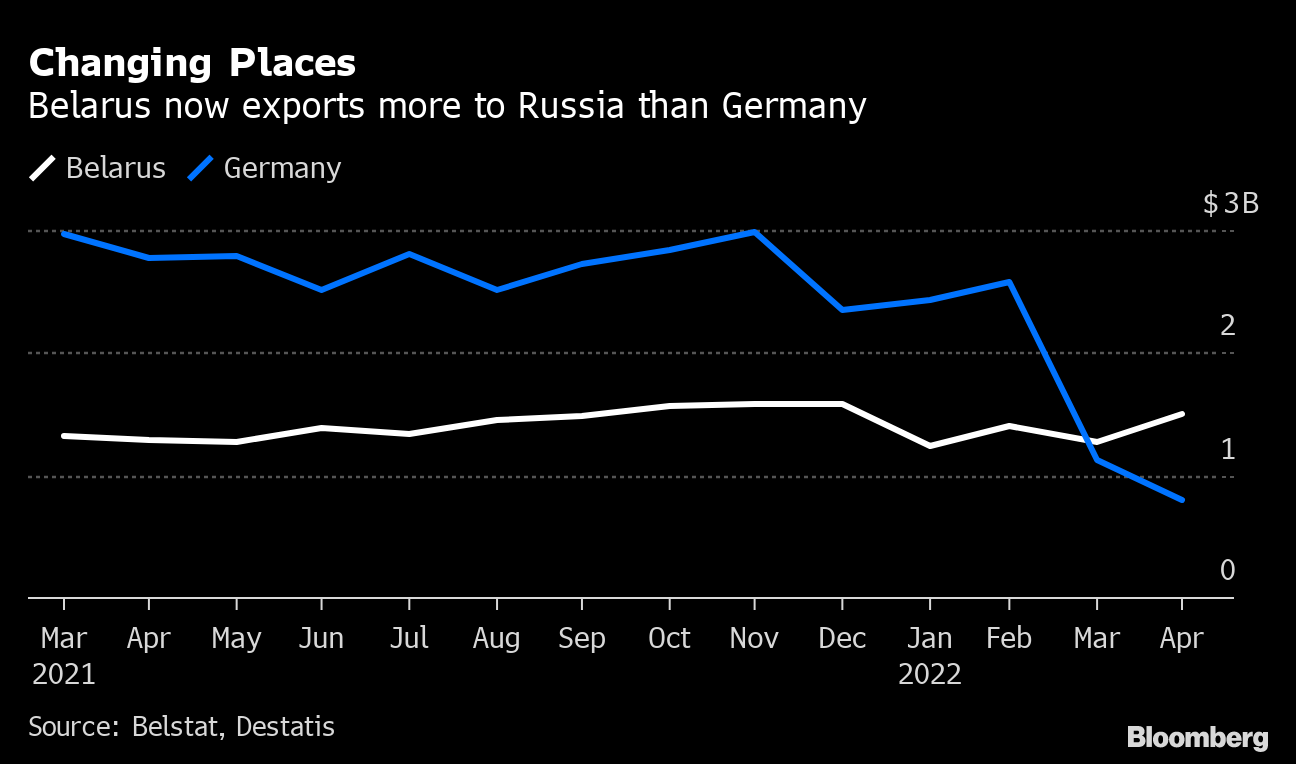
One stark result so far: For the first time, Belarus, a neighboring country that Russia used to help stage the invasion, in April leapfrogged Germany -- an economy more than 60 times bigger -- by the value of imports to Russia, according to a Bloomberg analysis of the latest data.
“The market practically crashed” this spring, said Andrey Pobezhimov, head of international logistics at SDEK, one of Russia's biggest express delivery companies. “Today it's very difficult to bring a cargo from Europe, sometimes almost impossible.”
Russia has made it harder to get an accurate read on its economy because it stopped publishing some key statistics including a detailed breakdown of imports and exports. But a picture that emerges from figures made available by Russia's biggest counterparts is of a commercial pecking order turned upside down.
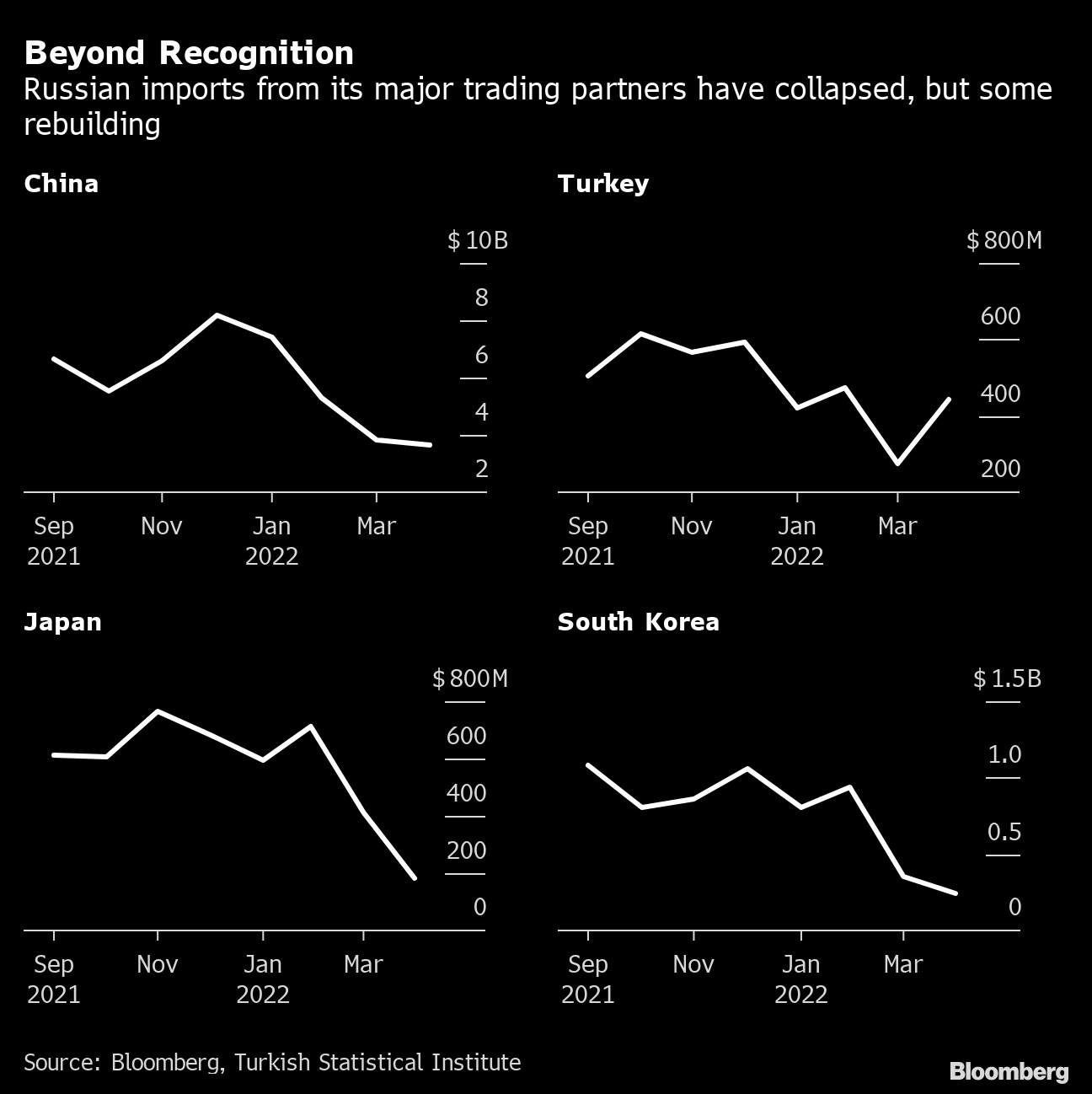
Sales to Russia from trading partners that together accounted for nearly half its imports in 2021 were down about 40% in April from a year earlier, Bloomberg calculations show. Even those, like China, which haven't joined the US and its allies in imposing sanctions, are cutting shipments of merchandise.
The invasion in late February was a moment of whiplash for an economy so woven into global commerce after three decades that its imports as a share of gross domestic product in the years before the war were notably higher than in such emerging markets as Brazil, India and China.
But since a global backlash against the war severed supply chains and prompted numerous multinationals to pull out, Russians have had to make do or learn how to navigate a new obstacle course -- sourcing ingredients from alternative foreign suppliers, scouring the world for new routes or finding other loopholes to haul in the wares. Otkritie Research estimates the value of imports in April may have plunged to as low as $5 billion, down from nearly $27 billion a year earlier.
What Our Economics Says...
“The collapse in imports is padding the current account but reflects a painful adjustment that will take time to pass through the economy. Until supply chains are reconfigured, producers will face bottlenecks and living standards are likely to deteriorate further.”
--Scott Johnson. For full analysis, click here
As trade with much of Europe dried up, Belarus is emerging as one of the main beneficiaries. Its exports to Russia of items ranging from construction materials to pet food surged by more than 100% in April when measured by value.
Boris, who owns a large supermarket chain and factories across Russia, said processing payments was initially an even bigger challenge than the delivery of shipments.
Enough workaround solutions are now available to ensure more shipments trickle through and imports start to recover, said Boris, asking to be identified only by first name to speak candidly about his business.
Long Way Down
But another major threat looms ahead as the European Union's fifth package of sanctions goes into effect in full next month. Boris, whose company relies on imports for about half the goods it sells, expects 5% of its products to vanish from store shelves.
“We've dropped a few steps but that doesn't mean we're at the landing yet,” he said. “The staircase down will be a long one.”
The collapse in imports has been one of the forces warping Russia's wartime economy and driving it toward what its central bank called “reverse industrialization.”
Car factories employing tens of thousands ground to a halt for lack of components and simple paper became scarce because manufacturers didn't have enough whitening agent. The Bank of Russia even expects some imports to shift to the “shuttle trade” seen in the 1990s, when people en masse traveled abroad to bring back goods to sell on open markets.
In the search for new ways to deliver consumer goods from abroad, Fesco, a major Russian cargo carrier, has launched a new maritime line between Vietnamese ports and its Vladivostok terminal on the Pacific coast. Its other new initiatives in April included the start of a container service between Istanbul and Novorossiysk on the Black Sea and rail shipments to western Europe.
Yet even in the government's telling, the outlook is bleak. Under the main official forecast, goods imports are set to decline by more than a quarter in real terms in 2022.
Besides cheap credit and subsidies for struggling industries, the government has also responded by canceling customs duties on numerous products and legalizing gray market sales, also known as parallel imports.
Countries such as Turkey may increasingly become conduits for imports, according to Andrej Golubchik, professor at the Russian Foreign Trade Academy. Shipments have restarted to India and the Persian Gulf by way of Iran, he said.
“Over the past two and a half months, market participants have come out of their stupor,” Golubchik said. “The first shock has almost passed.”
More stories like this are available on bloomberg.com
©2022 Bloomberg L.P.

-
Rs 50-Lakh Gold In Bank Locker, Rs 3 Lakh Of Protection: The Gap Most Families Don't Know About

The RBI ties a bank's liability to the annual locker rent and families who want to insure their jewellery face a separate question about how to prove what was inside.
-
The More Food Turns Into Fuel, The Harder It Is To Read Agricultural Markets | The Reason Why
A policy designed to reduce dependence on imported fuel can create new pressures elsewhere in the food economy.
-
Your iPhone Costs 12 Grams Of Gold, A Car About 100. What Does Your Life Weigh?
Measured in rupees, almost everything looks more expensive than it did a generation ago. Measured in grams of gold, a lot of it has become cheaper.
-
Gold Is Rs 22,000 Cheaper Than A Month Ago. Should You Buy Amid The Wedding Season?
Gold's potential slide to $3,500 could save around Rs 4,700 per 10 grams, but a soft inflation print could just as easily push prices back up. One way to split the risk is to buy in parts, some now and the rest after the Fed's Dec. 9 decision.
-
AI Agents Are Gaining Power. Who Governs Them?
Artificial intelligence agents promise to transform productivity by moving machines from assisting decisions to executing them. But as organisations delegate greater authority to these AI-agents, they must first establish who controls that authority and who remains accountable when things go wrong.
-
Why Swapping Your Old Gold Can Trigger A Rs 5 Lakh Tax Bill, And How You Can Avoid It Legally
Swapping old gold for new is taxed as a sale and a fresh purchase. Getting your own gold remade can cut most of that bill, though it has its own costs.
-
The AI Trade is Done. The Real Opportunity for Investors Starts in 2027 | Unhedged Position
As pureplay AI stocks plunge and circular, capex-led financing unwinds, 2027 is set to be a year of reckoning for AI companies. Yet the bust clears the way for a better opportunity for investors in 2027 -- shifting the spotlight from AI builders to the companies using AI.
-
Leadership As Mission: Why The Age Of AI Demands More Human Leadership
Debjani Ghosh examines how AI is changing leadership, arguing that its success must be measured by its impact on people and the accountability of those guiding its use.
-
We May Need Another Tukaram Mundhe To Fight Air Pollution | The Reason Why
Developers may install basic measures such as sprinklers and green nets, resume work, and continue violating rules when this equipment stops working.
-
Extracting Value From Battery Scrap Could Be Challenging For India | The Reason Why
A discarded lithium-ion battery still contains valuable materials such as lithium, nickel and cobalt. These can be recovered and reused. When such batteries are crushed and shredded, they produce a dark powder called black mass.









