Putin Thinks His Biggest Ally In Ukraine Is Time
(Bloomberg) -- As Russia's invasion of Ukraine settles into a grinding war of attrition, one question more than any other will likely decide the outcome: On whose side is time?
Much of what unfolds will be determined by unpredictable battlefield dynamics, especially as Russian forces attempt a dash for territory in eastern Ukraine before heavy artillery from the US and elsewhere arrives to bolster the defenses they have to overcome.

On Tuesday, US President Joe Biden wrote in the New York Times that he had decided to approve the provision of 80 km (50 mile) range multiple launch rocket systems to Ukraine, the most powerful artillery sent to date.
Old-Fashioned Artillery Proves a Big Plus for Ukraine's Forces
Yet as time passes, the wider economic and political vulnerabilities -- the prospect of fading international support for Ukraine and failing industrial components for Russia -- will become at least as important. And given the severity of the war's impact on the global economy, which side buckles first may be the war's most important and difficult prediction.
For Ukraine, still out gunned, economically devastated and struggling according to military analysts to integrate a steady stream of recruits, a key risk lies in the durability of the lifeline of fiscal and military support from abroad that's helped keep in the fight.
Russia in many ways faces the opposite challenge, struggling to raise fresh troops and starved of imports, including the components needed to produce and replace guided missiles and other weapons lost at the front. As a result, the advantage for Russia on firepower looks set to erode over time.

President Vladimir Putin appears to be counting on international solidarity with Ukraine to fracture first, as economies around the world come under pressure from inflation and food shortages exacerbated by the war, as well as from divergent domestic political and security interests.
“The current state of the global economy shows that our position is right and justified,” Putin said in an address late last month to a forum of the Eurasian Economic Union, a Moscow-dominated alternative to the European Union that includes Armenia, Belarus, Kazakhstan and Kyrgyzstan.
“These advanced economies have not had such inflation for the past 40 years; unemployment is growing, logistics chains are breaking and global crises are growing in such sensitive areas as food,” Putin said. “This is no joke.”
According to Tatiana Stanovaya, founder of political consultant R.Politik, “Putin's strategy is to wait this out and he's absolutely certain that he has plenty of time because he sees the West will soon face major economic problems and popular dissatisfaction will rise.”
Similar assumptions of weakness on the part of Kyiv and its allies proved catastrophically wrong in February, when Putin sent his forces in expecting little or no resistance. “He was mistaken,” Biden wrote in his article. “If he expects that we will waver or fracture in the months to come, he is equally mistaken.”
Yet there are signs that peak support for Ukraine may be approaching. More Americans now say the government's priority should be to limit damage to the US economy than to punish Russia, according to a May 12-16 poll by The Associated Press-NORC Center for Public Affairs Research. At 51% to 45%, the result was a reversal from April, when the same questions were asked.
France, Germany and Italy, in particular, have begun to call for cease-fire talks that, if concluded today, would leave as much as 20% of Ukrainian territory under Russian control. Hungary did much to dilute and delay the partial ban on purchases of Russian oil imports that EU leaders agreed in principle this week. Turkey continues to block bids from Finland and Sweden to join the North Atlantic Treaty Organization.

Russian officials, meanwhile, appear confident they have time at least to achieve Putin's minimum goals for the “special military operation” in Ukraine, namely annexation of all of the Luhansk and Donetsk provinces that make up the eastern Donbas region.
Russia's economy has seemingly weathered the US and European sanctions onslaught better than expected so far, with the ruble strong, oil and gas revenues high and inflation expectations stabilizing. Rising oil and natural gas prices are expected to earn Russia bumper energy export revenues of $285 billion this year, creating a deep financial cushion against sanctions.
Initial gloom in the Russian business community has turned to a belief the country's forces will prevail alongside and a race to buy cheap assets left behind by exiting foreign investors, according to a businessman who regularly travels between Russia, the United Arab Emirates and the US, who also asked not to be named.
Renault SA has transferred its majority, $2.3 billion stake in car maker AvtoVAZ to Russian state entities for a token sum. Holcim Ltd., the Switzerland based cement maker, said it would sell its three Russian factories. Many others already left.
Renault Hands Lada Maker to Russia as Price of War Mounts
Yet the clock is ticking for the Russian economy, too. Gross domestic product contracted 3% in April from a year earlier after recording growth of 1.3% in March, according to an estimate by the Economy Ministry, which blamed the swing on “the unprecedented sanctions pressure” hitting transport links and consumer demand.
The central bank forecasts GDP to contract up to 10% this year and inflation to be as much as 23%. It has cited supply chain disruptions and the withdrawal of foreign companies as key drivers for a recession that would be both “transformational” and “structural.”
Among the worst hit, according to a Bank of Finland paper published last month, will be transport, from the construction of cars to planes, as well as the production of machinery and electronics. That alone could cause a net loss of 4% of GDP under current sanctions, or as much as 10% if those become more severe.
“I don't think Putin and his people really understood just how integrated into the global economy Russia has become over the last 30 years,” said Iikka Korhonen, who heads the Bank of Finland Institute for Emerging Economies. The resulting scarcity of advanced imports is destroying productive jobs, a process likely to accelerate as inventories draw down and irreplaceable components break in the months to come, he said.
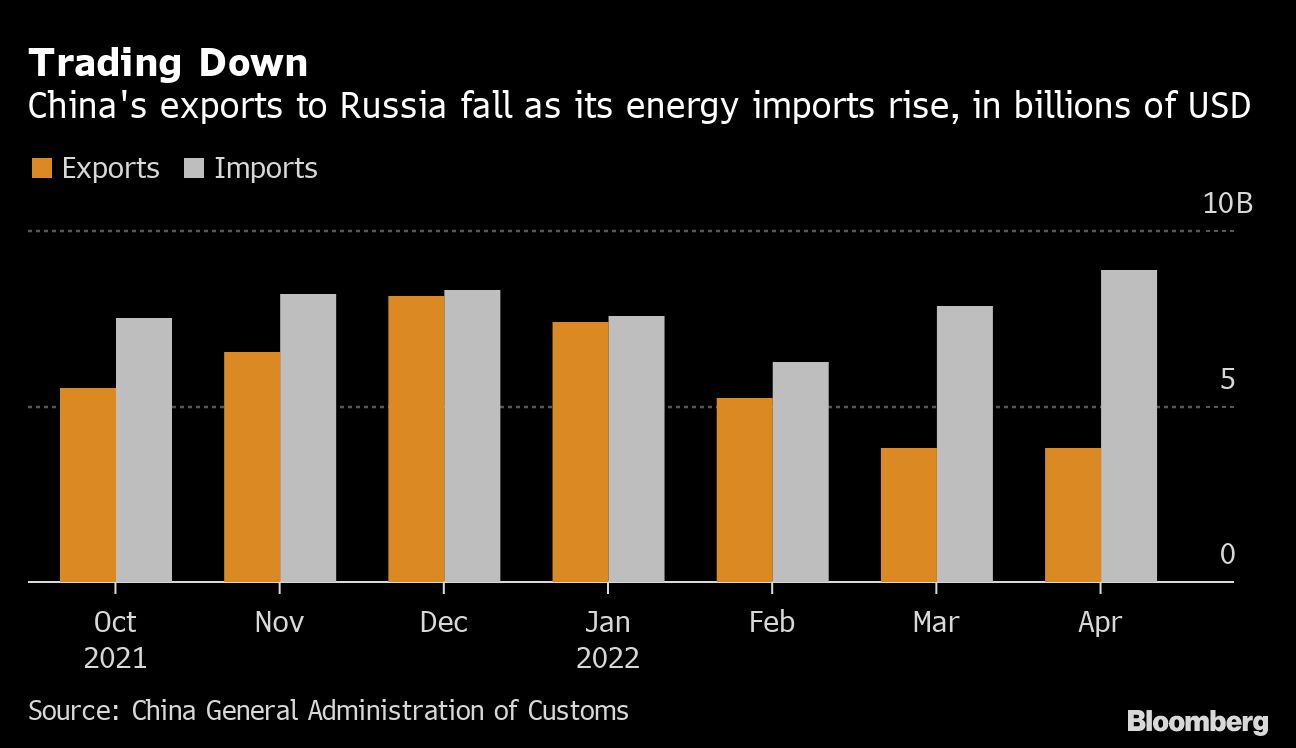
Russia's car industry, the most dependent on foreign inputs, already ground to a halt, with plants shutting down for lack of parts and year-on-year sales dropping 79% in April. Even Russian imports from China fell sharply this year, as sanctions forced Russia's decoupling from the global economy.

“People focus so much on financial variables like the ruble right now, but I think the key variable won't be any of those, it will be what happens in the real economy,” says Branko Milanovic, a former World Bank economist now at the City University of New York's Stone Center on Socio-Economic Inequality.
Milanovic sees Russia embarked on a unique experiment, substituting high tech imports with components from an ex-Soviet industrial base that's now 30 years or more old. That looks set to involve, he said, building Lada cars without airbags or navigation systems, and expanding production of Tupolev passenger jets.

Almost every manufacturing process in Russia by now relies on imports of foreign components, from Taiwanese silicon chips, to the widgets in basic factory machinery, to the Siemens X-Ray machines on which security systems at Russian airports largely rely, according to Milanovic. Which can be replicated at home or imported from China, and which are irreplaceable, will emerge only piecemeal and over time.
“It's the O-ring theory of economic breakdown,” Milanovic said, referring to the faulty rubber seals that doomed the U.S. Challenger space shuttle in 1986, “when you're missing just one part without which you can't continue.”
More stories like this are available on bloomberg.com
©2022 Bloomberg L.P.

-
Talking Points This Week: Leadership Shock At Nvidia, Earnings Strength, And The Fog Over Hormuz

The Anthropic IPO pricing and first trading day, Nvidia's upcoming earnings, and any fresh signals from Iran will set the tone for the following week.
-
Signature Play: The Classic Cocktail Is Dead. Or Is It?
Classic cocktails are disappearing from India's cocktail menus. But they're still being ordered, taught to bartenders and borrowed from. So, who's really having the last drink?
-
A New Samvat Wishlist: Inclusive Prosperity And Human Development
India has strengthened its economic foundations through infrastructure, digital access and enterprise. Its next growth chapter must deepen productivity, create better livelihoods and widen participation in prosperity.
-
Love, Sex Aur Dhokha: The Audacious Plot To Spy On Jensen Huang
A Taipei dinner, a Singapore chip buyer and a suspected Chinese asset: inside the alleged spy operation that got close to NVIDIA's Jensen Huang.
-
Ten Things I Learnt This Samvat
Patience can be a trap. Cheap stocks can stay cheap. Leverage can wipe you out. What did Samvat 2082 teach us? Niraj Shah writes on 10 lessons from the year gone by.
-
Talking Points This Week: Tech Nerves, FII Buying, And A Faraway Banking Shock
The global markets are not shining this Diwali. The exception in the large markets is, India.
-
Midterm Rally Lasted A Day. The Hard Reality Of A Divided US May Last Two Years | Opinion
Between a contested AI boom, a debt ceiling that arrives in 2027 and a president with every incentive to act alone, the next two years may prove more volatile than the first day's rally suggests.
-
Blue Wave Will Derail the AI Trade but Won't Dismantle the AI Era | Unhedged Position
The Democrats' sweep of the US Congress will see politics collide with economic forces both over the long and short term.
-
It's Time To Take The GST Council's Bet On Trust Global
Payment records can prove India's services exports, and clear, proportionate rules can bring foreign digital sellers into the tax net.
-
Opinion | India at 38: From Innovation Overperformer to Innovation Powerhouse
India now has 453 VC-backed deep science startups, 18 of them late-stage, after 117 percent growth since 2020. Laurus Labs, at USD 9.3 billion, is the most valuable deep science company in any middle-income economy outside China.









