Patidars, OBCs Have an Edge in Vijay Rupani’s Govt
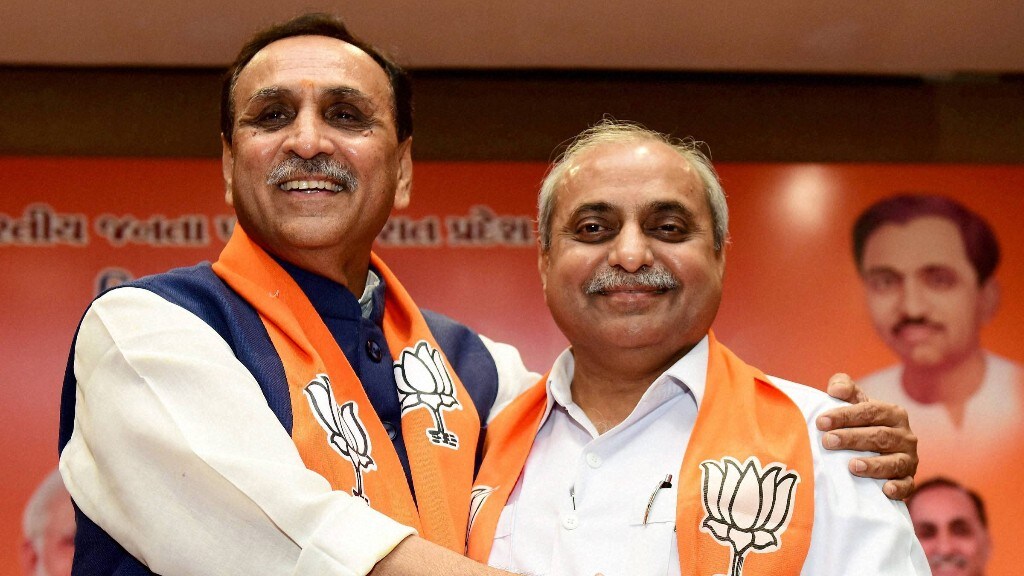
Heralding a new term in Gujarat, the Bharatiya Janata Party (BJP) resorted to a show of strength during Chief Minister Vijay Rupani's swearing-in ceremony in Gandhinagar on Tuesday, 26 December.
In all, 18 chief ministers from BJP-ruled states were present on the dais, including Bihar Chief Minister Nitish Kumar, along with Prime Minister Narendra Modi and BJP president Amit Shah. Other dignitaries included senior BJP leader LK Advani and Union Ministers Rajnath Singh and Ravi Shankar Prasad.
The ceremony also saw the presence of former BJP stalwarts Keshubhai Patel and Shankersinh Vaghela, as well as former chief minister Anandiben Patel. The ceremony saw 19 ministers take the oath of office, including Deputy Chief Minister Nitin Patel, at the helipad ground inside the new Secretariat complex in Gandhinagar.
In all, 10 ministers have been retained from the old Cabinet, whereas nine are new ministers.

Patidars Have the Edge
Of the 19 ministers who took oath on Tuesday, six are Patidars and five are from Other Backward Classes (OBC). While three ministers are from Scheduled Tribes (ST), three have been inducted from the Kshatriya community. The Cabinet also consists of one Scheduled Caste person and one Brahmin.
Clearly, the saffron party understands the importance of Patidars and OBCs, keeping in mind the caste equations for the 2019 elections.
By inducting three Scheduled Tribes MLAs, the BJP has ensured that the tribal belt of Gujarat votes in favour of the party in 2019.
The New, the Renewed and the Rejected
The BJP lost six ministers in the recently-concluded Assembly polls, along with House Speaker Ramanlal Vora. As a result, new faces were seen on the dais taking oath. Two-time former state BJP president RC Faldu made his debut along with Kaushik Patel and Ishwarbhai Parmar. Prominent names that have been dropped are Chiman Sapariya, Atmaram Parmar and Babubhai Bokhiria
State Education Minister Bhupindersinh Chudasma, former finance minister Saurabh Patel, Minister for Food, Civil Supply and Consumer Affairs Jayesh Radadiya; Labour and Employment Minister Dilipkumar Thakor, and Tourism and Tribal Welfare Minister Ganpat Vasava were retained in the Cabinet.

Ramanlal Patkar, Parbat Patel, Vasan Ahir, Kishore Kanani, and Vibhavari Dave were sworn in as the new Ministers of State.
Meanwhile, Minister of State for Home Pradisinh Jadeja, Minister of State for Fisheries Parshottam Solanki; Minister of State for Cooperation Ishwarsinh Patel, Minister of State for Animal Husbandry Bachubhai Khabad, and Minister of State for Higher Education Jaydrathsinh Parmar have also been retained by the new government.
The party has also dropped many holding the Minister of State portfolio – Shankar Chaudhury, Jayantibhai Kavadiya, Nanubhai Vanani; Jasha Barad, Vallabh Kakadiya, Rajendra Trivedi, Keshaji Chauhan; Rohit Patel, Vallabh Vaghasiya, Shabdsharan Tadvi, and Nirmala Wadhwani.
The distribution of portfolios will be decided on Wednesday, 27 December.

The General Elections
With the Assembly elections having concluded, the BJP is keen on repeating its performance of 2014 when the Modi-wave swept the state clean. However, looking at the party's performance in 2017, the same outcome looks unlikely for the saffron party.
The BJP's agenda is divided between development and Hindutva, which was on display during poll campaigning for the Assembly elections.
Both PM Modi and Amit Shah, who hail from Gujarat, understand that something special is needed to win all the 26 Lok Sabha seats in the state. Political analysts believe that the soft spoken Rupani will not last till the general elections, and will be replaced by someone who can campaign boisterously for the party.
However, there is still time for that change, as the BJP doesn't want to show chinks in its armour by replacing the sitting Chief Minister with a new man.

-
Getting To Work Costs Women More | The Reason Why
It is not just about women paying more than men. It is about women paying much more in cities than in villages.
-
AI Bias In Investing Cannot Be Eliminated, But It Can Be Governed
Framing is a particularly important example as identical financial information presented in terms of gains rather than losses can lead an LLM to reach a different assessment.
-
Joining The Dots | Dark Skies, Steady Diya: Why Hope Holds This Diwali
With war, a weak rupee and foreign outflows weighing on sentiment, policymakers at the NDTV World Summit and market veterans at NDTV Profit Ignite: Diwali Edition offered the same advice: stay invested and filter out the noise.
-
The Curious Case of Equitas Small Finance Bank And A CEO Who Quit For Stock
PN Vasudevan believes persistent investor concerns over a perceived conflict of interest had become a governance overhang on Equitas Small Finance Bank's stock, even as the lender improved profitability and asset quality.
-
Talking Points This Week: AI Cash Burn, A Tiger Comeback And An India That Still Finds Its Own Path
India is not immune to higher oil or tighter global liquidity, yet its earnings base is broader, its domestic policy levers are still available.
-
Foreign Investors Own Half Of HDFC Bank and ICICI Bank. An LTCG Cut Could Matter Most Here
Foreign portfolio investors have US$115 billion parked in HDFC Bank, ICICI Bank. If the government cuts long-term capital gains tax, Jefferies says returning foreign money could land here first.
-
'Never Seen This Level Of Negativity': Sandeep Tandon Says The Next Rally May Be Closer Than You Think
Veteran investor Sandeep Tandon says foreign selling is easing, large-caps are due a comeback and mid-caps are crowded, while he turns positive on gold, power and pharma this Diwali.
-
Indians Stay With Family, Not In Hotels | The Reason Why
India still lacks enough clean, reliable and affordable hotels for budget-conscious travellers.
-
The Economic Imperative: Analysing The Material Driving Force Behind India-Canada Strategic Reset
This economic complementarity is further reinforced by deep institutional investment ties and talent mobility, which form the bedrock of the bilateral framework.
-
Medicine Pricing: Where Must Profit Stop?
India must confront excessive margins, hidden incentives and regulatory gaps that threaten the integrity of medicine.










