Monetary Policy: Are Calls For An ‘Operation Twist’ Justified?

India's Monetary Policy Committee will conclude its fifth review of the current financial year on Thursday and chances are that another interest rate cut will be delivered. While a further easing in the policy repo rate is seen as nearly a given, the market remains focused on the lack of interest rate transmission.
135 basis points in repo rate cuts since February this year, copious amounts of banking system liquidity, and exceptionally dovish guidance, have all failed to bring down final lending rates and lift demand for credit.
Market participants are convinced that the culprit is weak transmission. And so, there are calls for the RBI to cut rates more aggressively to compensate for weak transmission. There are also calls to use bond purchases under the open market operation programme, perhaps in a manner that brings down longer-term interest rates which have been the most stubborn.
The Nuts And Bolts Of ‘Transmission'
Before we get to whether such an effort will help the Indian financial system, it is important to stop and remind ourselves how transmission takes place.
In general, a bank borrows from a central bank, such as the Reserve Bank of India, to manage any short-term liquidity mismatch. Therefore, the perception is, that any change in the cost of borrowing from the central bank has a ripple effect on the system, which adjusts to the new interest rate regime.
But it is neither that simple nor that linear.
In reality, stakeholders in the financial system develop interest rate structures based on their assessment of future expectations of interest rate and risks to those expectations. This assessment may differ across market players and the aggregate perception plays a crucial role in determining the interest rate structure across the financial system.
Yields on shorter tenor bonds, or the shorter end of the yield curve as its known in market parlance, is guided more by expectations of policy rate and system liquidity. Yields on longer tenor bonds, or the longer end of the yield curve, is guided by the expectation of inflation in the future.
The Current State Of Play
Now let's get back to the current conditions in the Indian money market.
Money market conditions prevailing today are comparable to the 2003-2004 period, when shorter term yields had fallen significantly due to the liquidity sloshing around in the system and an ultra-dovish guidance. In the current scenario, the RBI appears to have made a conscious decision to maintain a liquidity buffer against stress in the system and in order to promote stronger transmission of lower policy rates.
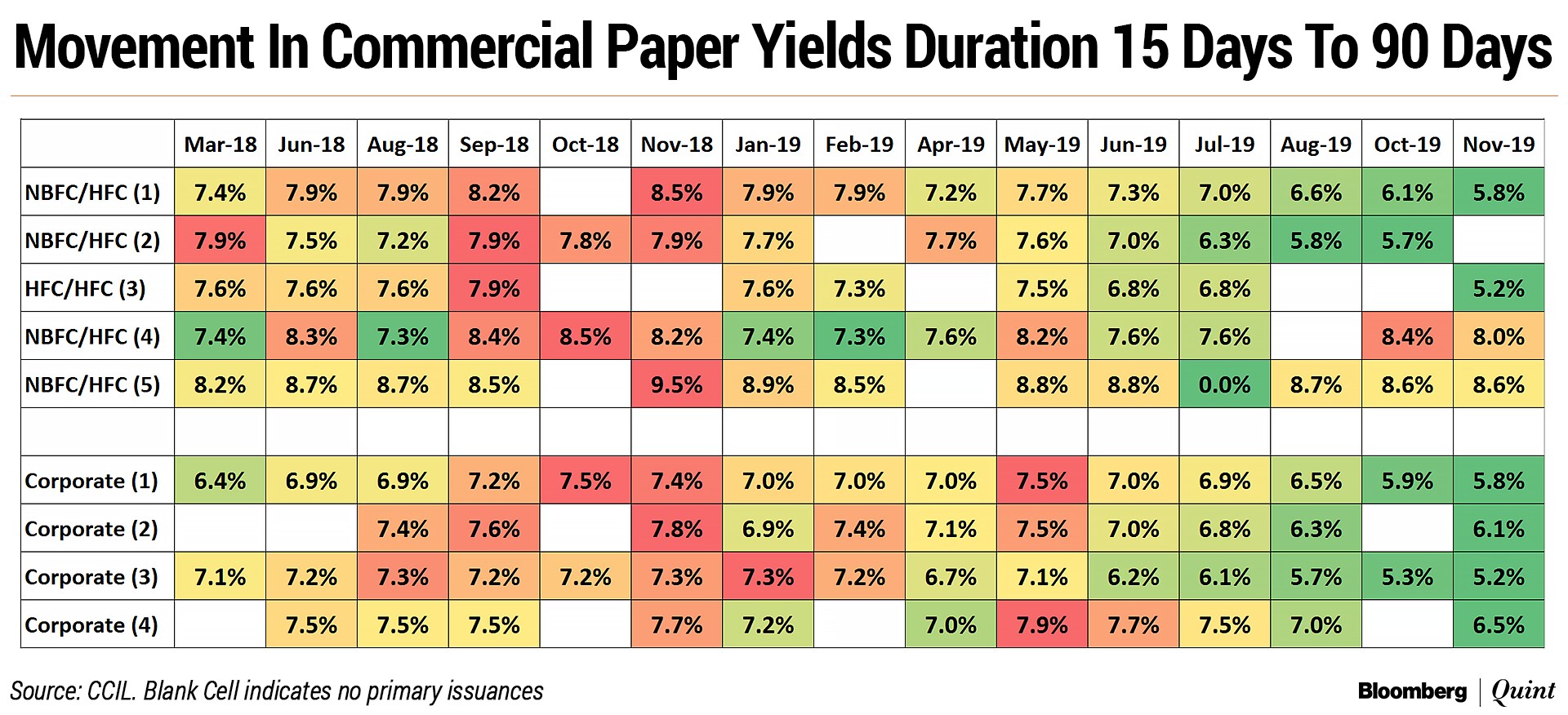
The risk-free rate or the yield on government issued treasury bills is now trading below or at par with the repo rate, having already built in the cut likely on Thursday. The three-month corporate commercial paper interest rate is now 40-50 basis points above the repo rate. For non-banking finance companies and housing finance companies, the short term borrowing rate, on average, is around 50 to 75 basis points above the policy rate. The interest rate on bank ‘certificates of deposit' used to raise bulk deposits of less than 60-days is also close to the repo rate.
However, these low rates are benefiting only a few entities, especially in the case of NBFCs and HFCs. Many other entities are still finding it difficult to access market or are paying a higher premium. This difference is attributable to the ‘credit premium' or ‘perception risk premium', which is a function of the market's view on different entities.
Enter ‘Operation Twist'
In contrast to the short term money market rates, where at least the risk-free rate has fallen, long term yields across government and private borrowers remain at elevated levels.
For instance the spread between the 10-year benchmark bond yield and the repo rate remains above 100 basis points, with the 10-year yield trading at 6.47 percent compared to the repo rate of 5.15 percent. This is largely due to concerns over the fiscal situation in India and expectations of a reversal in the growth-inflation dynamics in the foreseeable future.
Market participants are hoping that the central bank will introduce ‘Operation Twist' to bring down these long term interest rates.
Any such operation will essentially entail the RBI buying more long-term government bonds under its open market operations to pull down long-term yields. It would simultaneously sell-short term bonds to ensure that the liquidity surplus doesn't widen further.
The result, it is expected, will be a flatter yield curve.
The Financial Stability Question
Even if the RBI is leaning in the direction of an ‘Operation Twist', it needs to keep a few other issues in mind as well.
The Indian economy is evolving and greater financialisation has made the real sector more susceptible to volatility in the capital market. As such, a long period of surplus liquidity could lead to distortions in certain parts of the money market, just like a surge of liquidity post demonetisation led to a sharp fall in short term rates and induced non-bank lenders to step-up short term borrowings.
Equally, the market should not get addicted to open market purchases by the central bank any more than it is already.
The time may have also come to examine whether interest rates in India can remain below 5 percent, which was once considered a floor, for a sustained period of time. Now that retail and small business loans are linked to the repo rate, deep cuts in interest rates, which are then reversed quickly, could only end up adding to the economic uncertainty.
Soumyajit Niyogi is Associate Director at India Ratings & Research – A Fitch Group Company. Views are personal.
The views expressed here are those of the author, and do not necessarily represent the views of BloombergQuint or its editorial team.

-
The Economic Imperative: Analysing The Material Driving Force Behind India-Canada Strategic Reset

This economic complementarity is further reinforced by deep institutional investment ties and talent mobility, which form the bedrock of the bilateral framework.
-
Medicine Pricing: Where Must Profit Stop?
India must confront excessive margins, hidden incentives and regulatory gaps that threaten the integrity of medicine.
-
Why Amazon And Flipkart Are Struggling To Beat Meesho In India's Smaller Cities
With 274 million users and lowest-cost logistics, Meesho is defending its value commerce crown against giants like Amazon and Flipkart.
-
High US Salaries, No Green Card Certainty: The Financial Calculation Facing Indian H-1B Families
The suspension of PERM processing at eight technology employers does not cancel existing H-1B visas. What it does is force a question many Indian families have been avoiding: is the US salary worth tying your career and family plans to one employer?
-
Swiggy vs Eternal: Food Delivery's Two Rivals Are No Longer In The Same Race
Eternal is building a private AI assistant, dark.ai. Swiggy is still working out how to make Instamart pay, with an operating loss of Rs 895 crore in the July-September quarter while Blinkit stayed profitable.
-
Where You Live Shapes How You Get To Work | The Reason Why
Two-wheelers are the most popular way to get to work in India, accounting for nearly 43% of workplace commutes.
-
Unhedged Position: Can India See An Indonesia-Style Time Correction?
The Nifty is trading below levels it first clocked in 2024. Is there, then, as I have suggested in the headline, potential that the current time correction drags on painfully for the next three-five, even ten years?
-
Navigating Friction And Energy Realities: An Analysis Of Marco Rubio's October Visit To India
Occurring at a critical juncture marked by stalled trade negotiations and escalating geopolitical pressures over global energy supplies, the visit offers a profound window into modern US-India relations.
-
India Exports Capital. Why Not Export Trusteeship?
The big question, then, is whether India can build an institution that global borrowers, investors, banks, and lawyers can trust, even without an Indian connection.
-
France's Economy & Politics Are In Crisis | The Reason Why
Let's look at how the French economy and politics evolved under Nicolas Sarkozy, Franois Hollande and Emmanuel Macron.










