Monetary Policy: How “Temporary” Is The MPC’s Pause?

In a surprise decision, the Monetary Policy Committee, unanimously, kept the repo rate unchanged at 5.15 percent, after the five consecutive cuts since February 2019. The FY20 GDP growth projection was marked down from the earlier 6.1 percent to 5.0 percent and CPI inflation for H2FY20 was revised upward from the earlier 3.5-3.7 percent to 4.7-5.1 percent.
The forward guidance stressed that this is not the end of the rate cut cycle, as the “MPC recognises that there is monetary policy space for future action.” However, we need to re-parse the separate phrases of the reiteration of the earlier commitment to “continue with the accommodative stance as long as is necessary to revive growth, while ensuring that inflation remains within the target”.
While earlier, we read the first part “to revive growth” as the dominant objective, the emphasis has now clearly shifted to the latter part “ensuring that inflation remains within the target”.
The unchanged policy rate has re-lit a spotlight on the MPC's role as an ‘inflation targeter.'
What Made Them Do This?
So why might the MPC have unanimously chosen to pause?
First, quite explicitly, was the set of risks to inflation. There is concern that headline inflation will move up significantly, initially via food items and thereafter in the core (non-food and fuel) segment. Our own forecast of headline CPI inflation is the upper limit of the RBI forecast band, 5.1 percent.
A recovery in global growth with a resolution of trade tariff issues will raise commodity prices as well.
Forward guidance, while still reiterating, as noted above, the retention of the accommodative stance, has a new caveat on being “prudent to carefully monitor incoming data to gain clarity on the inflation outlook”. The earlier policy review's minutes showed some members expressing concerns with words to the same effect, but this concern is now shared by all members.
A large part of this concern on inflation would have arisen from responses in RBI's household inflation expectations survey. The statement reports that expectations increased in the November 2019 Survey by 120 basis points over a three-month horizon and 180 basis points over a one-year horizon.
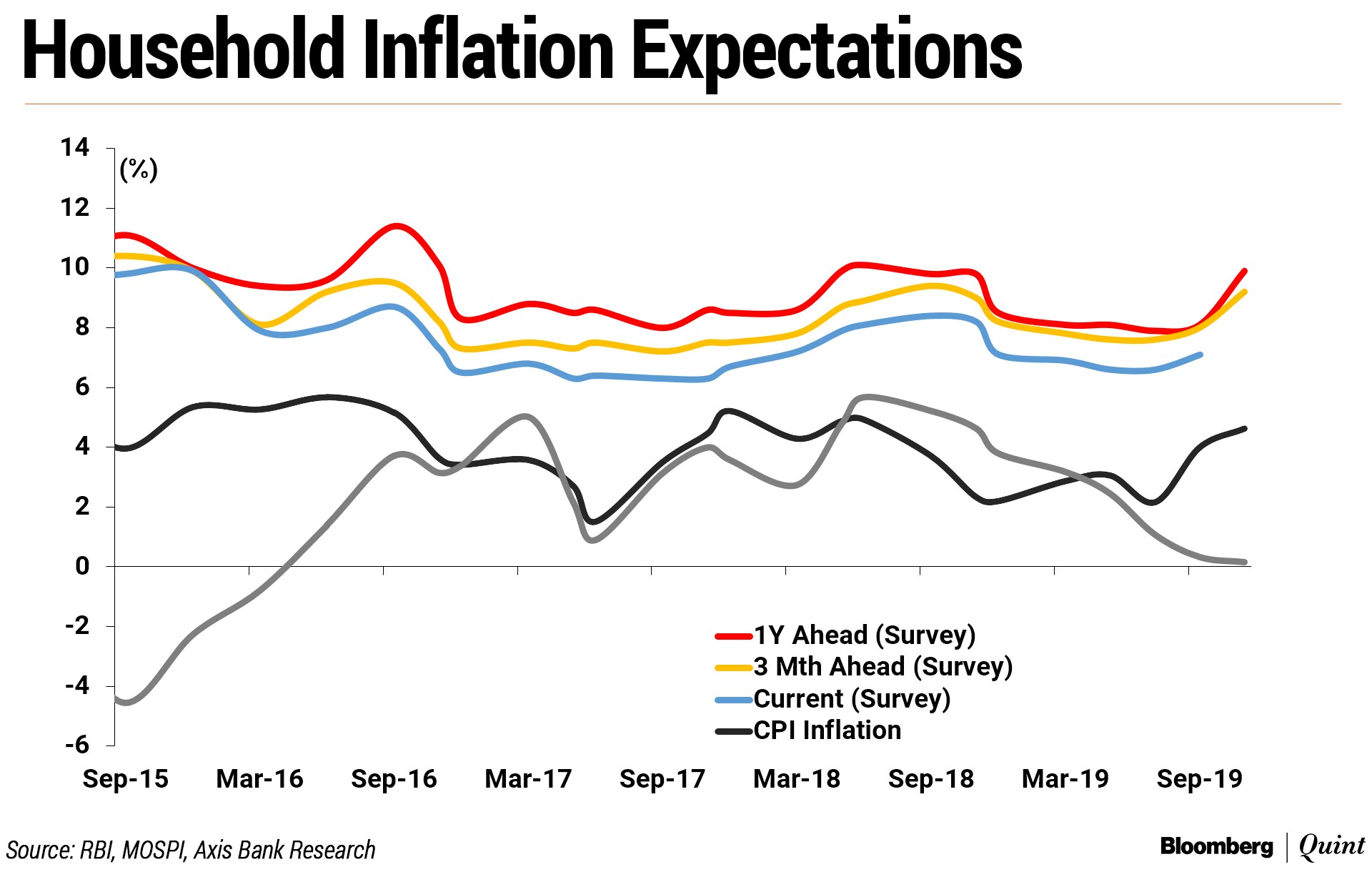
This is the second round after September that expectations have risen, although the earlier rise was much more moderate at 40 basis points and 20 basis points respectively. Before that, these expectations had fallen by 220 basis points and 210 basis points from the highs in Sept 2018. Moreover, household inflation expectations seem to have overridden, in MPC's perception, expectations of manufacturing firms who reported “weak demand conditions, reduced input price pressures and muted output prices reflecting further weakening of pricing power”.
Second, there is an implicit concern of fiscal slippages. While the statement does not explicitly state this, the comment that “the forthcoming Union Budget will provide better insight into further measures to be undertaken by the Government …” is a pointer to uncertainty regarding potential fiscal slippages and the extent of deviation from the stated consolidation glide path. The next policy review, incidentally, is on Feb. 5, 2020, and the FY21 Union Budget is scheduled on Feb. 1.
Where From Here?
So, forward guidance notwithstanding, is this the end of the rate cut cycle? Given RBI's projections of growth and inflation over the next nine months, initial reactions would suggest so. Although CPI is projected to reverse down to 3.8-4.0 percent in H1FY21, GDP growth is projected to improve gradually to 4.9-5.5 percent in H2FY20 and 5.9-6.3 percent in H1FY21. Although this looks somewhat optimistic as of now, even a somewhat lower trajectory would obviate the need to use the available “monetary policy space for future action”.
The counter-argument is that RBI's Industrial Outlook Survey responses indicate only a “marginal pickup in business sentiments in Q4”. Coupled with the sharp fall in reported capacity utilisation from 73.6 percent in Q1 to 68.9 percent in Q2 (seasonally adjusted, from 74.6 percent to 69.8 percent), although reflective of the past than of the future, this indicates a further widening of the “negative output gap”.
Although backward-looking, this level of weakness warrants careful scrutiny of the “green shoots” peeping in the October-November high-frequency activity indicators.
Facilitating larger credit flows will be a key component in the expected growth revival. A very sharp drop in the flow of credit, particularly to the commercial sector, has been a defining feature of the current slowdown. Unclogging credit lines will have to be a major objective in the set of policy responses to revive growth. RBI has, in past policy reviews, relaxed micro-prudential norms for loans to NBFCs, MSMEs, retail credit and other stressed segments, but has taken great care to calibrate these relaxations in the current stressed environment. The centre has reinforced these with proposals for credit guarantee schemes and funds to increase credit flows to some sectors. These programmes need to be expeditiously implemented to mitigate some of the credit squeeze.
Transmission to bank lending and market rates has accelerated in recent months and will continue as banks cut deposit interest rates if liquidity continues to be surplus, as we expect.
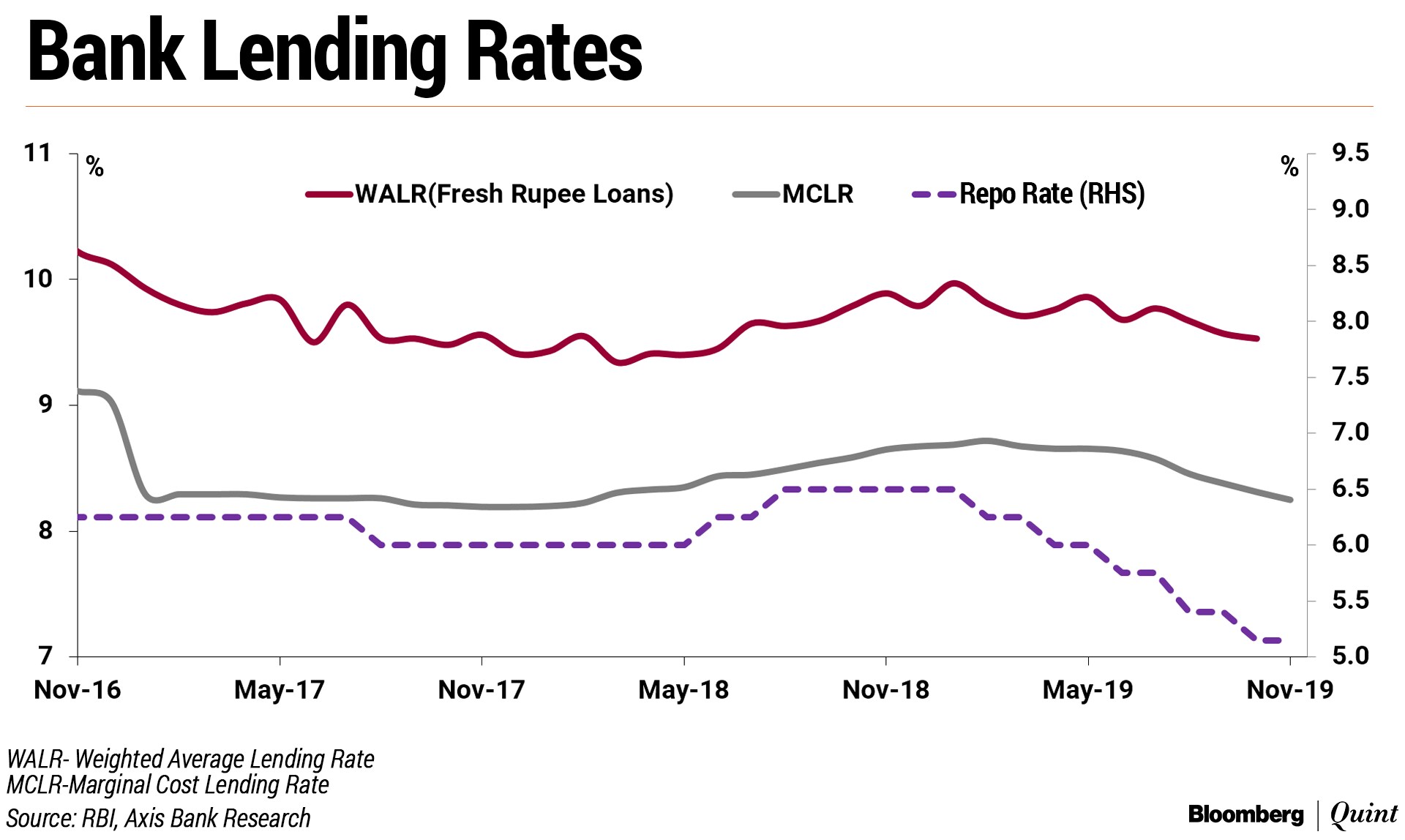
Lending rates on a widening portfolio of loans linked to market benchmarks will also help. However, despite this surplus, spreads of many market interest rates over the repo rate have continued to be sticky and some, probably reflecting credit risk, have actually increased. The former is best reflected in the sovereign 10-year benchmark bond yield, reflecting inter alia concerns on the fiscal deficit, and leads to the broader question on the room for a fiscal stimulus to support monetary policy easing.
Saugata Bhattacharya is the Chief Economist at Axis Bank. Views are personal.
The views expressed here are those of the author, and do not necessarily represent the views of BloombergQuint or its editorial team.

-
The Economic Imperative: Analysing The Material Driving Force Behind India-Canada Strategic Reset

This economic complementarity is further reinforced by deep institutional investment ties and talent mobility, which form the bedrock of the bilateral framework.
-
Medicine Pricing: Where Must Profit Stop?
India must confront excessive margins, hidden incentives and regulatory gaps that threaten the integrity of medicine.
-
Why Amazon And Flipkart Are Struggling To Beat Meesho In India's Smaller Cities
With 274 million users and lowest-cost logistics, Meesho is defending its value commerce crown against giants like Amazon and Flipkart.
-
High US Salaries, No Green Card Certainty: The Financial Calculation Facing Indian H-1B Families
The suspension of PERM processing at eight technology employers does not cancel existing H-1B visas. What it does is force a question many Indian families have been avoiding: is the US salary worth tying your career and family plans to one employer?
-
Swiggy vs Eternal: Food Delivery's Two Rivals Are No Longer In The Same Race
Eternal is building a private AI assistant, dark.ai. Swiggy is still working out how to make Instamart pay, with an operating loss of Rs 895 crore in the July-September quarter while Blinkit stayed profitable.
-
Where You Live Shapes How You Get To Work | The Reason Why
Two-wheelers are the most popular way to get to work in India, accounting for nearly 43% of workplace commutes.
-
Unhedged Position: Can India See An Indonesia-Style Time Correction?
The Nifty is trading below levels it first clocked in 2024. Is there, then, as I have suggested in the headline, potential that the current time correction drags on painfully for the next three-five, even ten years?
-
Navigating Friction And Energy Realities: An Analysis Of Marco Rubio's October Visit To India
Occurring at a critical juncture marked by stalled trade negotiations and escalating geopolitical pressures over global energy supplies, the visit offers a profound window into modern US-India relations.
-
India Exports Capital. Why Not Export Trusteeship?
The big question, then, is whether India can build an institution that global borrowers, investors, banks, and lawyers can trust, even without an Indian connection.
-
France's Economy & Politics Are In Crisis | The Reason Why
Let's look at how the French economy and politics evolved under Nicolas Sarkozy, Franois Hollande and Emmanuel Macron.










