Monetary Policy: A Tilt Back Towards ‘Normalcy’

There is usually a palpable sense of relief that comes from returning to a state of ‘normalcy' and following a set routine. In these unprecedented times, Reserve Bank of India is helping to restore our sense of equilibrium by moving back to a pre-announced date for holding its monetary policy meetings. This is a welcome sign that times could be changing. To an extent, it signals a possible end to the atmosphere of uncertainty and the need for emergency response mechanisms, which would allow policy responses to move back within predictable parameters.
However, the economic backdrop against which the meeting took place remains anything but normal. The monetary policy committee has its work cut out with inflation creeping above the target band even as growth prospects remain anemic. After a series of emergency actions, the MPC took comfort in pledging adherence to its inflation-targeting mandate, leaving policy settings unchanged, with a promise to keep the need for a growth revival at the centre of its future policy deliberations.
Governor Das reiterated that supporting a rebound in the economy remains the primary task. But with the worst of the growth shocks seemingly behind us, the policy decision on Thursday established that inflation remaining within the mandated target range remains a prerequisite for further policy easing going forward. The MPC now appears set to use its remaining monetary ammunition sparingly, as it awaits a “durable reduction” in inflation.
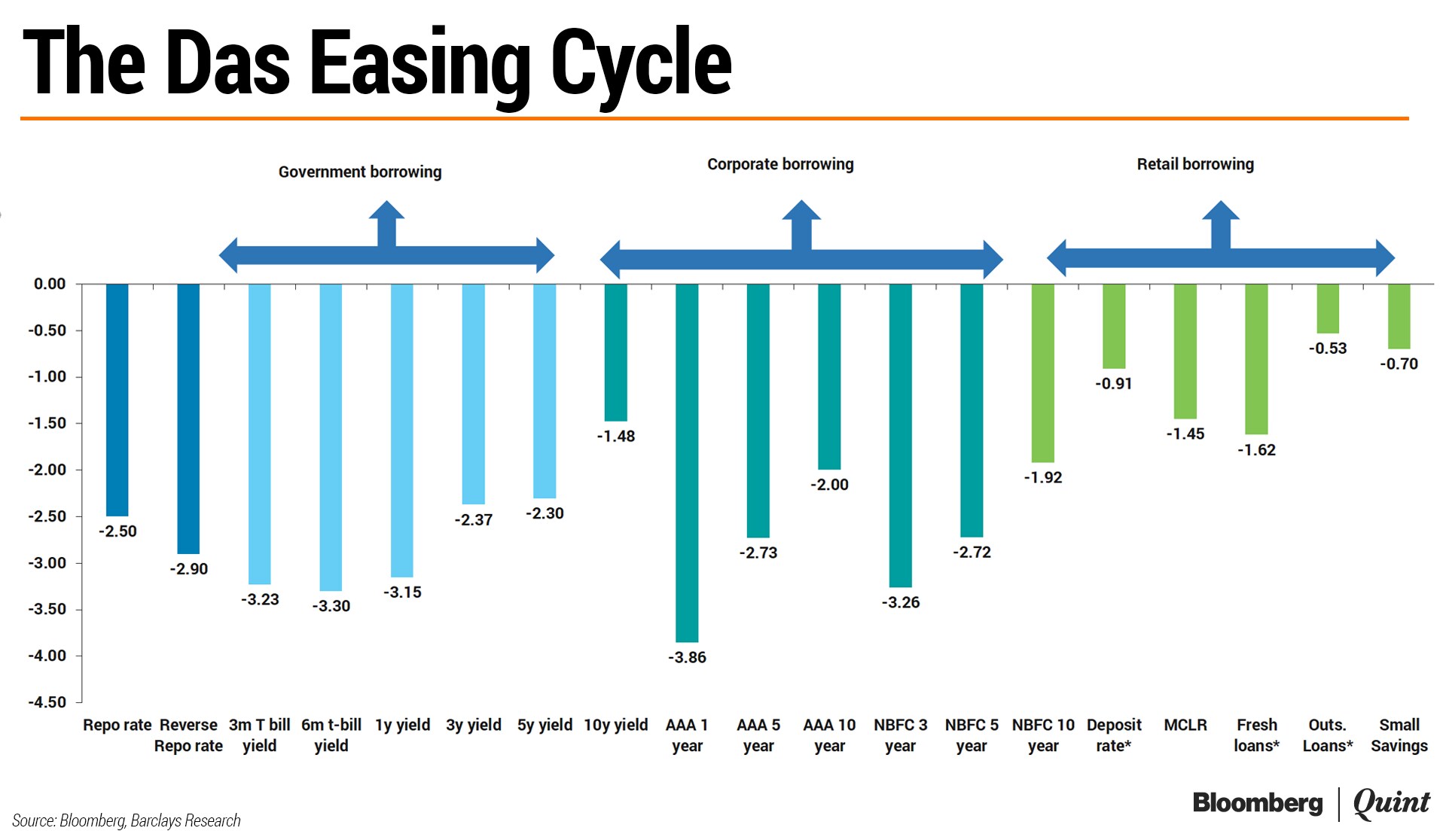
The RBI continues to keep the markets guessing as far as its economic projections are concerned. While the central bank has flagged that it expects an economic contraction in the first half of this fiscal year, following by a domestic revival in H2, estimates of the downturn and revival are yet unclear. For inflation, RBI sees cost-push pressures evident across the board and expects prices to remain elevated through Q2 before easing on the back of favourable base effects. In some sense, if the trade-off from weak growth and high inflation swings to strong growth and falling inflation, there might be some space to reduce policy rates. But the delta changes needed for this policy trade-off to occur and allow further easing are not clear. This is the reason why we no longer expect the RBI to cut rates in the near term, and expect only a token 25 basis point cut in Jan-March 2021 to acknowledge the continued accommodative monetary policy stance.
We feel the challenge for policymakers will remain to revive aggregate demand in the economy, once the Covid-19 crisis is under control. During the initial phase of the lockdown, India experienced a simultaneous pullback in both aggregate supply and aggregate demand, which resulted in higher inflation, falling incomes, and higher savings. Since then, as the lockdown restrictions have been eased, aggregate supply conditions have normalised a bit more quickly than aggregate demand, which has pushed down inflation at the margin. However, the increase in taxes on fuel and alcohol, along with rising commodity prices whether that of gold or steel, will impede the revival of aggregate demand, rather than supply.
As such, while we do not expect India's economy to experience a double-dip recession, the risks of disappointment on the economic revival are likely to remain.
The Governor emphasised on Thursday RBI's success in ensuring the effective transmission of the cumulative 250 basis points of policy rate cuts into money markets and borrowing costs, and indicated this process will continue. We believe that the interest rate transmission lags have become somewhat slower, and the average cost of funding is still likely to decline in the coming months, converging with marginal funding costs decline over an extended period. One way to speed up the decline in funding costs could be in the form of further reductions in small savings scheme rates, which continue to be priced at a premium to other deposit instruments.
The developmental and regulatory measures announced on Thursday confirmed the widely expected news on the one-time restructuring of loans, but it remains to be seen how much relief will be provided, and what will be the take-up for this resolution mechanism. Overall, we believe the increase in potential NPAs and special mention loans, and the accompanying impact on financial stability will soon be clear, hence it is reassuring to see RBI trying to provide relief to companies hit by the pandemic and the subsequent lockdowns.
This meeting was also in all likelihood the last MPC meeting with the current set of external members, who have completed their four years unless they are offered temporary extensions. As recently noted in a BloombergQuint article, the MPC has contributed immensely to the debate around monetary policy and its conduct, bringing more diverse viewpoints to the arena, both from members within and without the RBI, for which the financial markets, the analyst community, and policy watchers should be thankful.
Rahul Bajoria is Chief India Economist at Barclays. Views expressed are personal.
The views expressed here are those of the author and do not necessarily represent the views of Bloomberg Quint or its editorial team.

-
The Economic Imperative: Analysing The Material Driving Force Behind India-Canada Strategic Reset

This economic complementarity is further reinforced by deep institutional investment ties and talent mobility, which form the bedrock of the bilateral framework.
-
Medicine Pricing: Where Must Profit Stop?
India must confront excessive margins, hidden incentives and regulatory gaps that threaten the integrity of medicine.
-
Why Amazon And Flipkart Are Struggling To Beat Meesho In India's Smaller Cities
With 274 million users and lowest-cost logistics, Meesho is defending its value commerce crown against giants like Amazon and Flipkart.
-
High US Salaries, No Green Card Certainty: The Financial Calculation Facing Indian H-1B Families
The suspension of PERM processing at eight technology employers does not cancel existing H-1B visas. What it does is force a question many Indian families have been avoiding: is the US salary worth tying your career and family plans to one employer?
-
Swiggy vs Eternal: Food Delivery's Two Rivals Are No Longer In The Same Race
Eternal is building a private AI assistant, dark.ai. Swiggy is still working out how to make Instamart pay, with an operating loss of Rs 895 crore in the July-September quarter while Blinkit stayed profitable.
-
Where You Live Shapes How You Get To Work | The Reason Why
Two-wheelers are the most popular way to get to work in India, accounting for nearly 43% of workplace commutes.
-
Unhedged Position: Can India See An Indonesia-Style Time Correction?
The Nifty is trading below levels it first clocked in 2024. Is there, then, as I have suggested in the headline, potential that the current time correction drags on painfully for the next three-five, even ten years?
-
Navigating Friction And Energy Realities: An Analysis Of Marco Rubio's October Visit To India
Occurring at a critical juncture marked by stalled trade negotiations and escalating geopolitical pressures over global energy supplies, the visit offers a profound window into modern US-India relations.
-
India Exports Capital. Why Not Export Trusteeship?
The big question, then, is whether India can build an institution that global borrowers, investors, banks, and lawyers can trust, even without an Indian connection.
-
France's Economy & Politics Are In Crisis | The Reason Why
Let's look at how the French economy and politics evolved under Nicolas Sarkozy, Franois Hollande and Emmanuel Macron.










