Exclusive: Electoral Bond May Lead to More Black Money, Warned EC

In February 2017, the government quietly made four crucial amendments to four different Acts in the Finance Bill, 2017 before introducing electoral bonds. The Quint has found out that the Election Commission (EC) had sharply criticised the amendments, calling it a “retrograde step” which also opens up the possibility of setting up of shell companies and routing black money.
However, the government ignored these objections and we, the people, got to know nothing about it.
The government had stated that the objective of the electoral bond was to keep the donor anonymous. The Quint revealed on 12 April that there were hidden unique alphanumeric sequences on electoral bonds which may be used to secretly track donors.
In its 3-page letter written to the Ministry of Law and Justice, exclusively accessed by The Quint, the EC rebuts each amendment made by the government in the Finance Bill, 2017. RTI activist Vihar Durve received this letter as a response in April 2018 to an application filed to the EC seeking the Commission's correspondence on the electoral bonds.
Let's take a look at the government's dubious amendments and the EC's objections one by one.
Electoral Bonds a Means to Hide Political Donation From Public
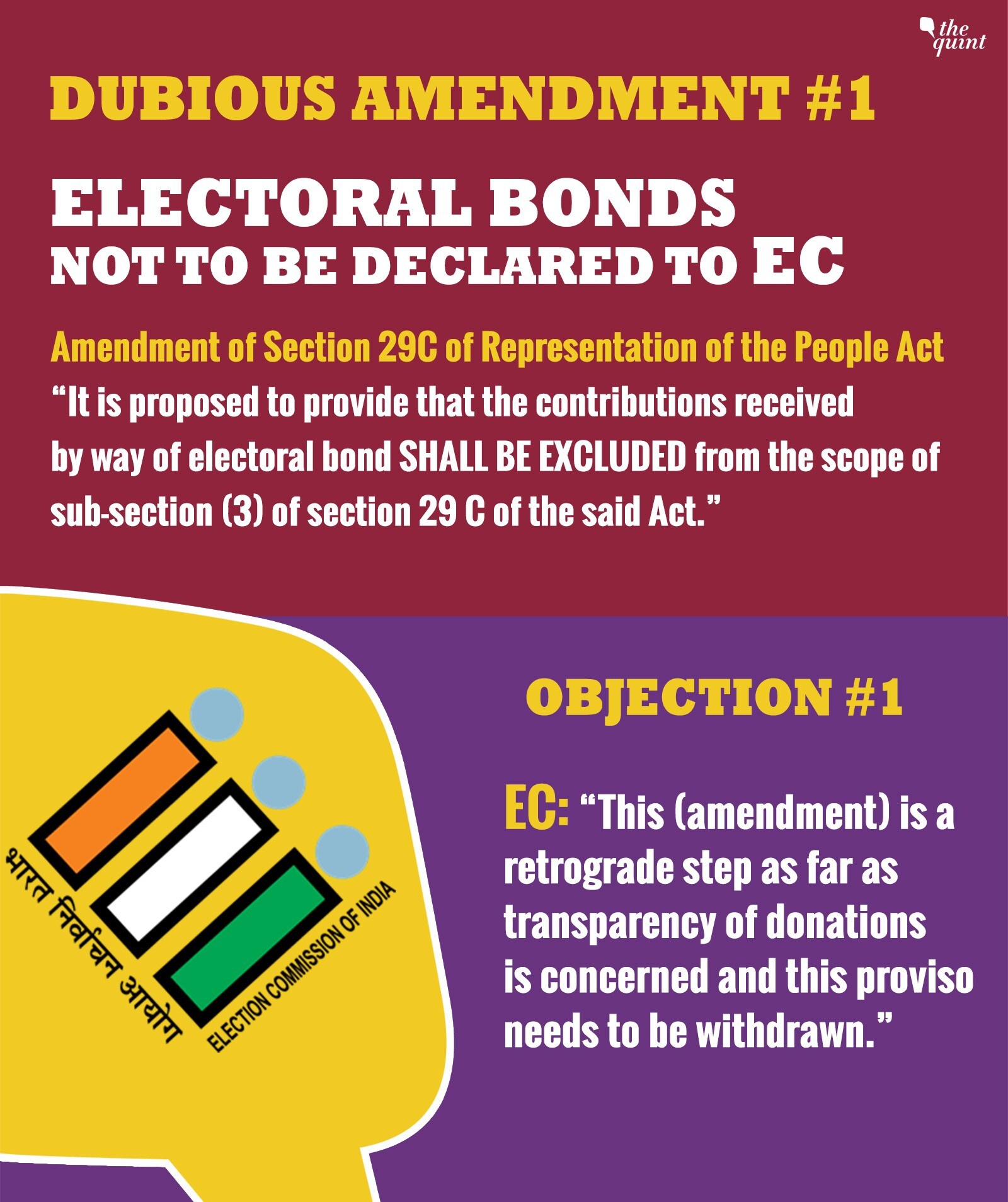
Amendment of Sec 29C of the Representation of the People Act, 1951
The government amended Section 29C of the Representation of the People (RP) Act, 1951 so that political donations made through electoral bonds need not be declared to the Election Commission. Hence the public will never know how much donations were made to political parties through electoral bonds.
The amendment stated,
“It is proposed to provide that the contributions received by way of electoral bond shall be excluded from the scope of sub-section (3) of section 29C of the said Act.”
The EC in the letter demanded a reversal of the amendment.
Too caught to read this story? You can listen to it instead.
“This is a retrograde step as far as transparency of donations is concerned and this proviso needs to be withdrawn,” the Commission said.
The EC also pointed out that the amendment of 29C will possibly lead to violation of Section 29B of the Representation of the People Act, 1951, which “prohibits the political parties from taking donations from Government Companies and Foreign sources”.
The consequence of this amendment is that parties are free to take donations from any source through electoral bonds in violation of the existing law and get away with it. The public will only be aware of those donations which are made through cheques and bank transfers.
Electoral Bonds = Black Money + Shell Companies
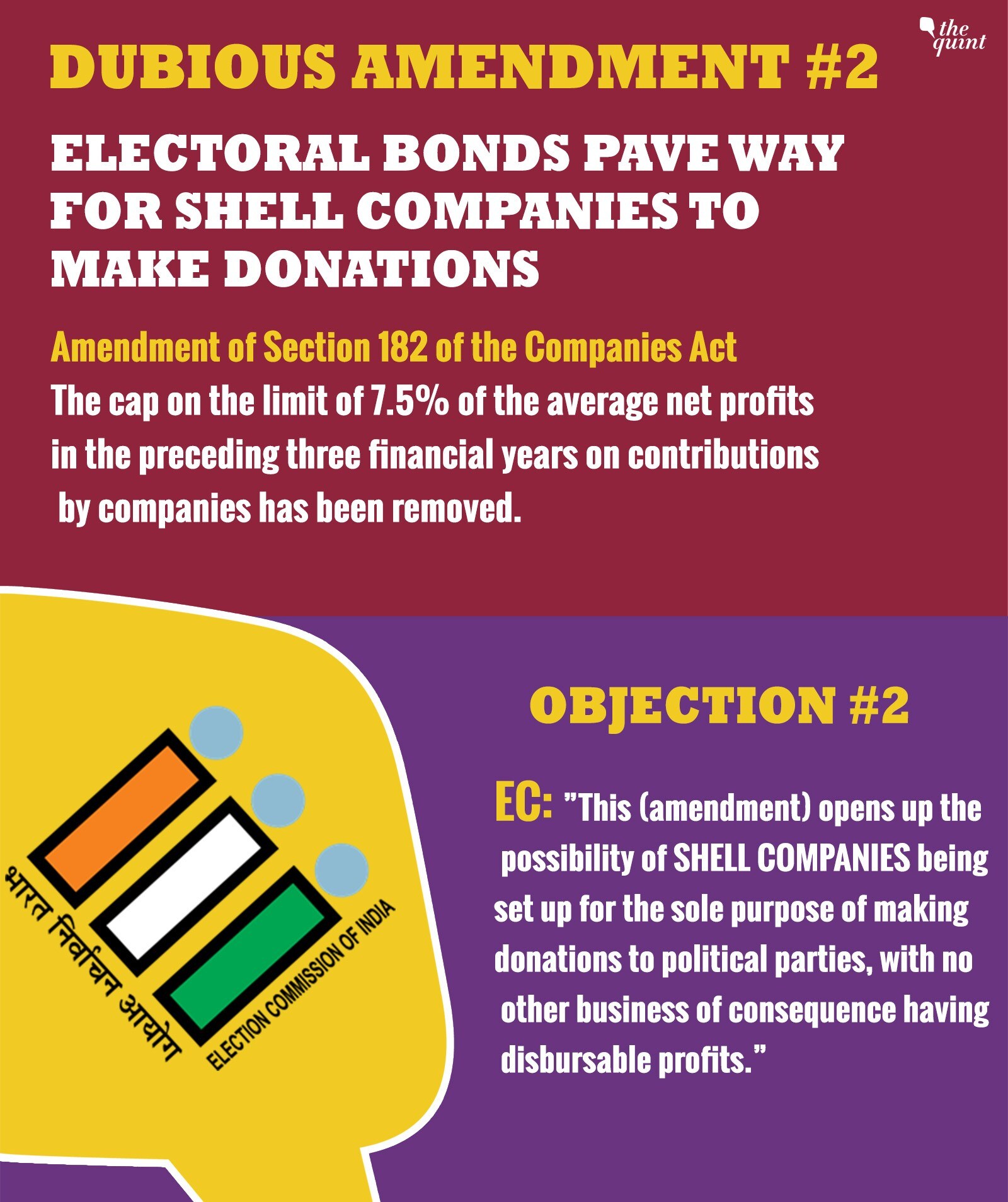
Amendment of Section 182 of the Companies Act, 2013
The amendment of Section 182 of the Companies Act, 2013 removed the limit of 7.5 percent of net profit in the preceding three financial years for companies to donate to political parties. Now companies are free to donate any amount to parties or as the EC said, exist for the sole purpose of making donations.
The government also amended sub-section 3 of Section 182 of the Companies Act, 2013, which originally read:
“Every company shall disclose in its profit and loss account any amount or amounts contributed by it to any political party during the financial year to which that account relates, giving particulars of the total amount contributed and the name of the party to which such amount has been contributed.”
The amendment abolished the provision that firms must declare their “political contributions” in their profit and loss statements. Under the amended act, the company just needs to declare “total amount” under this head.
The amended act said,
“Every company shall disclose in its profit and loss account the total amount contributed by it under this section during the financial year.”
Electoral Bonds Will Pump in Black Money
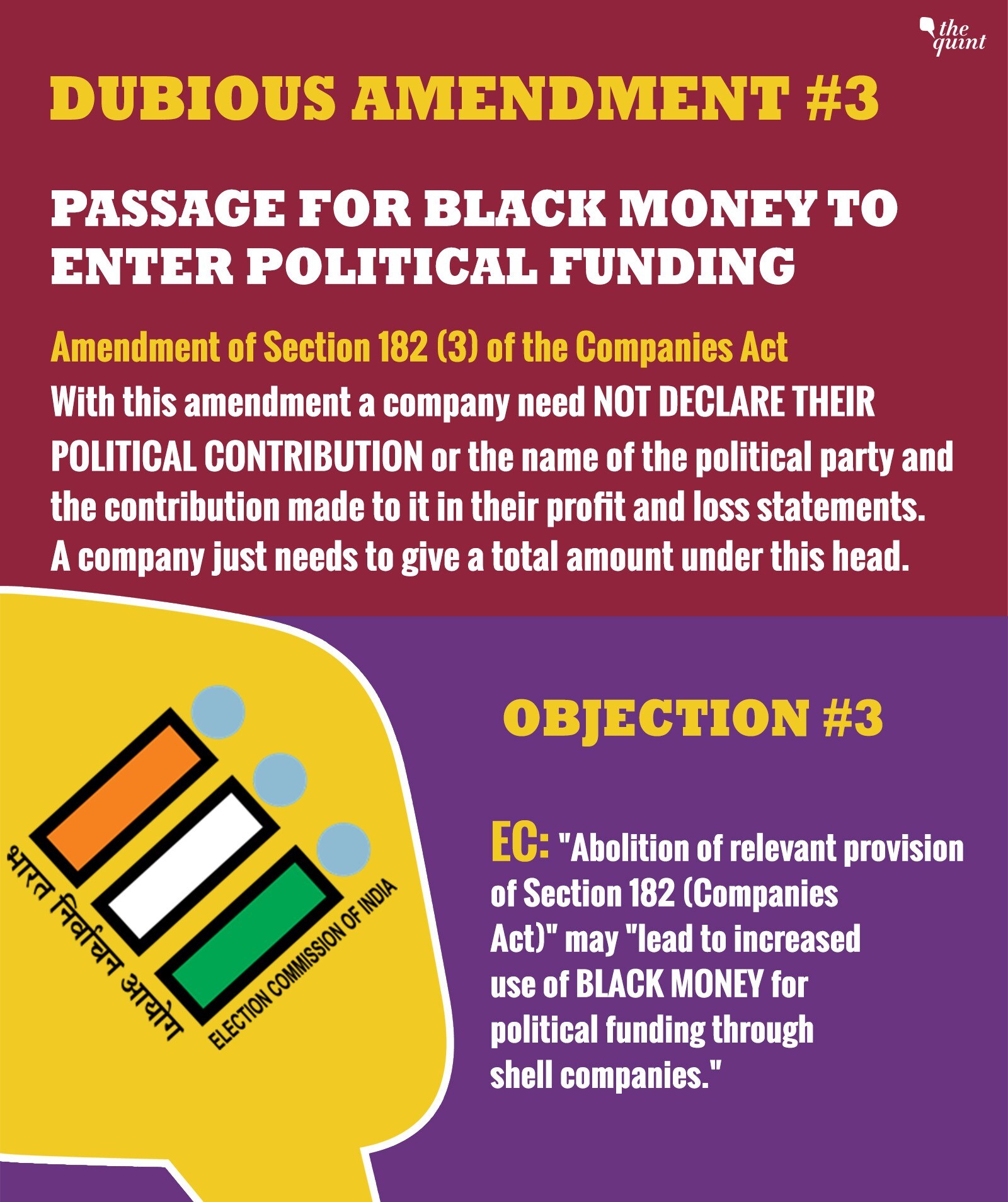
The EC, in strongly worded sentences, criticised the amendment of Section 182 on two major grounds.
The Modi government had demonetised 500 and 1,000 rupees notes with a stated objective to fight black money. However, the amendment of Section 182 of Companies Act is likely to facilitate the entrance of black money into the system through electoral bonds.
The EC said,
“This (amendment) opens up the possibility of shell companies being set up for the sole purpose of making donations to political parties, with no other business of consequence having disbursable profits.”
As a result, “the Commission has expressed its apprehension” that it “would lead to increased use of black money for political funding through shell companies.”
The second ground is that non-disclosure of “political contribution” by the companies in the profit and loss account “would compromise transparency”.
The EC also said that amendments made in the RP Act and the Companies Act should be “reconsidered and modified”.
“So as to provide for transparent reporting of Contribution received by the Political Parties through electoral bonds...and a provision should be made in the Companies Act to declare the party-wise Contributions made by companies, so that the transparency in the fund-raising by political parties is maintained.”
Anonymous Donations Still Capped at Rs 20K & Not 2K : EC
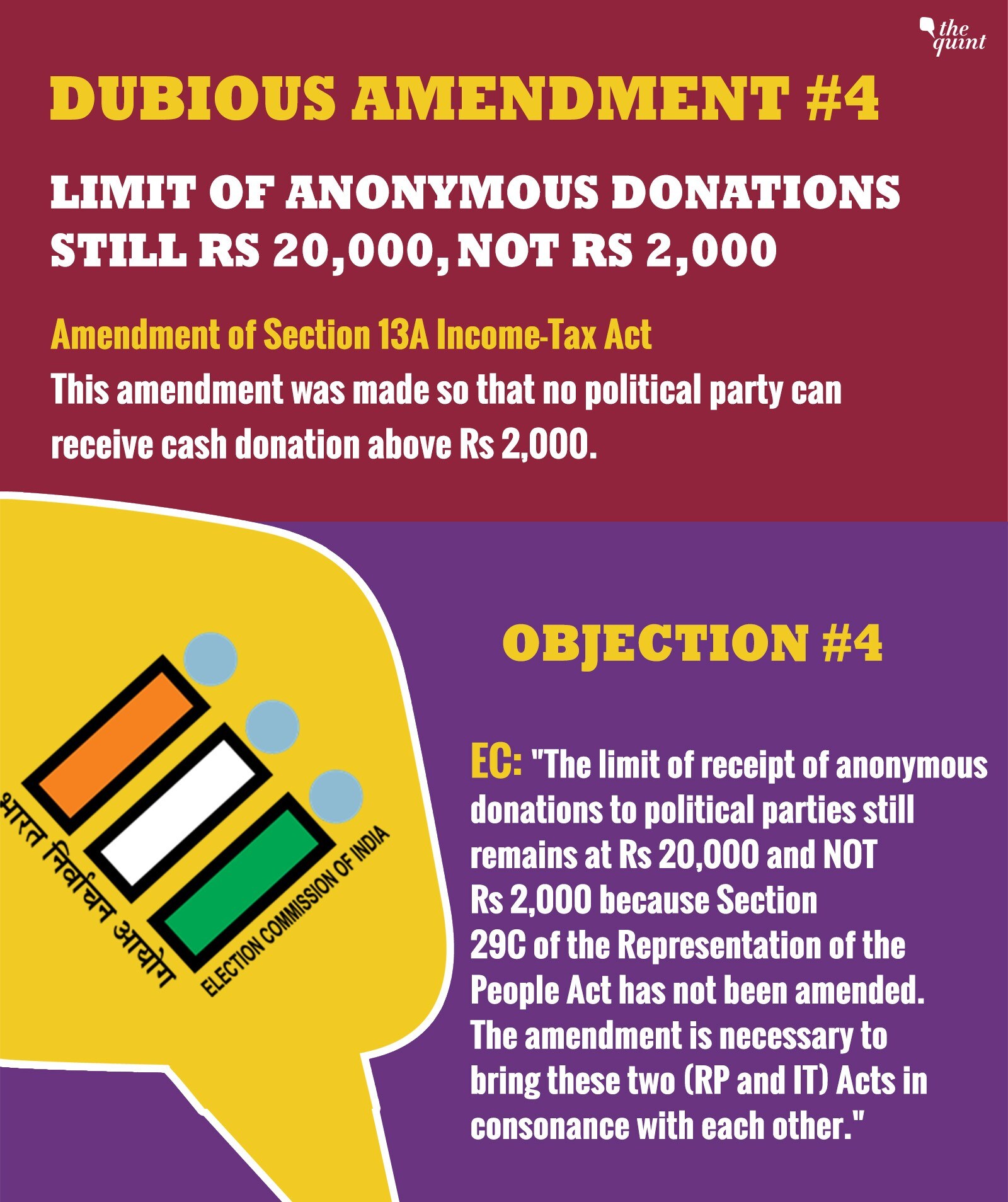
Amendment of Income-Tax Act, 1961
Finance Minister Arun Jaitley, while presenting the General Budget 2017-18 in Parliament, said that political parties can receive a maximum donation of up to Rs 2,000 in cash. proposing a transparent funding system. Accordingly, Section 13A of the Income-tax Act 1961 was amended putting a cap on cash donation at Rs 2000.
The Modi government amended IT Act to reduce the cap on cash donations to Rs 2,000 and also amended the Reserve Bank of India Act to introduce electoral bonds claiming that it will cleanse political funding and make it more transparent.
But the Rs 2,000 cap is not enforceable without another amendment.
According to the EC, the government has not yet amended Section 29 C of the RP Act which compels political parties to declare to EC all donations above Rs 20,000.
Therefore, cash donations between Rs 2,000 and Rs 20,000 will continue to escape the EC's scrutiny.
Hence, the EC has requested the government to bring IT and RP Acts in consonance with each other.
Wait & Watch: EC
So far the Ministry of Law and Justice has not reacted to the EC's apprehensions, nor has the EC made efforts for the reversal of amendments made by the government to make political funding opaque and non-transparent.
We are waiting for the political parties to file their contribution report on the fund they received for the year 2017-18. After that we will decide the future course of action.Source in the Election Commission
The EC officer told The Quint that the EC was not even consulted when amendments were made in all four existing Acts.
In the first edition of electoral bonds issued between 1-10 March 2018, the SBI sold Rs 222-crore worth of electoral bonds. Clearly, a huge amount of donations are being made through the bonds.
Why did the government amend the RP Act to keep political donations made through electoral bonds away from public knowledge?
The damaging letter of the EC clearly shows that through electoral bonds the Modi government has paved a way to channel black money into political donations through shell companies. While keeping the public in dark.
Click to read the Election Commission's letter to the law ministry regarding electoral bonds.

-
Indians Are Travelling, But Not Every Journey Is A Holiday | The Week In Whys

Pilgrims, patients and working women are the real travellers, and the system hasn't quite caught up with them.
-
Getting To Work Costs Women More | The Reason Why
It is not just about women paying more than men. It is about women paying much more in cities than in villages.
-
AI Bias In Investing Cannot Be Eliminated, But It Can Be Governed
Framing is a particularly important example as identical financial information presented in terms of gains rather than losses can lead an LLM to reach a different assessment.
-
Joining The Dots | Dark Skies, Steady Diya: Why Hope Holds This Diwali
With war, a weak rupee and foreign outflows weighing on sentiment, policymakers at the NDTV World Summit and market veterans at NDTV Profit Ignite: Diwali Edition offered the same advice: stay invested and filter out the noise.
-
The Curious Case of Equitas Small Finance Bank And A CEO Who Quit For Stock
PN Vasudevan believes persistent investor concerns over a perceived conflict of interest had become a governance overhang on Equitas Small Finance Bank's stock, even as the lender improved profitability and asset quality.
-
Talking Points This Week: AI Cash Burn, A Tiger Comeback And An India That Still Finds Its Own Path
India is not immune to higher oil or tighter global liquidity, yet its earnings base is broader, its domestic policy levers are still available.
-
Foreign Investors Own Half Of HDFC Bank and ICICI Bank. An LTCG Cut Could Matter Most Here
Foreign portfolio investors have US$115 billion parked in HDFC Bank, ICICI Bank. If the government cuts long-term capital gains tax, Jefferies says returning foreign money could land here first.
-
'Never Seen This Level Of Negativity': Sandeep Tandon Says The Next Rally May Be Closer Than You Think
Veteran investor Sandeep Tandon says foreign selling is easing, large-caps are due a comeback and mid-caps are crowded, while he turns positive on gold, power and pharma this Diwali.
-
Indians Stay With Family, Not In Hotels | The Reason Why
India still lacks enough clean, reliable and affordable hotels for budget-conscious travellers.
-
The Economic Imperative: Analysing The Material Driving Force Behind India-Canada Strategic Reset
This economic complementarity is further reinforced by deep institutional investment ties and talent mobility, which form the bedrock of the bilateral framework.










