Direct Tax Code: Simplified Capital Gains Tax Regime Proposed – Exclusive
(This is a collaboration with leading tax information portal Taxsutra to publish select in-depth articles on legal and policy matters. This is Part 4 in the exclusive series on the recommendations of the DTC Task Force. Part 1 on the key structural changes proposed by the committee can be found here, Part 2 on suggestions to address the decade-old Vodafone problem here, and Part 3 on plugging money laundering loopholes here.)
One area that has seen a lot of tinkering in the government's annual budget exercise is the taxation of capital gains. The changes have been mainly to capital gains tax rates applicable to different classes of assets and the holding periods that determine whether the gains would be taxable as short term or long term. This year too there is some pre-budget clamour to do away with the recently introduced long term capital gains tax.
The Direct Tax Code Task Force, in its report, deliberated on the capital gains taxation framework in detail and has proposed a simplified regime. Taxsutra has spoken to those involved in the finalisation of the report and identified the key changes recommended.
But first it is necessary to acknowledge the complexity of the current capital gains tax framework to put the report's recommendations into context.
For instance, the holding period and tax rate for LTCG vary based on multiple factors such as type of asset, whether the security is listed on the stock exchange, applicability of Securities Transaction Tax, residential status of the taxpayer, etc.
Consider the taxability of long term capital gains on sale of equity shares of a company.
For the capital gains to be considered long term the holding period for listed equity shares is 12 months but for unlisted shares it is 24 months.
If the sale or transfer of the listed equity shares is done on a stock exchange where STT is levied, the LTCG tax rate applicable is 10 percent. But gains of up to Rs 1 lakh are exempt.
For shares that were listed on the stock exchange after Jan. 31, 2018, the taxpayer can compute LTCG after considering indexation benefit up to financial year 2017-18. But indexation benefit is not available on shares that stood listed on the stock exchange on Jan. 31, 2018.
Also Read: Only A Fifth Of Stocks Will Attract Long-Term Capital Gains Tax
Further, for off-market transactions of listed equity shares where STT is not paid, tax payable on LTCG is lower of 20 percent of gains computed after considering indexation benefit or 10 percent of gains computed without considering indexation benefit. However, in the case of unlisted equity shares, the tax rate is 20 percent after considering indexation benefit.
Also Read: Long-Term Capital Loss From Share Sale Can Be Set Off, Carried Forward
There are special provisions applicable to non-residents Indians, foreign institutional investors, etc., which have an impact on capital gains taxation. In case of LTCG arising to a non-resident taxpayer on unlisted equity shares of a closely held company, applicable tax rate is 10 percent without considering indexation benefit.
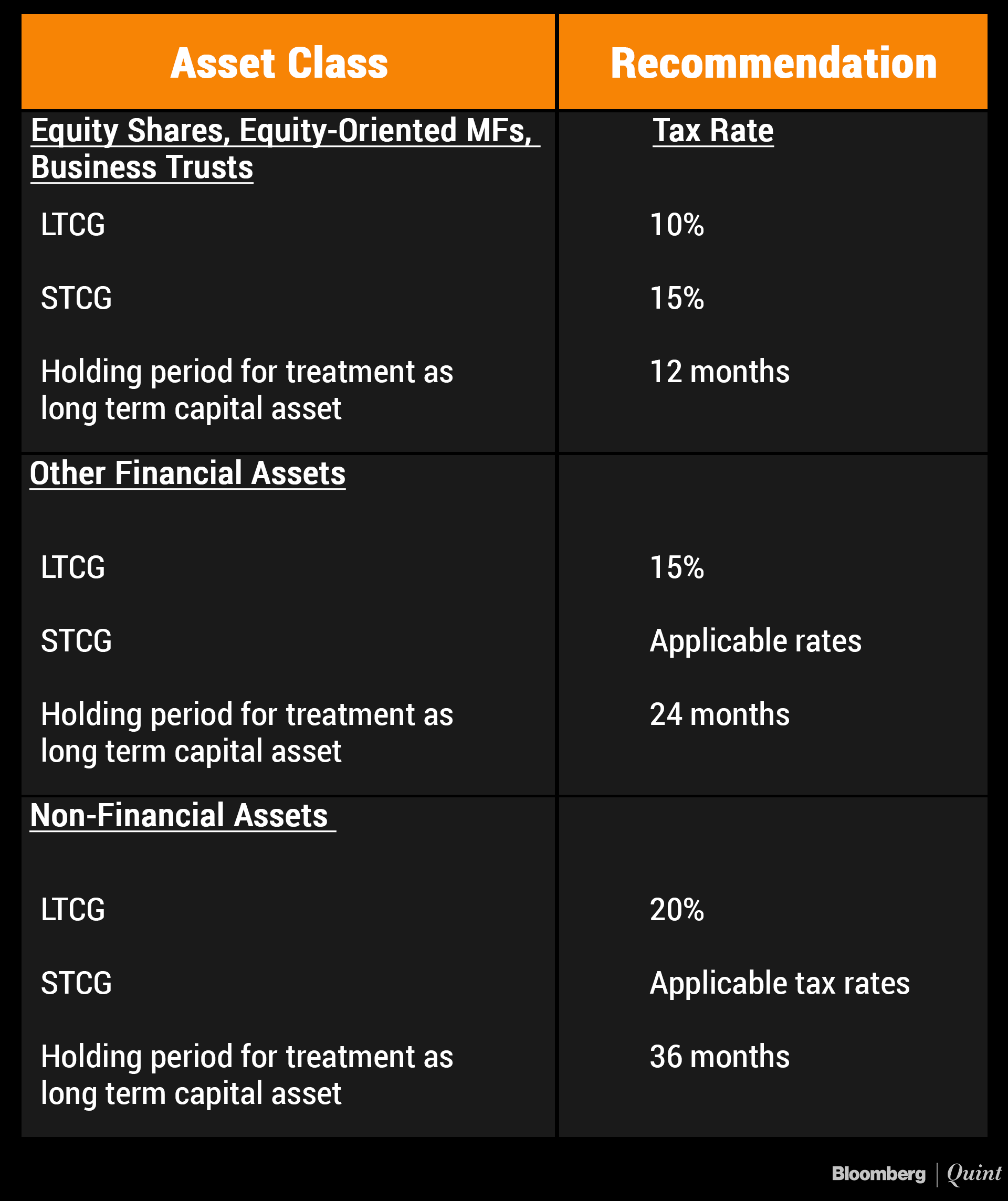
The DTC task force report recommends categorisation of assets into 3 classes —
- financial assets like equity shares, units of equity oriented mutual funds, business trusts
- other financial assets
- non-financial assets
The recommendations as understood by Taxsutra are —
STT And Exemptions
Since those who argue against the levy of capital gains tax often cite the STT burden as grounds enough, the DTC report's view on STT is important too. It recommends the continuation of STT which was brought into effect in 2004.
Also Read: Income Tax Returns: Capital Gains Calculation Glitch Haunts Taxpayers
As for capital gains tax exemptions, the report recommends they should be kept at a bare minimum. Currently, the taxpayer can claim exemption from taxation of long term capital gains on certain assets by making investments in qualified assets such as residential property, bonds of National Highway Authority of India and Rural Electrical Corporation, subject to fulfillment of various conditions.

-
Extracting Value From Battery Scrap Could Be Challenging For India | The Reason Why

A discarded lithium-ion battery still contains valuable materials such as lithium, nickel and cobalt. These can be recovered and reused. When such batteries are crushed and shredded, they produce a dark powder called black mass.
-
One El Nino, India Can Handle. Two Could Break The Granary
India's grain stocks can absorb one bad year, but a second El Nino could drain the buffer in two to three years, economists say.
-
India's Troika Of Good Luck | Joining The Dots
As Jensen Huang's exit drags Nvidia down, a cooling AI trade and resilient earnings have revived investor interest in India. A likely RBI rate hike looms.
-
Talking Points This Week: Leadership Shock At Nvidia, Earnings Strength, And The Fog Over Hormuz
The Anthropic IPO pricing and first trading day, Nvidia's upcoming earnings, and any fresh signals from Iran will set the tone for the following week.
-
Signature Play: The Classic Cocktail Is Dead. Or Is It?
Classic cocktails are disappearing from India's cocktail menus. But they're still being ordered, taught to bartenders and borrowed from. So, who's really having the last drink?
-
A New Samvat Wishlist: Inclusive Prosperity And Human Development
India has strengthened its economic foundations through infrastructure, digital access and enterprise. Its next growth chapter must deepen productivity, create better livelihoods and widen participation in prosperity.
-
Love, Sex Aur Dhokha: The Audacious Plot To Spy On Jensen Huang
A Taipei dinner, a Singapore chip buyer and a suspected Chinese asset: inside the alleged spy operation that got close to NVIDIA's Jensen Huang.
-
Ten Things I Learnt This Samvat
Patience can be a trap. Cheap stocks can stay cheap. Leverage can wipe you out. What did Samvat 2082 teach us? Niraj Shah writes on 10 lessons from the year gone by.
-
Talking Points This Week: Tech Nerves, FII Buying, And A Faraway Banking Shock
The global markets are not shining this Diwali. The exception in the large markets is, India.
-
Midterm Rally Lasted A Day. The Hard Reality Of A Divided US May Last Two Years | Opinion
Between a contested AI boom, a debt ceiling that arrives in 2027 and a president with every incentive to act alone, the next two years may prove more volatile than the first day's rally suggests.