Las Vegas Massacre: Gunman Had ‘Bump-stock’ Device That Could Speed Fire
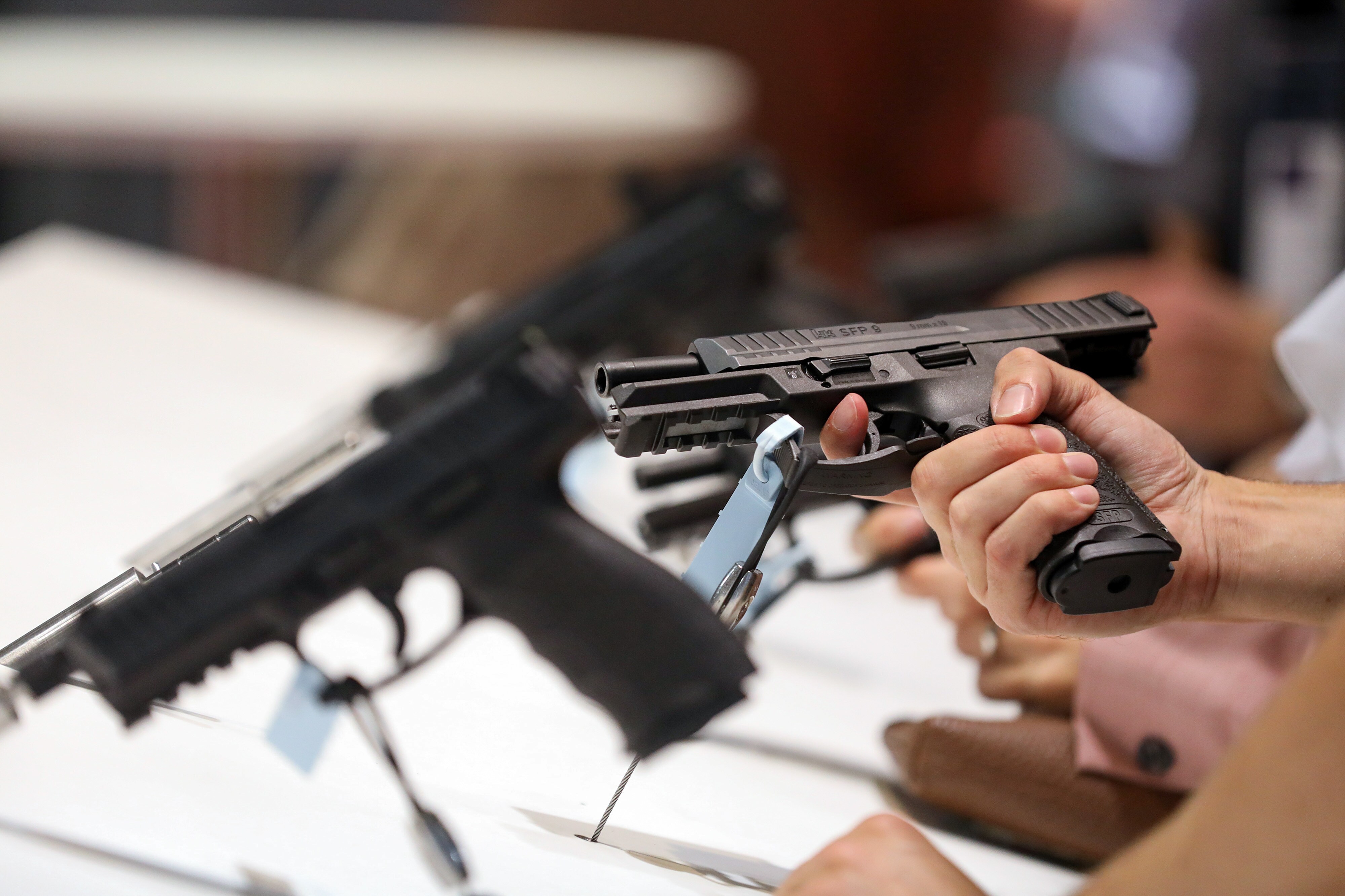
The gunman who unleashed hundreds of rounds of gunfire on a crowd of concertgoers in Las Vegas had two "bump-stocks" that could have converted semi-automatic firearms into fully automatic ones, officials said.
The devices have attracted scrutiny in recent years from authorities.
California Senator Dianne Feinstein has long railed against them. Several years ago, she told The Associated Press she was concerned about the emergence of new technologies that could retrofit firearms to make them fully automatic.
"This replacement shoulder stock turns a semi-automatic rifle into a weapon that can fire at a rate of 400 to 800 rounds per minute," she said.
A semi-automatic weapon requires one trigger pull for each round fired. With a fully automatic firearm, one trigger pull can unleash continuous rounds until the magazine is empty. The purchasing of fully automatic weapons has been significantly restricted in the U.S. since the 1930s.
In 1986, the federal National Firearms Act was amended further to prohibit the transfer or possession of machine guns by civilians, with an exception for those previously manufactured and registered.
Numerous attempts to design retrofits failed until recent years when bump stocks entered the market.
The device basically replaces the gun's shoulder rest, with a "support step" that covers the trigger opening. By holding the pistol grip with one hand and pushing forward on the barrel with the other, the shooter's finger comes in contact with the trigger. The recoil causes the gun to buck back and forth, "bumping" the trigger.
Technically, that means the finger is pulling the trigger for each round fired, keeping the weapon a legal semi- automatic.
Las Vegas shooter Stephen Paddock had 23 guns in his hotel room.
Two officials familiar with the investigation told the AP that Paddock had two bump stocks. They are investigating whether those stocks were used to modify weapons used in the massacre, according to the officials, who were briefed by law enforcement and spoke on condition of anonymity because the investigation is still unfolding.
Paddock killed 59 people and wounded hundreds more at a country music festival near his hotel. Police stormed his 32nd floor hotel room and found that he had killed himself after committing the deadliest mass shooting in modern US history.

-
The Economic Imperative: Analysing The Material Driving Force Behind India-Canada Strategic Reset

This economic complementarity is further reinforced by deep institutional investment ties and talent mobility, which form the bedrock of the bilateral framework.
-
Medicine Pricing: Where Must Profit Stop?
India must confront excessive margins, hidden incentives and regulatory gaps that threaten the integrity of medicine.
-
Why Amazon And Flipkart Are Struggling To Beat Meesho In India's Smaller Cities
With 274 million users and lowest-cost logistics, Meesho is defending its value commerce crown against giants like Amazon and Flipkart.
-
High US Salaries, No Green Card Certainty: The Financial Calculation Facing Indian H-1B Families
The suspension of PERM processing at eight technology employers does not cancel existing H-1B visas. What it does is force a question many Indian families have been avoiding: is the US salary worth tying your career and family plans to one employer?
-
Swiggy vs Eternal: Food Delivery's Two Rivals Are No Longer In The Same Race
Eternal is building a private AI assistant, dark.ai. Swiggy is still working out how to make Instamart pay, with an operating loss of Rs 895 crore in the July-September quarter while Blinkit stayed profitable.
-
Where You Live Shapes How You Get To Work | The Reason Why
Two-wheelers are the most popular way to get to work in India, accounting for nearly 43% of workplace commutes.
-
Unhedged Position: Can India See An Indonesia-Style Time Correction?
The Nifty is trading below levels it first clocked in 2024. Is there, then, as I have suggested in the headline, potential that the current time correction drags on painfully for the next three-five, even ten years?
-
Navigating Friction And Energy Realities: An Analysis Of Marco Rubio's October Visit To India
Occurring at a critical juncture marked by stalled trade negotiations and escalating geopolitical pressures over global energy supplies, the visit offers a profound window into modern US-India relations.
-
India Exports Capital. Why Not Export Trusteeship?
The big question, then, is whether India can build an institution that global borrowers, investors, banks, and lawyers can trust, even without an Indian connection.
-
France's Economy & Politics Are In Crisis | The Reason Why
Let's look at how the French economy and politics evolved under Nicolas Sarkozy, Franois Hollande and Emmanuel Macron.










