Indu Malhotra Takes Oath As Supreme Court Judge
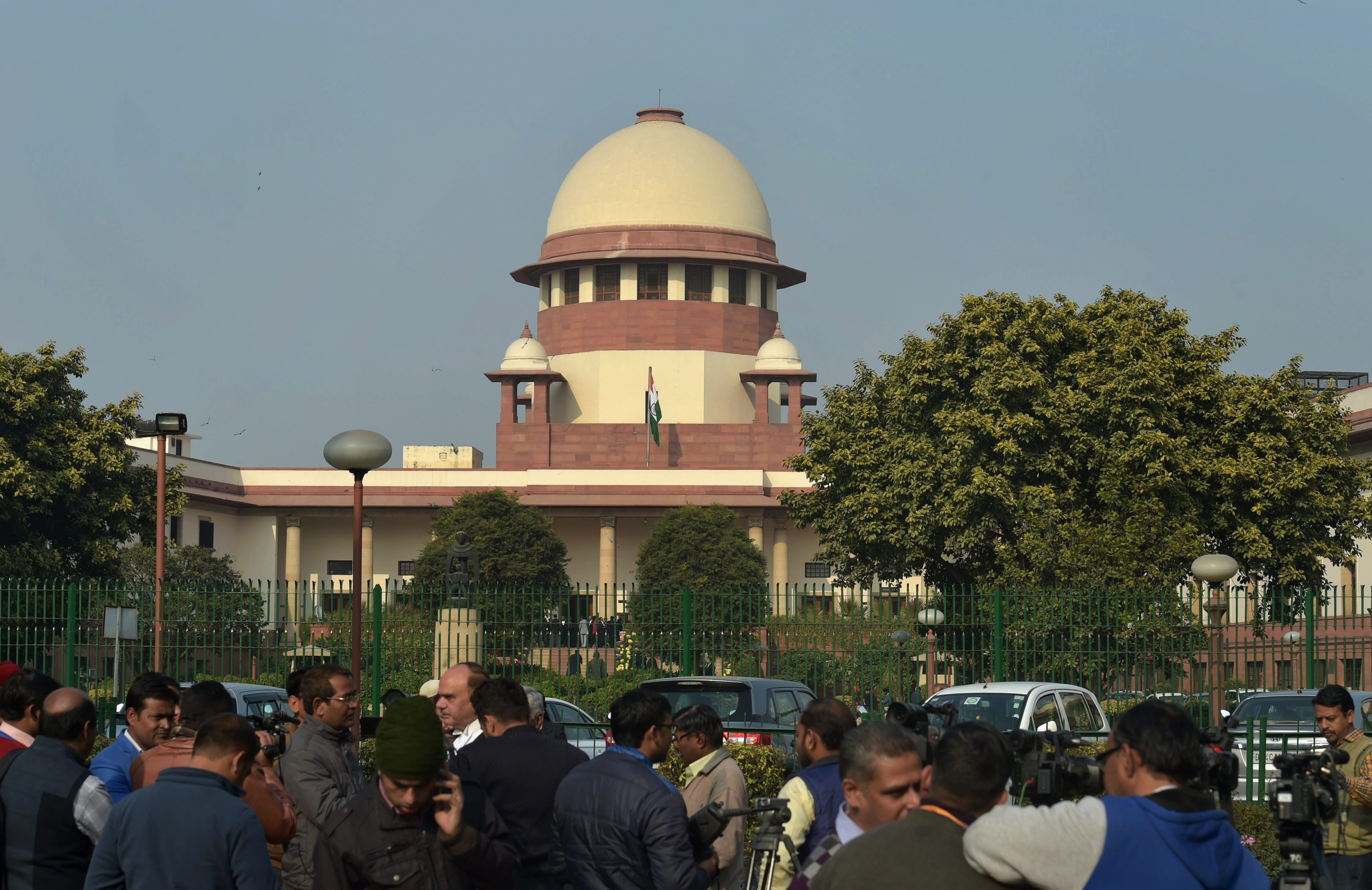
Senior Advocate Indu Malhotra was today administered the oath of office as a Supreme Court judge by Chief Justice of India Dipak Misra, making her the first woman lawyer to enter the top judiciary directly.
With Malhotra joining the bench, the strength of the Supreme Court is now 25, against the sanctioned strength of 31, including the chief justice of India.
Malhotra, 61, was administered the oath of office and secrecy in a ceremony held at court number 1 in the apex court.
This would be the third occasion in the 67-year history of the Supreme Court when it has two sitting women judges together -- the first being Justices Gyan Sudha Misra and Ranjana Prakash Desai, then Justices Desai and R Banumathi and now Justices Banumathi and Malhotra.
Malhotra's name was recommended by the collegium for elevation along with that of Uttarakhand High Court Chief Justice K M Joseph, but the Centre has sought reconsideration of the proposal for the latter.
Malhotra would be the seventh woman judge in the top court since Independence. Other women judges were elevated to the apex court from high courts.
Malhotra joined the legal profession in 1983 and was enrolled with the Bar Council of Delhi. She qualified as an Advocate-on-Record in the Supreme Court in 1988 and has been dealing with several matters of constitutional importance.
She was one of the prominent senior advocates regularly appearing in educational matters pertaining to medical and engineering colleges.
Malhotra was one of the members of the Vishaka Committee on sexual harassment at workplace and was also part of a 10-member committee constituted by the top court to deal with complaints of sexual harassment within the court.
The Bangalore born Malhotra was designated senior advocate by the top court in 2007 and became the second woman to be designated as such by the apex court after a gap of over 30 years.
The first woman judge of the apex court was Justice Fathima Beevi who was appointed in 1989, 39 years after the Supreme Court was set up in 1950. She was elevated to the apex court after her retirement as judge of the Kerala High Court.
The second was Justice Sujata V Manohar, who started her career as a judge from the Bombay High Court and rose to become the chief justice of Kerala High Court. She was elevated to the apex court where she remained from Nov. 8, 1994 till Aug. 27, 1999.
Justice Ruma Pal followed Justice Manohar after a gap of almost five months and became the longest-serving woman judge, from Jan. 28, 2000 to June 2, 2006.
After her retirement, it took four years to appoint the next woman judge. Justice Gyan Sudha Misra was elevated to the Supreme Court from the Jharkhand High Court where she was the chief justice. Her tenure in the apex court was from April 30, 2010 to April 27, 2014.
During her stint, she was joined by Justice Ranjana Prakash Desai, who served the apex court between Sept. 13, 2011 to Oct. 29, 2014. These two judges also created a history by holding court together as an all-women bench for a day in 2013.

-
AI Bias In Investing Cannot Be Eliminated, But It Can Be Governed

Framing is a particularly important example as identical financial information presented in terms of gains rather than losses can lead an LLM to reach a different assessment.
-
Joining The Dots | Dark Skies, Steady Diya: Why Hope Holds This Diwali
With war, a weak rupee and foreign outflows weighing on sentiment, policymakers at the NDTV World Summit and market veterans at NDTV Profit Ignite: Diwali Edition offered the same advice: stay invested and filter out the noise.
-
The Curious Case of Equitas Small Finance Bank And A CEO Who Quit For Stock
PN Vasudevan believes persistent investor concerns over a perceived conflict of interest had become a governance overhang on Equitas Small Finance Bank's stock, even as the lender improved profitability and asset quality.
-
Talking Points This Week: AI Cash Burn, A Tiger Comeback And An India That Still Finds Its Own Path
India is not immune to higher oil or tighter global liquidity, yet its earnings base is broader, its domestic policy levers are still available.
-
Foreign Investors Own Half Of HDFC Bank and ICICI Bank. An LTCG Cut Could Matter Most Here
Foreign portfolio investors have US$115 billion parked in HDFC Bank, ICICI Bank. If the government cuts long-term capital gains tax, Jefferies says returning foreign money could land here first.
-
'Never Seen This Level Of Negativity': Sandeep Tandon Says The Next Rally May Be Closer Than You Think
Veteran investor Sandeep Tandon says foreign selling is easing, large-caps are due a comeback and mid-caps are crowded, while he turns positive on gold, power and pharma this Diwali.
-
Indians Stay With Family, Not In Hotels | The Reason Why
India still lacks enough clean, reliable and affordable hotels for budget-conscious travellers.
-
The Economic Imperative: Analysing The Material Driving Force Behind India-Canada Strategic Reset
This economic complementarity is further reinforced by deep institutional investment ties and talent mobility, which form the bedrock of the bilateral framework.
-
Medicine Pricing: Where Must Profit Stop?
India must confront excessive margins, hidden incentives and regulatory gaps that threaten the integrity of medicine.
-
Why Amazon And Flipkart Are Struggling To Beat Meesho In India's Smaller Cities
With 274 million users and lowest-cost logistics, Meesho is defending its value commerce crown against giants like Amazon and Flipkart.










