India Shortlists 16 Firms For Incentives To Boost Electronics Manufacturing
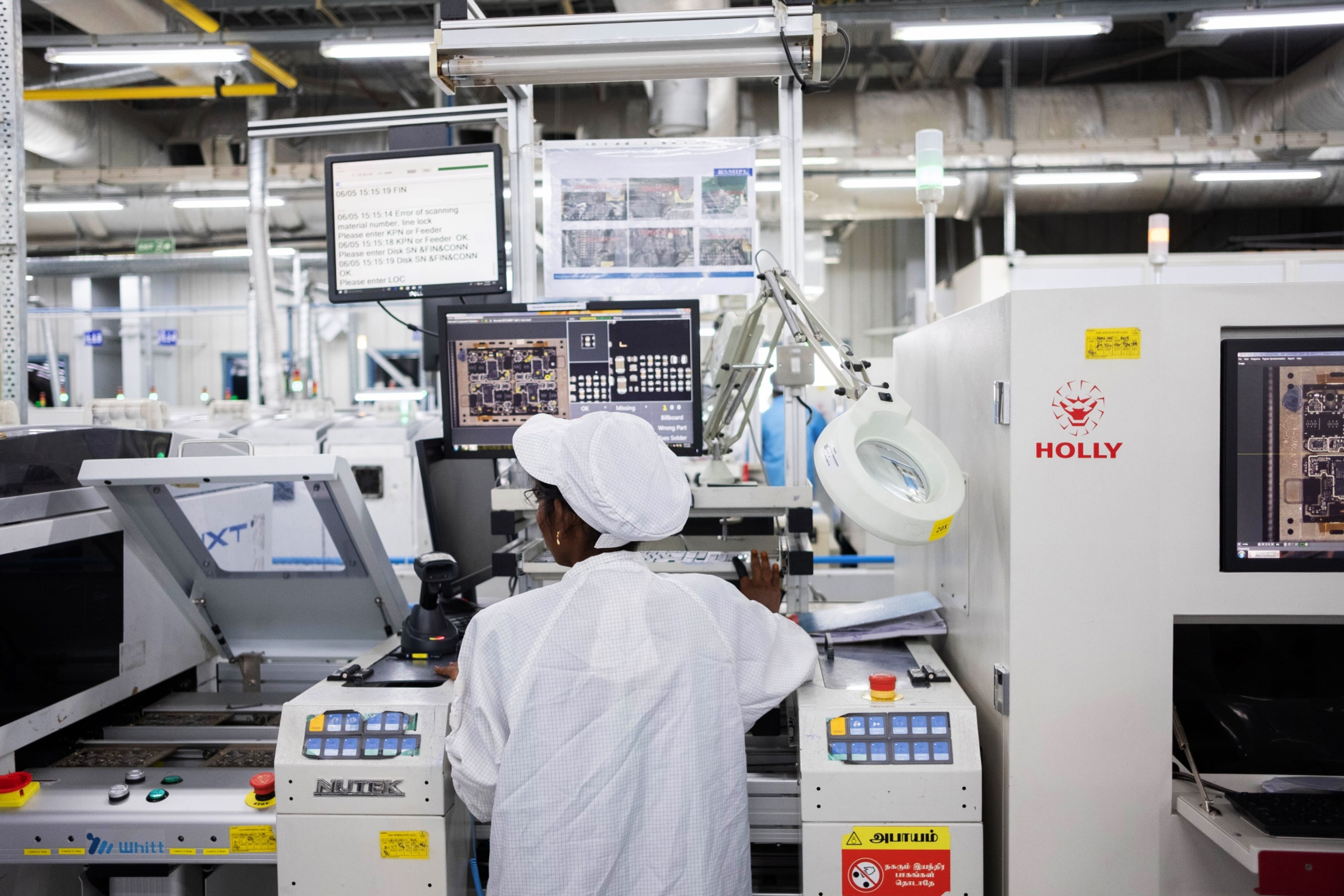
India shortlisted 16 domestic and global electronics makers under a $6.6-billion stimulus programme to boost manufacturing in Asia's third-largest economy.
Domestic firms include contract manufacturers Dixon Technologies Ltd. and Optiemus Infracom Ltd., and phone makers Lava International Ltd. and Micromax Informatics, according to a government statement. Samsung Electronics Co., Rising Star and contract suppliers to Apple Inc.—Foxconn Technology Group and Wistron Corp.—are among the international firms that have made the cut for the production-linked incentives.
Incentives will be provided in each of the next five years for manufacturers opting for the scheme. India expects production worth Rs 10.5 lakh crore and exports amounting to Rs 6.5 lakh crore over five years by domestic and global companies. Domestic value addition is expected to grow from 15-20% at present to 35-40% in the case of mobile phones and 45-50% for electronic components, it said in a statement.
The incentives would be disbursed from a Rs 45,000-crore fund, according to the draft regulations for the electronics manufacturing policy. Of this, Rs 41,000 crore would be disbursed to firms based on production-linked incentive criteria. The rest would be offered under a proposed capital subsidy or reimbursement scheme.
Dixon Stands To Gain
Subsidies for mobile-phone manufacturing with factory cost up to $200 (Rs 15,000) have been earmarked exclusively for Indian firms with a similar incentive structure (4%-6%). Up to 80% of such smartphones are already being assembled in India, according to media reports.
Dixon Technologies to be a significant beneficiary as over 70% of smartphones sold in India are priced at less than Rs 15,000, Aditya Bhartiya, an analyst at Investec Securities, said.
Dixon Technologies' strategy of leveraging a domestic mobile PLI win for exports should aid long-term volume certainty if it achieves significant scale benefits and cost competitiveness, according to Renu Baid, an analyst at IIFL Securities. The brokerage assigned a 2025-26 target price-to-earnings ratio of 20 times for the company to arrive at its current discounted value of Rs 2,300 per share.
Dixon Technologies has a presence in smartphone assembly operations, with customers like Panasonic Corp. and Gionee, since 2016-17. It also manufactures phones for Xiaomi and Samsung. The company said in recent disclosures to the exchanges that it has concluded an agreement with a large global brand for the domestic and export markets.
Dixon Technologies has got large contracts with big global brands for servicing not only the domestic markets but also for exports, Chief Financial Officer Saurabh Gupta told BloombergQuint. Project implementation, Gupta said, will be accelerated, and the plan is to start production sometime in the fourth quarter of fiscal 2021.
Scheme Approvals
In July, five domestic companies had applied under the scheme for the mobile-domestic category, with Dixon Technologies and Lava submitting two applications each. Micromax, Karbonn and Optiemus Infracom were the other applicants.
Apple and Samsung together account for nearly 60% of global sales revenue of mobile phones and this scheme is expected to increase their manufacturing base in India. Samsung, which lost market share to Chinese players like Xiaomi, Redmi and Oppo over the last few years, could look to rebound.
Six companies secured approval under the Specified Electronic Components Segment, including AT&S, Ascent Circuits, Visicon, Walsin, Sahasra and Neolync.
Union Minister for Electronics & IT Ravi Shankar Prasad was quoted as saying in a statement that the industry has reposed its faith in India's stellar progress as a world-class manufacturing destination. “We're optimistic and looking forward to building a strong ecosystem across the value chain and integrating with the global value chains, thereby strengthening electronics manufacturing ecosystem in the country,” Prasad said.
Watch the full conversation here:

-
'Never Seen This Level Of Negativity': Sandeep Tandon Says The Next Rally May Be Closer Than You Think

Veteran investor Sandeep Tandon says foreign selling is easing, large-caps are due a comeback and mid-caps are crowded, while he turns positive on gold, power and pharma this Diwali.
-
Indians Stay With Family, Not In Hotels | The Reason Why
India still lacks enough clean, reliable and affordable hotels for budget-conscious travellers.
-
The Economic Imperative: Analysing The Material Driving Force Behind India-Canada Strategic Reset
This economic complementarity is further reinforced by deep institutional investment ties and talent mobility, which form the bedrock of the bilateral framework.
-
Medicine Pricing: Where Must Profit Stop?
India must confront excessive margins, hidden incentives and regulatory gaps that threaten the integrity of medicine.
-
Why Amazon And Flipkart Are Struggling To Beat Meesho In India's Smaller Cities
With 274 million users and lowest-cost logistics, Meesho is defending its value commerce crown against giants like Amazon and Flipkart.
-
High US Salaries, No Green Card Certainty: The Financial Calculation Facing Indian H-1B Families
The suspension of PERM processing at eight technology employers does not cancel existing H-1B visas. What it does is force a question many Indian families have been avoiding: is the US salary worth tying your career and family plans to one employer?
-
Swiggy vs Eternal: Food Delivery's Two Rivals Are No Longer In The Same Race
Eternal is building a private AI assistant, dark.ai. Swiggy is still working out how to make Instamart pay, with an operating loss of Rs 895 crore in the July-September quarter while Blinkit stayed profitable.
-
Where You Live Shapes How You Get To Work | The Reason Why
Two-wheelers are the most popular way to get to work in India, accounting for nearly 43% of workplace commutes.
-
Unhedged Position: Can India See An Indonesia-Style Time Correction?
The Nifty is trading below levels it first clocked in 2024. Is there, then, as I have suggested in the headline, potential that the current time correction drags on painfully for the next three-five, even ten years?
-
Navigating Friction And Energy Realities: An Analysis Of Marco Rubio's October Visit To India
Occurring at a critical juncture marked by stalled trade negotiations and escalating geopolitical pressures over global energy supplies, the visit offers a profound window into modern US-India relations.










