Cabinet Approves Fugitive Economic Offenders Bill

India's cabinet has given its nod to a draft law that allows the government to take over all assets of loan defaulters and financial offenders who flee the country to evade criminal prosecution in cases where total claims are more than Rs 100 crore.
The cabinet approved the draft of the Fugitive Economic Offenders Bill in its meeting today, Finance Minister Arun Jaitley said in a media briefing. The law, if passed in Parliament, will allow the confiscation of all the assets owned in India by the economic offenders. These will also include benami assets or those held by proxies.
We will try and make sure this is passed as expeditiously as possible because we can't allow people to make a mockery of the law. That you first indulge in loot and then refuse to submit to the jurisdiction of our legal system.Arun Jaitley, Finance Minister
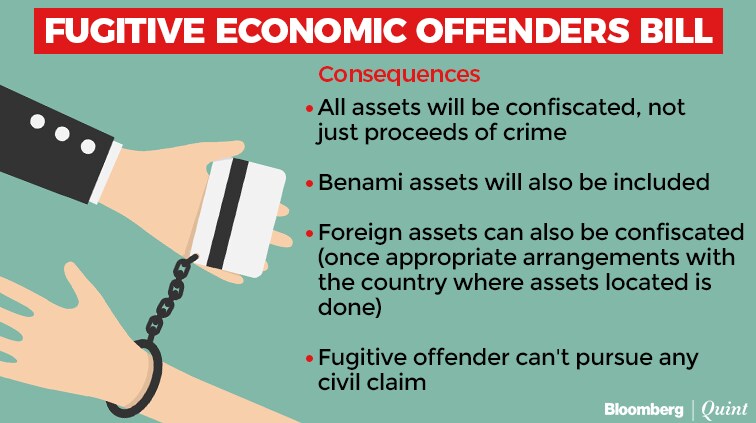
The government's move comes after a near Rs 12,700 crore fraud was unearthed at state-run Punjab National Bank where companies linked to billionaire jeweller Nirav Modi allegedly obtained fraudulent credit guarantees to borrow short-term loans from foreign banks. Modi had left India before the crackdown began. The case is being equated with Vijay Mallya, the former chairman of defunct Kingfisher Airlines, who India wants extradited from the U.K. in a loan default case.
“There was a need for a legislation like this because of the widespread belief that people who breach the law then evade the process and get away,” Sidharth Luthra, senior advocate at the Supreme Court, told BloombergQuint in an interaction. “The time taken and the cost to get them back hurt the exchequer and the Indian taxpayer. It becomes a bit of a mockery that they are sitting outside with funds taken out of India.”
Also Read: Global Investors Are Rattled By India's New Season Of Scandal
Luthra said the “confiscatory nature” of the law will face some challenges and will be tested in court. “But the courts should uphold this, by and large, with some tweaking.”
The draft bill, which was approved by the Law Ministry in September, defines a fugitive economic offender as:
- An individual with an arrest warrant who has left India to avoid criminal prosecution.
- It also includes those who refuse returning to the country to face the law.
It will be accompanied with a list of scheduled offences, the finance minister said, and cover the cases where total claims are more than Rs 100 crore. The bill is meant to “provide measures to deter economic offenders from evading the process of Indian law” by remaining outside the jurisdiction of the country's courts.
Also Read: Ghosts Of Frauds Past Haunt Indian Jewelers As Banks Raise Alarm

-
'Never Seen This Level Of Negativity': Sandeep Tandon Says The Next Rally May Be Closer Than You Think

Veteran investor Sandeep Tandon says foreign selling is easing, large-caps are due a comeback and mid-caps are crowded, while he turns positive on gold, power and pharma this Diwali.
-
Indians Stay With Family, Not In Hotels | The Reason Why
India still lacks enough clean, reliable and affordable hotels for budget-conscious travellers.
-
The Economic Imperative: Analysing The Material Driving Force Behind India-Canada Strategic Reset
This economic complementarity is further reinforced by deep institutional investment ties and talent mobility, which form the bedrock of the bilateral framework.
-
Medicine Pricing: Where Must Profit Stop?
India must confront excessive margins, hidden incentives and regulatory gaps that threaten the integrity of medicine.
-
Why Amazon And Flipkart Are Struggling To Beat Meesho In India's Smaller Cities
With 274 million users and lowest-cost logistics, Meesho is defending its value commerce crown against giants like Amazon and Flipkart.
-
High US Salaries, No Green Card Certainty: The Financial Calculation Facing Indian H-1B Families
The suspension of PERM processing at eight technology employers does not cancel existing H-1B visas. What it does is force a question many Indian families have been avoiding: is the US salary worth tying your career and family plans to one employer?
-
Swiggy vs Eternal: Food Delivery's Two Rivals Are No Longer In The Same Race
Eternal is building a private AI assistant, dark.ai. Swiggy is still working out how to make Instamart pay, with an operating loss of Rs 895 crore in the July-September quarter while Blinkit stayed profitable.
-
Where You Live Shapes How You Get To Work | The Reason Why
Two-wheelers are the most popular way to get to work in India, accounting for nearly 43% of workplace commutes.
-
Unhedged Position: Can India See An Indonesia-Style Time Correction?
The Nifty is trading below levels it first clocked in 2024. Is there, then, as I have suggested in the headline, potential that the current time correction drags on painfully for the next three-five, even ten years?
-
Navigating Friction And Energy Realities: An Analysis Of Marco Rubio's October Visit To India
Occurring at a critical juncture marked by stalled trade negotiations and escalating geopolitical pressures over global energy supplies, the visit offers a profound window into modern US-India relations.










