Hung Assembly: What Will Karnataka Governor Vajubhai Vala Do Now?
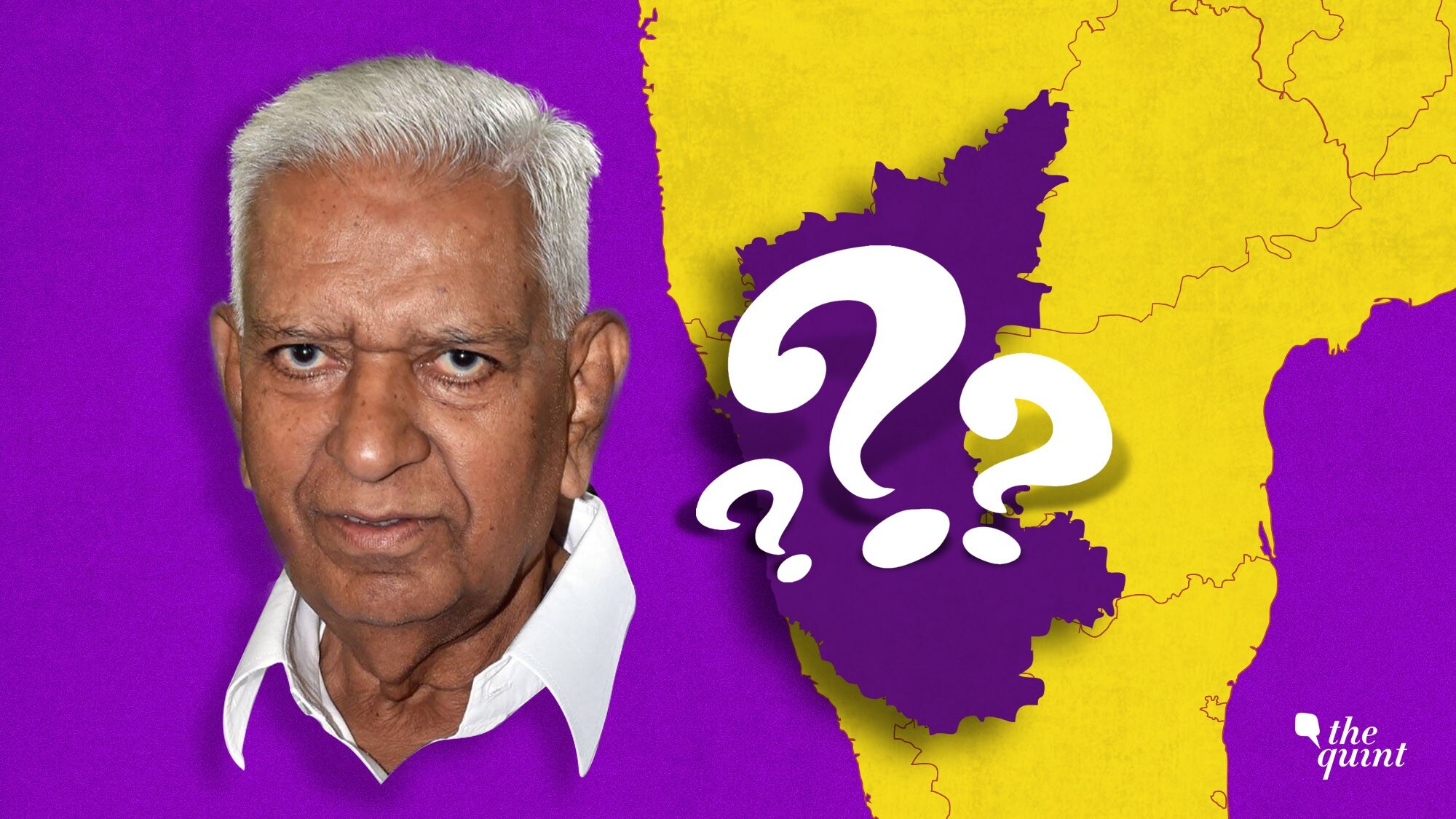
By 10 am on 15 May, the Bharatiya Janata Party (BJP) had emerged as the single-largest party in Karnataka. Celebrations broke out at the party headquarters. Spokespersons in news studios accused TV anchors of airing biased exit polls.
However, by 2 pm, all had fallen silent.
As the BJP's lead slipped from 112 to hover around 104, the incumbent Chief Minister Siddaramaiah and Congress' state-in-charge Gulab Nabi Azad announced they were open to an alliance with the Janata Dal (Secular) (JD(S)), offered the CM's post to the party which has been ranked third in the contest, and hoped they would accompany them to Governor Vajubhai Vala's residence.
The JD(S) promptly agreed.
Within minutes, breaking news tickers declared BS Yeddyurappa was on his way to the governor's residence as well.
What we have in Karnataka currently, is a stalemate.
The governor has said that he will not be entertaining any proposals till the time the Election Commission declares the final results. So, what will be the next step for Vajubhai Vala, a former Gujarat BJP leader, who had, in 2002, vacated his Rajkot seat for Narendra Modi and had also served in his cabinet as a Finance Minister? Will he call upon the single-largest party to form the government as per convention or allow two political contenders who've agreed on a post-poll alliance to come to rule?
If the Congress-JD(S) alliance keeps the BJP from making it to the majority mark, what are the options for the Karnataka governor?
Scenario 1: Allow the Single-Largest Party to Form Government
If Vala goes by constitutional tradition, he should call upon the single-largest party, in this case the BJP, to form the government. But the norm was not followed in the Manipur and Goa elections.
In Goa, the governor had not contacted the Congress, which had emerged the single largest party and had allowed the BJP to form the government on a first-come-first serve basis. Similarly, in Manipur, although the Congress had emerged as the single-largest party, it had fallen short of majority while the BJP had garnered support from other MLAs in the state and the governor had invited the latter to form the government.
Scenario 2: Allow the Congress + JD(S) to Form Government
The power and role of a governor had come under the scanner after the Goa and Manipur elections, where the Congress was caught napping while the BJP managed to get the support of the governor to form the government. Now that the tables have turned, it will be interesting to see how the governor responds to this political stalemate.
There are other precedents as well:
- In 2005, the BJP won 30 out of 81 seats in Jharkhand but JMM leader Shibu Soren, who had the support of 17 MLAs of his own party plus others, was invited to form the government.
- In 2002, in Jammu and Kashmir, the National Conference won 28 MLAs but the governor invited the PDP and the Congress combine consisting of 15+21 MLAs to form the government.
- In 2013, the BJP won 31 seats in Delhi, but the AAP with 28 MLAs, with the support of the Congress, was invited to form the government.
- In September 1999, the Congress with 75 MLAs and the NCP with 58 MLAs had contested against each other in the Maharashtra Assembly polls but had come together to edge out Shiv Sena-BJP (125 MLAs), which had a pre-poll tie-up for the 288-member House.
Scenario 3: Governor Can Call for a Re-Election
The governor can also call for a re-election if no like-minded parties are able to come together and form government. This is least likely in the current situation.
Sarkaria Commission Recommendations, 1988
The Sarkaria Commission set up by the central government in 1983 to examine and suggest changes within the framework of the Constitution of India, came out with a report in 1988, outlining the constitutional convention of inviting the single-largest party if there is a fractured mandate. The guidelines were affirmed by a Constitution Bench of the Supreme Court in 2005.
According to the recommendations of the commission, this is the order of preference the governor should follow while selecting a CM:
- An alliance of parties that was formed prior to the elections
- The single-largest party staking claim to form the government with the support of others, including Independents
- A post-electoral coalition of parties, with all the partners in the coalition joining the government
- A post-electoral alliance of parties, with some of the parties in the alliance forming a government and the remaining parties, including Independents, supporting the government from outside
MM Punchhi Commission Recommendations, 2010
The Government of India had constituted a commission to analyse the Centre-State Relations under the chairmanship of Justice Madan Mohan Punchhi, former Chief Justice of India on 27 April 2007.
According to the recommendations of the commission, which were submitted in a seven-volume report on 30 March 2010, there should be clear guidelines for the appointment of chief ministers, so that there is regulation on the discretionary power of the governor. According to the recommendations, the following order of precedence ought to be followed by the governor in case of a hung House:
- The group with the largest pre-poll alliance commanding the largest number
- The single largest party with support of others
- The post-electoral coalition with all parties joining the government
- The post electoral alliance with some parties joining the government and remaining including Independents supporting from outside
In the Nabam Rebia and Bamang Felix vs Deputy Speaker case in 2016, a five-judge bench, recommended to follow the Punchhi and Sarkaria Commissions regarding the role of the governor and said the governor was bound by the advice of the council of ministers.
Constitutional expert Subhash Kashyap, on 15 May, reiterated that, “It is up to the understanding of the governor whom he calls to form the government. It is up to him if he wants to call the single-largest party or a coalition government”.
(The Quint is now on WhatsApp. To receive handpicked stories on topics you care about, subscribe to our WhatsApp services. Just go to TheQuint.com/WhatsApp and hit Send.)

-
Indians Are Travelling, But Not Every Journey Is A Holiday | The Week In Whys

Pilgrims, patients and working women are the real travellers, and the system hasn't quite caught up with them.
-
Getting To Work Costs Women More | The Reason Why
It is not just about women paying more than men. It is about women paying much more in cities than in villages.
-
AI Bias In Investing Cannot Be Eliminated, But It Can Be Governed
Framing is a particularly important example as identical financial information presented in terms of gains rather than losses can lead an LLM to reach a different assessment.
-
Joining The Dots | Dark Skies, Steady Diya: Why Hope Holds This Diwali
With war, a weak rupee and foreign outflows weighing on sentiment, policymakers at the NDTV World Summit and market veterans at NDTV Profit Ignite: Diwali Edition offered the same advice: stay invested and filter out the noise.
-
The Curious Case of Equitas Small Finance Bank And A CEO Who Quit For Stock
PN Vasudevan believes persistent investor concerns over a perceived conflict of interest had become a governance overhang on Equitas Small Finance Bank's stock, even as the lender improved profitability and asset quality.
-
Talking Points This Week: AI Cash Burn, A Tiger Comeback And An India That Still Finds Its Own Path
India is not immune to higher oil or tighter global liquidity, yet its earnings base is broader, its domestic policy levers are still available.
-
Foreign Investors Own Half Of HDFC Bank and ICICI Bank. An LTCG Cut Could Matter Most Here
Foreign portfolio investors have US$115 billion parked in HDFC Bank, ICICI Bank. If the government cuts long-term capital gains tax, Jefferies says returning foreign money could land here first.
-
'Never Seen This Level Of Negativity': Sandeep Tandon Says The Next Rally May Be Closer Than You Think
Veteran investor Sandeep Tandon says foreign selling is easing, large-caps are due a comeback and mid-caps are crowded, while he turns positive on gold, power and pharma this Diwali.
-
Indians Stay With Family, Not In Hotels | The Reason Why
India still lacks enough clean, reliable and affordable hotels for budget-conscious travellers.
-
The Economic Imperative: Analysing The Material Driving Force Behind India-Canada Strategic Reset
This economic complementarity is further reinforced by deep institutional investment ties and talent mobility, which form the bedrock of the bilateral framework.










