Heart Of Asia Summit: Sartaj Aziz Rakes Up Indo-Pak Ties, Says Simplistic To Blame A Country
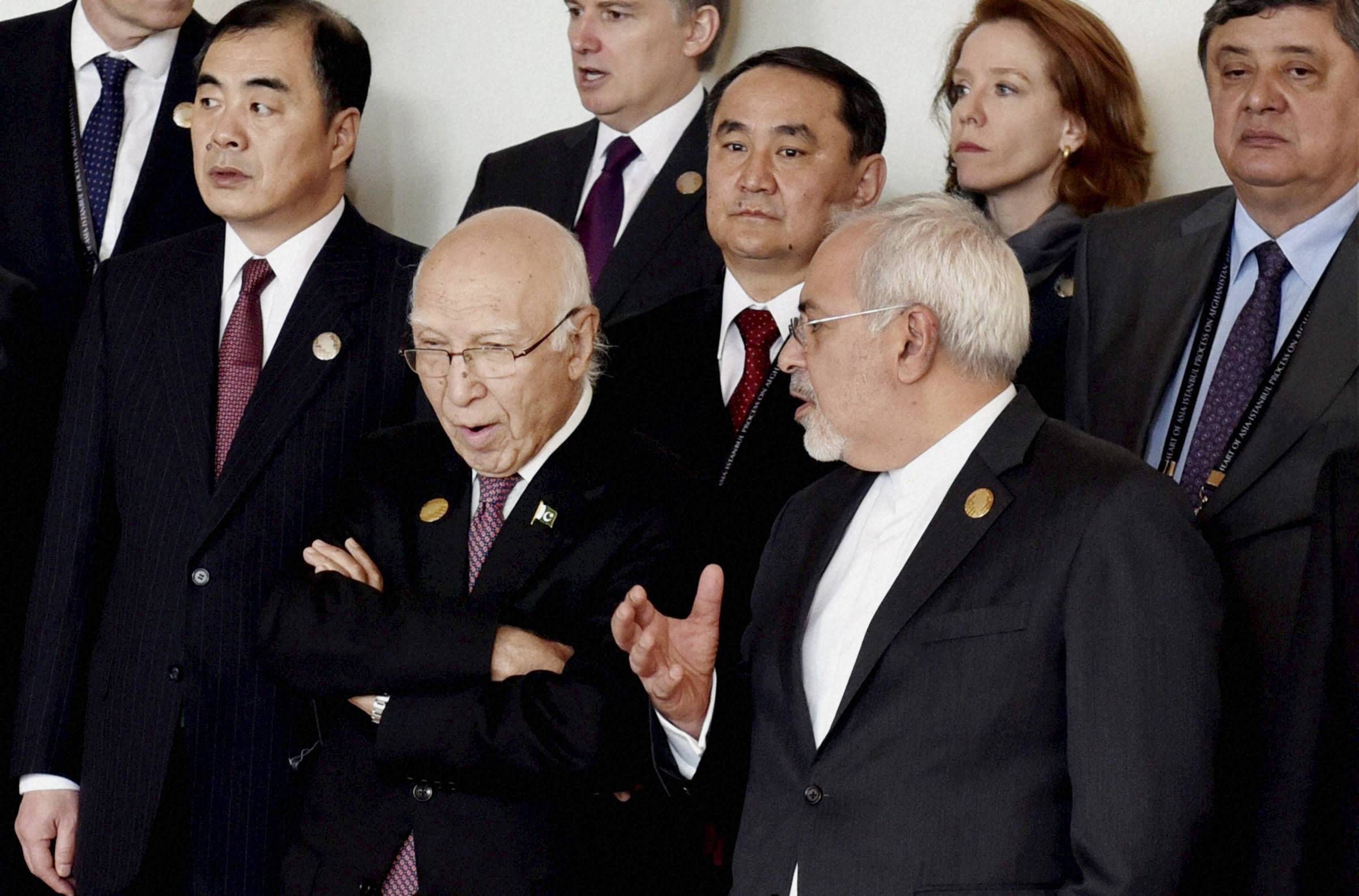
Under severe attack over terrorism emanating from its soil, Pakistan's Foreign Affairs Advisor Sartaj Aziz on Sunday hit back saying it is "simplistic" to blame one country even as he raked up the issue of strain in Indo-Pak ties at the Heart of Asia conference on Afghanistan.
Aziz asserted his attending the meet despite "escalation" along the LoC was testimony to Pakistan's "unflinching" commitment for lasting peace in Afghanistan and expressed unhappiness over cancellation of SAARC Summit in Islamabad in November, terming it as a setback to regional cooperation. He did not mention the issue of Jammu and Kashmir.
Noting that Pakistan was aware about serious challenges being faced by Afghanistan, Aziz said, "The first and foremost in our view is continuing violence and acts of terrorism claiming scores of human lives. This needs to be addressed urgently and effectively through collective efforts.
The security situation in Afghanistan is very complex. It is simplistic to blame only one country for the recent upsurge in violence. We need to have an objective and holistic view.Sartaj Aziz, Foreign Affairs Advisor, Pakistan
His strong response came after India and Afghanistan hit out at Pakistan for sponsoring and supporting terrorism and called for "resolute action" against terrorists as well as their masters.
Afghan President Ashraf Ghani, who jointly inaugurated the annual Ministerial conference here along with Prime Minister Narendra Modi, directly hit out at Pakistan for "launching an undeclared war" against his country and demanded an Asian or international regime to verify Pak-sponsor terror operations.
In his address at the HoA conference, a platform for Afghanistan's transition, Aziz said," My participation in the event, despite escalation on the Line of Control and the Working Boundary with India, is testimony to Pakistan's unflinching commitment for lasting peace in Afghanistan and the region.
"I look forward to meaningful deliberations today towards this objective," he said and pressed for a politically negotiated settlement of the Afghan issue.
Observing that regional cooperation plays an important role in ensuring political stability and promoting economic cooperation, he said postponement of the SAARC Summit scheduled in Islamabad in November was a setback to these efforts and "undermined the spirit of regional cooperation".
"SAARC is an important forum, not only for promoting regional cooperation but also for the improvement of relations," he said.
India had pulled out of SAARC Summit, citing cross-border terror strikes emanating from Pakistan. Afghanistan and other SAARC countries had also sought cancellation of the eight-nation meet on the grounds that there was incitement of terrorism in the region.
Aziz arrived in Amritsar on Saturday night amid heightened tension between India and Pakistan over a series of cross-border terror attacks on India by Pakistan-based terror outfits and India's surgical strike across the LoC two months back. Aziz said the peace process for talks between Afghan Government and Taliban has not yet produced positive results and Pakistan has been making "serious efforts for facilitating the peace talks".
"In our view, there is no military solution to the Afghan conflict and all our efforts should be to achieve a politically negotiated settlement through an Afghan-led Afghan-owned process," he said.
He said Pakistan deeply values the Heart of Asia-Istanbul Process in promote Afghanistan's connectivity with neighbouring and regional countries for durable stability in Afghanistan.
"Afghan security forces have firmly and bravely stood their ground in repulsing militant and terrorist attacks.
The international community has reiterated its commitment of support to Afghanistan in the areas of security and economic development upto 2020.
"The Government and people of Pakistan stand in complete solidarity with the elected government and people of Afghanistan in furthering the objective of peace, stability and development in Afghanistan.
"We would do whatever we can to help achieve this objective," he said.
The conference is being attended by over 30 countries including Russia, China, the US.
"The Afghan Government has also signed peace agreement with Hizb-i-Islami Afghanistan (HIA). The implementation of this peace deal can serve as a model for talks with other insurgent groups in future," he said.
Calling for enhanced regional connectivity to stimulate economic development, he said Pakistan was building its national rail, road and energy transmission network to meet with the growing regional transport needs.
"The focus is on modern, state of the art infrastructure including through the China Pakistan Economic Corridor (CPEC).
"There is immense potential for connecting our transportation and energy infrastructure with Afghanistan, and other countries of West and Central Asia," he said.
He said Pakistan was committed to enhancing facilitation for transit of Afghan goods through Pakistan.
"We believe the two sides need to work together for extension of and improvements in the Afghanistan Pakistan Transit Trade Agreement (APTTA)," he said.
The postponement of the SAARC Summit scheduled in Islamabad in November 2016 was a setback to these efforts and undermined the spirit of regional cooperation.
He voiced hope that the deliberations would be constructive and focused on the efforts for lasting peace and stability in Afghanistan, which is our shared objective.
Pakistan also welcomes the invitation of Azerbaijan to host the 7th Ministerial Conference of the Heart of Asia process in 2017 and looks forward to its active participation in this Conference, he said.

-
Indians Are Travelling, But Not Every Journey Is A Holiday | The Week In Whys

Pilgrims, patients and working women are the real travellers, and the system hasn't quite caught up with them.
-
Getting To Work Costs Women More | The Reason Why
It is not just about women paying more than men. It is about women paying much more in cities than in villages.
-
AI Bias In Investing Cannot Be Eliminated, But It Can Be Governed
Framing is a particularly important example as identical financial information presented in terms of gains rather than losses can lead an LLM to reach a different assessment.
-
Joining The Dots | Dark Skies, Steady Diya: Why Hope Holds This Diwali
With war, a weak rupee and foreign outflows weighing on sentiment, policymakers at the NDTV World Summit and market veterans at NDTV Profit Ignite: Diwali Edition offered the same advice: stay invested and filter out the noise.
-
The Curious Case of Equitas Small Finance Bank And A CEO Who Quit For Stock
PN Vasudevan believes persistent investor concerns over a perceived conflict of interest had become a governance overhang on Equitas Small Finance Bank's stock, even as the lender improved profitability and asset quality.
-
Talking Points This Week: AI Cash Burn, A Tiger Comeback And An India That Still Finds Its Own Path
India is not immune to higher oil or tighter global liquidity, yet its earnings base is broader, its domestic policy levers are still available.
-
Foreign Investors Own Half Of HDFC Bank and ICICI Bank. An LTCG Cut Could Matter Most Here
Foreign portfolio investors have US$115 billion parked in HDFC Bank, ICICI Bank. If the government cuts long-term capital gains tax, Jefferies says returning foreign money could land here first.
-
'Never Seen This Level Of Negativity': Sandeep Tandon Says The Next Rally May Be Closer Than You Think
Veteran investor Sandeep Tandon says foreign selling is easing, large-caps are due a comeback and mid-caps are crowded, while he turns positive on gold, power and pharma this Diwali.
-
Indians Stay With Family, Not In Hotels | The Reason Why
India still lacks enough clean, reliable and affordable hotels for budget-conscious travellers.
-
The Economic Imperative: Analysing The Material Driving Force Behind India-Canada Strategic Reset
This economic complementarity is further reinforced by deep institutional investment ties and talent mobility, which form the bedrock of the bilateral framework.










