Haphazard Appointment Of Judges Worsening High Court Judicial Delays
High courts nationwide are 37 percent short of judges, and ad hoc appointments–not posting judges to courts that need them most–are worsening delays and affecting India's economy, according to our analysis of data released by the department of justice.
There were over 4.2 million cases pending in the 24 high courts of India on Feb. 4, according to the National Judicial Data Grid, with 49 percent of these cases more than five years old.
Data from central ministries show that infrastructure projects of close to Rs 52,000 crore are affected by court orders, according to the Economic Survey 2017-18.
India's judicial delays are legendary, and the shortage of judges is well documented, as IndiaSpend has previously reported (here, here, here and here).
The Allahabad High court has the highest number of pending cases, exceeding 900,000 cases in 2016 and 2017.
The number of pending cases has declined during 2017 by a slight margin in only three of 24 high courts.
In terms of increase in pending cases, Karnataka High Court is the most stressed court with an increase in pendency of 36,479 cases followed by Hyderabad and Punjab & Haryana with 32,548 and 30,195 pending cases, respectively.
The working strength of judges has not changed for the three high courts of Jharkhand, Meghalaya and Sikkim.
The number of judges has declined in Calcutta (seven), Himachal Pradesh (three), Gujarat and Tripura (two) and Manipur and Orissa (one).
The working strength has increased in all other courts with Madras witnessing the maximum increase of 16 judges, followed by Bombay with 10 judges, and Patna, Rajasthan, Gauhati and Chhattisgarh with six judges each.
One would expect that the most stressed courts should get a good share of new judges. The simplest metric to compute the stress is the average pending cases per judge. The higher the average case burden per judge, more stressed the court.
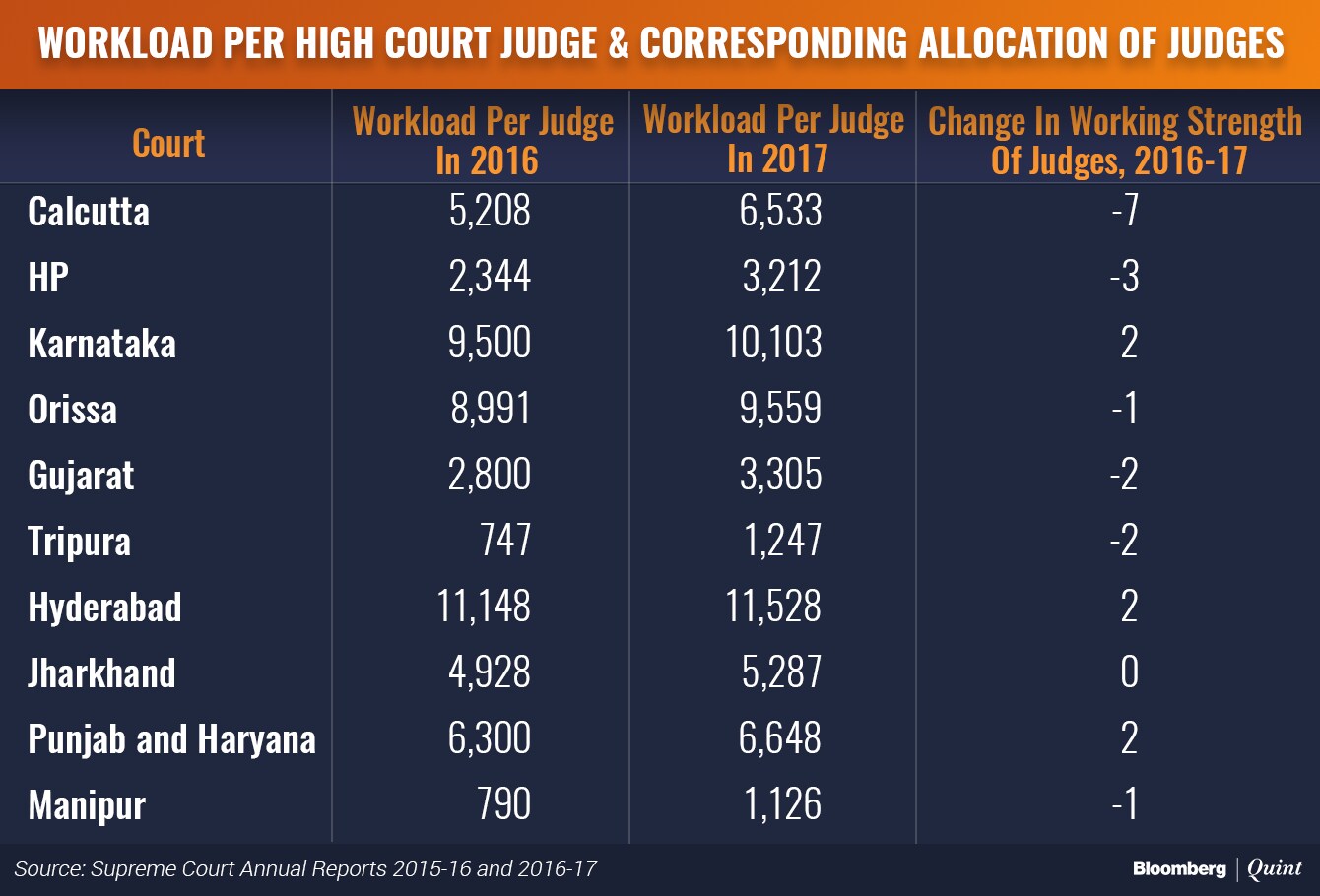
Note: Click here for data on all high courts.
Supreme Court Annual Reports 2015-16 and 2016-17
In 2016, although Bombay had a lower workload per judge than Calcutta, Bombay saw an increase of 10 judges while Calcutta saw a decline of seven judges.
Rajasthan and Gauhati got the same increase in judges while Rajasthan had twice the workload per judge than Gauhati.
Madras and Bombay have got disproportionally high allocation of judges, while Allahabad, Hyderabad, Karnataka and Jammu & Kashmir have lower allocation despite high caseloads.
New judges should be allotted–or transfers made–to courts depending on pending cases. And the judicial appointments and transfers should be based on the metric of workload per judge.
Currently, the collegium (which comprises of the Chief Justice of India and four senior most judges of the Supreme Court) recommends the appointments and transfers of judges. The collegium does not have any place in the Constitution.
The government had recommended the National Judicial Appointments Commission (NJAC) as a constitutional body to replace the collegium system of appointments of judges. However, the Supreme Court rejected the NJAC Act.
“Given the high pendency of cases and high vacancy in the Allahabad High Court, transparency in the allocation of judges is very important,” said Vinod Kumar Singh, senior advocate, High Court of Allahabad (Lucknow bench). “I hope the collegium makes the allocation process more transparent.”
“But for the system to heal, the process of higher judicial appointments needs a fundamental rejig,” Member of Parliament Baijayant ‘Jay' Panda, wrote in The Times of India on January 18, 2018. “SC would do well to review its NJAC decision; if it does not, Parliament must re-enact something similar.”
(Shobhit Mathur is the executive director at Vision India Foundation, a non-profit policy research and training organisation based in New Delhi. Pallabi Mandal is a BTech student at NSIT, New Delhi.)
This article has been published in arrangement with IndiaSpend.

-
Gold Is Rs 22,000 Cheaper Than A Month Ago. Should You Buy Amid The Wedding Season?

Gold's potential slide to $3,500 could save around Rs 4,700 per 10 grams, but a soft inflation print could just as easily push prices back up. One way to split the risk is to buy in parts, some now and the rest after the Fed's Dec. 9 decision.
-
AI Agents Are Gaining Power. Who Governs Them?
Artificial intelligence agents promise to transform productivity by moving machines from assisting decisions to executing them. But as organisations delegate greater authority to these AI-agents, they must first establish who controls that authority and who remains accountable when things go wrong.
-
Why Swapping Your Old Gold Can Trigger A Rs 5 Lakh Tax Bill, And How You Can Avoid It Legally
Swapping old gold for new is taxed as a sale and a fresh purchase. Getting your own gold remade can cut most of that bill, though it has its own costs.
-
The AI Trade is Done. The Real Opportunity for Investors Starts in 2027 | Unhedged Position
As pureplay AI stocks plunge and circular, capex-led financing unwinds, 2027 is set to be a year of reckoning for AI companies. Yet the bust clears the way for a better opportunity for investors in 2027 -- shifting the spotlight from AI builders to the companies using AI.
-
Leadership As Mission: Why The Age Of AI Demands More Human Leadership
Debjani Ghosh examines how AI is changing leadership, arguing that its success must be measured by its impact on people and the accountability of those guiding its use.
-
We May Need Another Tukaram Mundhe To Fight Air Pollution | The Reason Why
Developers may install basic measures such as sprinklers and green nets, resume work, and continue violating rules when this equipment stops working.
-
Extracting Value From Battery Scrap Could Be Challenging For India | The Reason Why
A discarded lithium-ion battery still contains valuable materials such as lithium, nickel and cobalt. These can be recovered and reused. When such batteries are crushed and shredded, they produce a dark powder called black mass.
-
One El Nino, India Can Handle. Two Could Break The Granary
India's grain stocks can absorb one bad year, but a second El Nino could drain the buffer in two to three years, economists say.
-
India's Troika Of Good Luck | Joining The Dots
As Jensen Huang's exit drags Nvidia down, a cooling AI trade and resilient earnings have revived investor interest in India. A likely RBI rate hike looms.
-
Talking Points This Week: Leadership Shock At Nvidia, Earnings Strength, And The Fog Over Hormuz
The Anthropic IPO pricing and first trading day, Nvidia's upcoming earnings, and any fresh signals from Iran will set the tone for the following week.









