Before it Can Fire, Bullet Train Draws Gujarat Farmers’ Ire
Video Editor: Abhishek Sharma
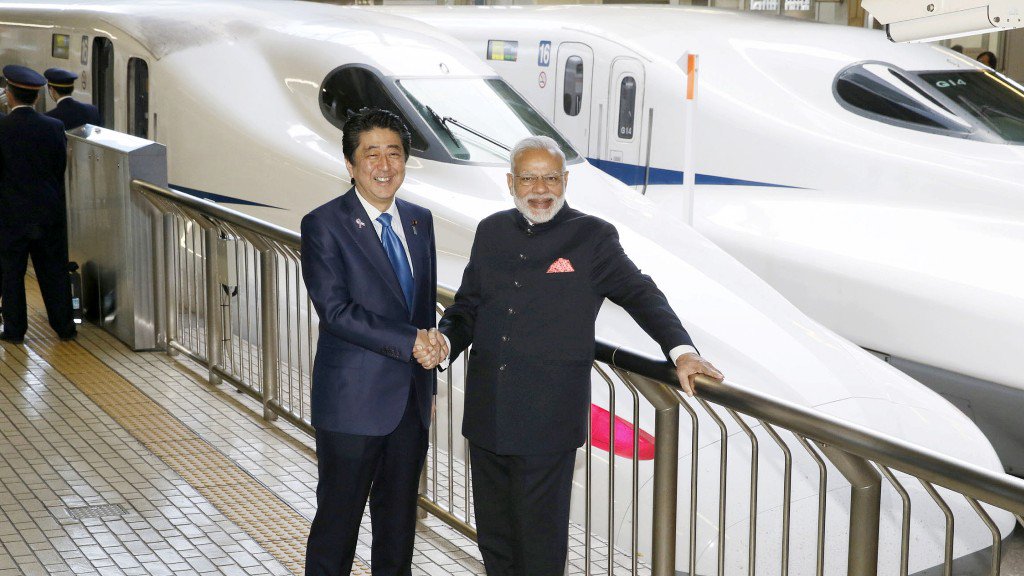
Prime Minister Narendra Modi left no stone unturned when he staged a grand welcome for his Japanese counterpart Shinzo Abe in September 2017. The reason for Modi's excitement was well-know — Abe was in India to lay, along with Modi, the foundation stone for the Mumbai-Ahmedabad High Speed Rail Corridor.
The multibillion-dollar ‘Shinkansen' (Bullet Train) project promises to reshape the way Indians travel, by covering 508 kms between Ahmedabad and Mumbai in just a couple of hours.
Although the ambitions of the project are quite lofty, things are not so hunky-dory at ground level.
The Gujarat government aims to acquire around 800 hectares of land for the project by December 2018. However, by mid-June 2018, not even a single acre of land has been acquired.
To make up for lost time, the state government is rushing the acquisition process, issuing short notices to farmers and land owners. The farmers of Gujarat are seething with rage as the government has neither declared the rate of compensation nor issued notices and notifications apprising the farmers about the project and its ramifications.
One Project, Two Laws!
As the ‘High-Speed Rail Corridor' covers two states (Maharashtra and Gujarat), the controlling authority for the land acquisition process is the Centre, according to the Land Acquisition Act, 2013.
“However, the Gujarat government is applying its 2016 amendment of the Centre's law in order to take advantage of some serious loopholes in the acquisition process,” says Surat-based environmentalist Krishnakant Chauhan, who is helping farmers and land owners of south Gujarat protect their interests.
The 2013 act protects farmers and land owners by considering their consent and mandates a ‘social impact study' before the acquisition process is undertaken. But with the 2016 amendment of the Gujarat government, consent and social impact study goes right out of the window.
The Quint spoke to Dwaipayan Dutta from Arcadis India Private limited, who are consulting the National High-Speed Rail Corporation Limited (NHSRCL) on the land acquisition process in Gujarat.
Yes, we are applying the Gujarat Amendment (2016) of the Land Acquisition Act, 2013. Our work is based on the directives issued by the NHSRCL, and if they allow us to apply the 2013 act, then we will do so. We are only the consultants and will cater to the requirements of our clients.Dwaipayan Dutta, Arcadis India Private Limited, Consultants on Land Acquisition Process to NHSRCL
The Quint also spoke to the NHSRCL spokesperson and the Press Advisor to the Chairman of Railway Board, Dhananjay Kumar, who explicitly said that both laws are applicable.
The 2016 act is an amendment of the 2013 land acquisition act. In Maharashtra too, we are applying the 2013 land acquisition act. Besides the state has control over the land acquisition process so we have to follow the law that is applicable there.Dhananjay Kumar, spokesperson, NHSRCL
No Clarity on Compensation
Dhananjay insists that the highest rate of compensation will be offered to the land losers, albeit he did agree that this information has not been properly disseminated to the farmers and land owners of Gujarat.
According to him, three parameters will be considered while calculating the compensation package.
· Circle rate or Jantri rate (which has not been revised in Gujarat since 2011)
· Market Value: A maximum 50 % compensation on the average of the highest stamp duty paid for a property in the last three years along with an ex gratia of Rs 5 lakh. (If someone willingly consents to give away their land, additional 25% will be paid to them above the actual compensation.)
· Compensation rate applicable on an existing or recently concluded PPP (Public Private Partnership) project.
Mohanbhai Patel will lose two homes and a mango orchard to the bullet train, which will cut right through the heart of his property.
Neither did they send any valuer to assess the property nor did they inform me about the cost of my property. Based on the current market value, just the land alone will cost Rs 50-60 lakh. They issued a notice only a fortnight ago and want a quick reply. We should at least three months. This is our land, it cannot be sold overnight. Where will we go?Mohanbhai Patel, land owner from Valsad
Slapdash Stakeholder Meets
NHSRCL called for stakeholder consultation meetings by publishing ads in local newspapers to notify land owners. But this was done in an utterly disorganised manner.
In Nadiad district, the notice was advertised in the local newspaper 20 days before the meeting. But in Bharuch and Vadodara, the notice was advertised 24 hours before the meeting. What's worse, the notification meant for Bharuch was put out in a Vadodara newspaper.Krishnakant Chauhan, Surat-based Environmentalist
Dwaipayan Dutta claimed that stakeholder consultations across Gujarat have concluded. “We follow what our client (NHSRCL) demands. They asked us to conduct the stakeholder consultation within a week. They are not aware of the consequences of rushing into such meetings, which we faced in Vadodara and Bharuch. People were agitated because the meeting's notice was genuinely short,” he said.
Dhananjay Kumar too rues the fact that there is animosity among farmers against the project .
I agree that information on compensation has been poorly dispensed among the farmers and land owners, and their rage is completely logical. We mean to change this scenario and will ensure that all concerned parties are clear on the compensation rate and process. I am certain that once the farmers are aware of the high returns, they will turn-in their land willingly.Dhananjay Kumar, NHSRCL spokesperson and Press Adviser to the Chairman of Railway Board

-
We May Need Another Tukaram Mundhe To Fight Air Pollution | The Reason Why

Developers may install basic measures such as sprinklers and green nets, resume work, and continue violating rules when this equipment stops working.
-
Extracting Value From Battery Scrap Could Be Challenging For India | The Reason Why
A discarded lithium-ion battery still contains valuable materials such as lithium, nickel and cobalt. These can be recovered and reused. When such batteries are crushed and shredded, they produce a dark powder called black mass.
-
One El Nino, India Can Handle. Two Could Break The Granary
India's grain stocks can absorb one bad year, but a second El Nino could drain the buffer in two to three years, economists say.
-
India's Troika Of Good Luck | Joining The Dots
As Jensen Huang's exit drags Nvidia down, a cooling AI trade and resilient earnings have revived investor interest in India. A likely RBI rate hike looms.
-
Talking Points This Week: Leadership Shock At Nvidia, Earnings Strength, And The Fog Over Hormuz
The Anthropic IPO pricing and first trading day, Nvidia's upcoming earnings, and any fresh signals from Iran will set the tone for the following week.
-
Signature Play: The Classic Cocktail Is Dead. Or Is It?
Classic cocktails are disappearing from India's cocktail menus. But they're still being ordered, taught to bartenders and borrowed from. So, who's really having the last drink?
-
A New Samvat Wishlist: Inclusive Prosperity And Human Development
India has strengthened its economic foundations through infrastructure, digital access and enterprise. Its next growth chapter must deepen productivity, create better livelihoods and widen participation in prosperity.
-
Love, Sex Aur Dhokha: The Audacious Plot To Spy On Jensen Huang
A Taipei dinner, a Singapore chip buyer and a suspected Chinese asset: inside the alleged spy operation that got close to NVIDIA's Jensen Huang.
-
Ten Things I Learnt This Samvat
Patience can be a trap. Cheap stocks can stay cheap. Leverage can wipe you out. What did Samvat 2082 teach us? Niraj Shah writes on 10 lessons from the year gone by.
-
Talking Points This Week: Tech Nerves, FII Buying, And A Faraway Banking Shock
The global markets are not shining this Diwali. The exception in the large markets is, India.









