Germany Risks Reprising Sick Man Status on Russia, China Ties
(Bloomberg) --
Germany's economy might again become the “sick man of Europe,” reprising a role from two decades ago as policies that kept factories humming turn sour.
After years of pushing exports to China and building up energy links to Russia, Europe's largest economy faces a poisonous cocktail of risks. Its heavy reliance on manufacturing makes it more vulnerable than European peers to war-related disruptions in Russian energy supplies and bottlenecks in trade. The upshot is risk of contraction and even higher prices squeezing unsettled consumers.
“Germany is in a disastrous economic situation,” said Aline Schuiling, senior economist at ABN Amro. “Concerns about its outlook are well justified.”
Schuiling predicts Germany's output will shrink in the second quarter. While economists at Bank of America Merrill Lynch and Banco Santander are among those sharing her opinion, the Bloomberg consensus is still for growth of 0.4%.
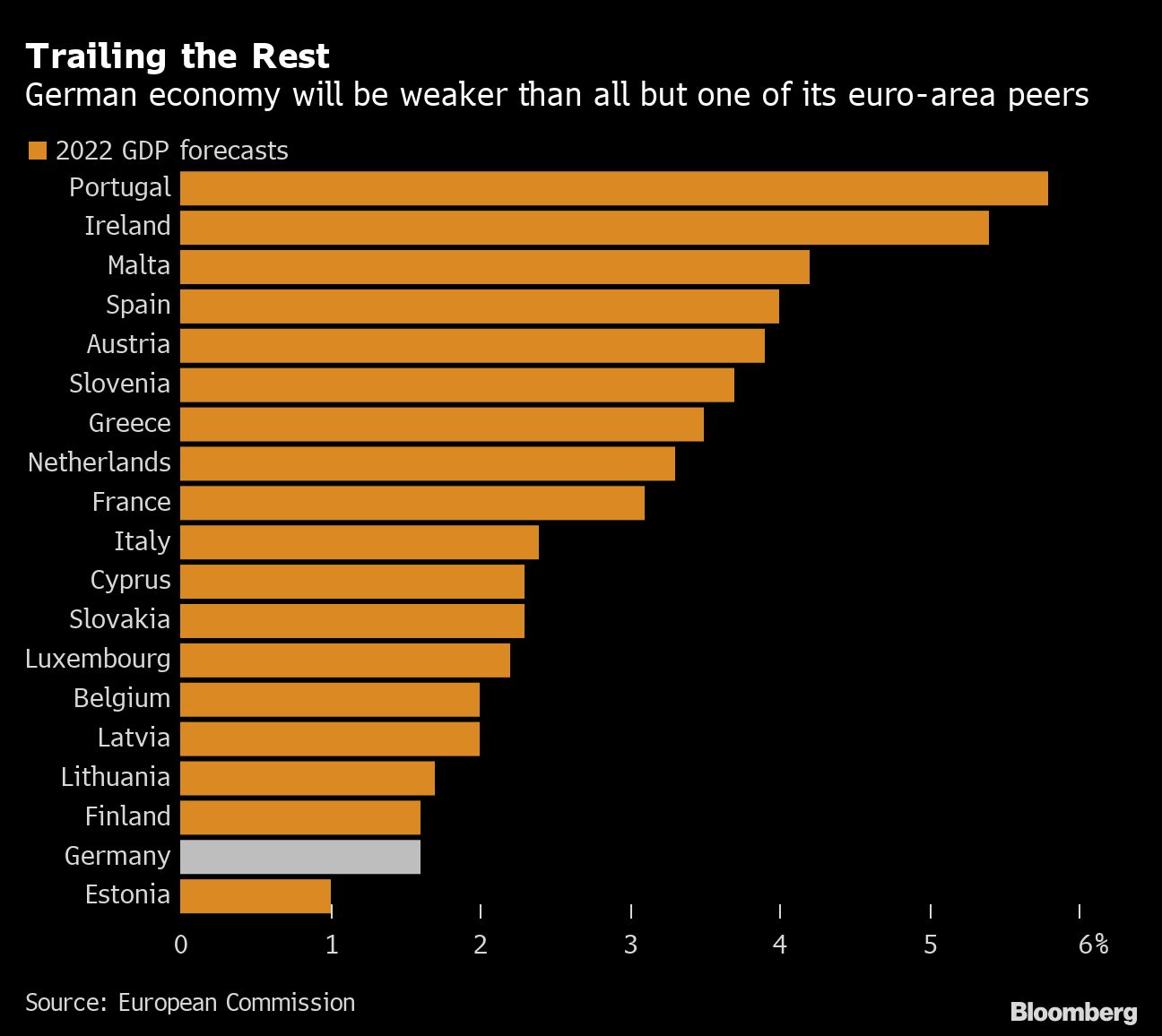
The European Commission expects only Estonia to post slower economic growth than Germany this year -- due to similar impacts but a closer proximity to Russia -- while inflation in both countries is expected to be stronger than the 19-nation euro-area average.

The strain is becoming evident at the heart of the Germany economy. Some 77% of manufacturers are complaining that material and equipment shortages are hurting business -- more than anywhere else in Europe. The country's machine makers slashed their forecast for production growth to just 1% from 4%.
On top of the industrial headaches, the summer travel season is likely to siphon off cash as German consumers spend money in sunny Mediterranean countries after two years of pandemic. Retailers may have already started feeling the pinch with sales dropping the most in a year in April.

Germany's struggles stem from ignoring geopolitical risks to strengthen its manufacturing base, which -- along with sweeping labor reforms -- helped pull the country out of a slump in the early 2000s. Both former Chancellor Angela Merkel and her predecessor Gerhard Schroeder intensified the country's reliance on cheap energy from Russia, while encouraging companies to do business in China.
“That made Germany the best performing economy in Europe, but now there is a heavy price to pay,” billionaire investor George Soros said last week at the World Economic Forum.
Chancellor Olaf Scholz seemed to acknowledge the concerns, saying “some people were a bit careless in the past.” Germany now needs to urgently diversify supply chains and export markets, he said at the event in Davos, Switzerland.
“Many companies have to face it,” Scholz said. “They often violated what they'd learned at the start of business school: that you don't to put all your eggs in one basket.”

Since taking office, Scholz's first trip to Asia was to Japan, while he also hosted Indian Prime Minister Narendra Modi in Berlin. He hasn't yet visited China and has stepped up criticism of human-rights abuses in the country. His government has also held talks with Qatar as part of its efforts to replace Russian gas.
Despite the clouds, there are some hopeful signs. Easing pandemic lockdowns in Beijing and Shanghai could help buoy demand for German goods and clear some of the supply-chain bottlenecks hampering the country's manufacturers.
Automakers including Daimler Truck Holding AG, the world's largest maker of commercial vehicles, expect an ongoing chip shortage to be less of an issue this quarter and significantly improve in the second half.
Bundesbank President Joachim Nagel argues that the German economy is holding up, and that output could still increase 2% this year.

The consumer side might be less resilient as inflation continues to surge. Households are facing additional expenses on food of more than 250 euros ($268) a person this year, according to an Allianz SE study, which predicts Germany will see faster inflation than its European peers.
With the cost of living rising, there's less available for discretionary spending. Revenue growth at online clothing retailer Zalando SE is likely to stay flat until the second half, Bloomberg Intelligence predicts.
A big chunk of what's left will likely be spent in countries such as Spain, Italy and Greece this summer. Domestic destinations accounted for only 37% of all trips longer than five days taken by Germans in 2021.
That might change with the government offering a nine-euro monthly ticket for public transportation this summer. The measure, which allows unlimited travel on regional trains, is part of a package aimed at taking the sting out of higher consumer prices, especially for fuel.
On Wednesday, Scholz said his government is taking the “unusual step” of convening talks with employers and unions outside the regular wage negotiations as part of a national effort to counter inflation.
“We want concerted action against price pressure,” he told lawmakers in the lower house of parliament in Berlin.
More stories like this are available on bloomberg.com
©2022 Bloomberg L.P.

-
Talking Points This Week: Leadership Shock At Nvidia, Earnings Strength, And The Fog Over Hormuz

The Anthropic IPO pricing and first trading day, Nvidia's upcoming earnings, and any fresh signals from Iran will set the tone for the following week.
-
Signature Play: The Classic Cocktail Is Dead. Or Is It?
Classic cocktails are disappearing from India's cocktail menus. But they're still being ordered, taught to bartenders and borrowed from. So, who's really having the last drink?
-
A New Samvat Wishlist: Inclusive Prosperity And Human Development
India has strengthened its economic foundations through infrastructure, digital access and enterprise. Its next growth chapter must deepen productivity, create better livelihoods and widen participation in prosperity.
-
Love, Sex Aur Dhokha: The Audacious Plot To Spy On Jensen Huang
A Taipei dinner, a Singapore chip buyer and a suspected Chinese asset: inside the alleged spy operation that got close to NVIDIA's Jensen Huang.
-
Ten Things I Learnt This Samvat
Patience can be a trap. Cheap stocks can stay cheap. Leverage can wipe you out. What did Samvat 2082 teach us? Niraj Shah writes on 10 lessons from the year gone by.
-
Talking Points This Week: Tech Nerves, FII Buying, And A Faraway Banking Shock
The global markets are not shining this Diwali. The exception in the large markets is, India.
-
Midterm Rally Lasted A Day. The Hard Reality Of A Divided US May Last Two Years | Opinion
Between a contested AI boom, a debt ceiling that arrives in 2027 and a president with every incentive to act alone, the next two years may prove more volatile than the first day's rally suggests.
-
Blue Wave Will Derail the AI Trade but Won't Dismantle the AI Era | Unhedged Position
The Democrats' sweep of the US Congress will see politics collide with economic forces both over the long and short term.
-
It's Time To Take The GST Council's Bet On Trust Global
Payment records can prove India's services exports, and clear, proportionate rules can bring foreign digital sellers into the tax net.
-
Opinion | India at 38: From Innovation Overperformer to Innovation Powerhouse
India now has 453 VC-backed deep science startups, 18 of them late-stage, after 117 percent growth since 2020. Laurus Labs, at USD 9.3 billion, is the most valuable deep science company in any middle-income economy outside China.









