Fuel Tax Tussle: Who Can Afford To Cut Taxes, Centre Or States?
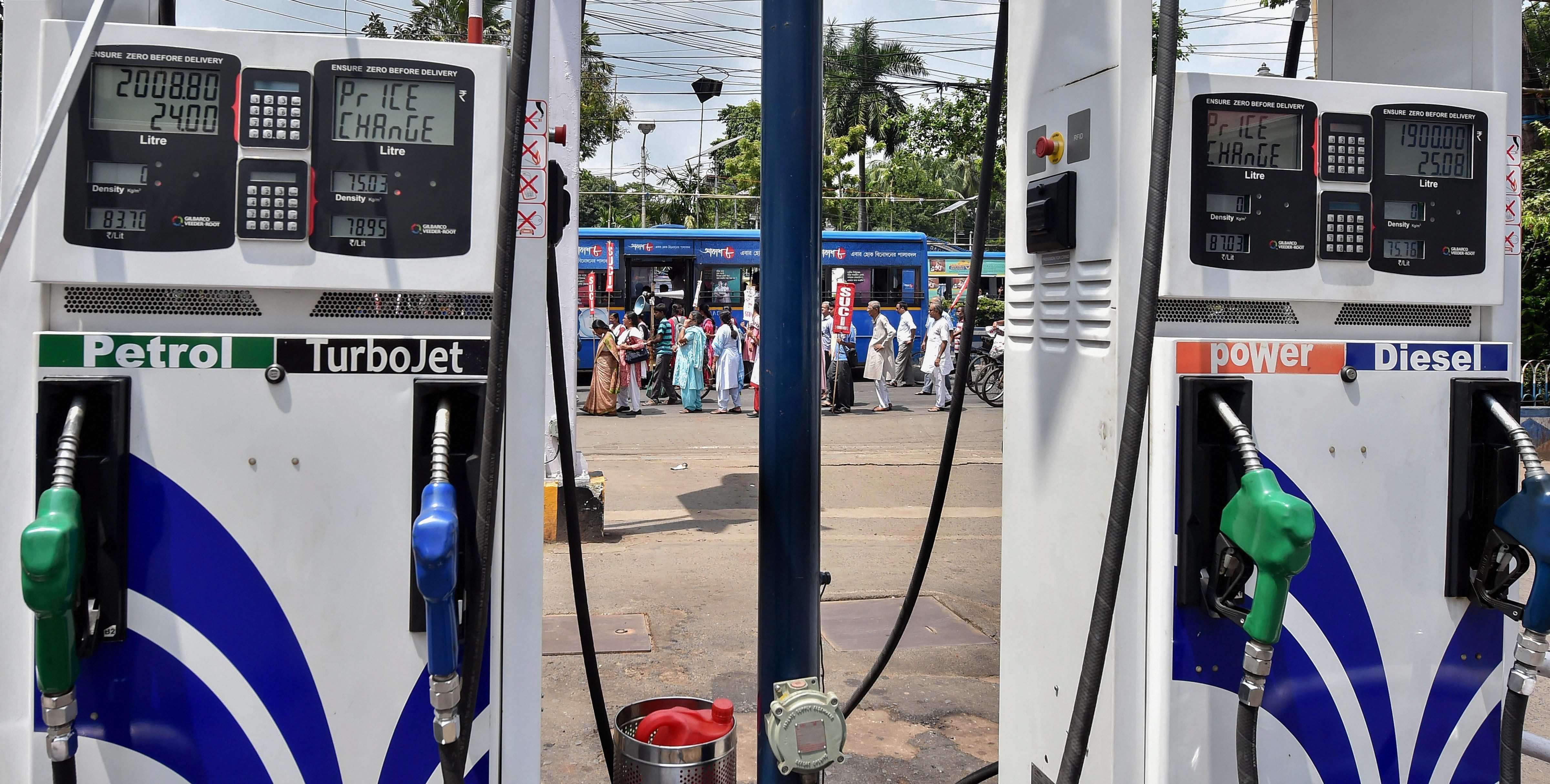
Opposition parties called a nationwide strike to protest against record-high auto fuel prices even as central and state governments expect the other to lower taxes to cushion consumers.
Petrol and diesel prices were retailing at a record Rs 88.12 and Rs 77.32 a litre, respectively, in Mumbai and Rs 80.73 and 72.83 a litre, in New Delhi today, according to Indian Oil Corporation Ltd.'s website. Both central and state levies combined account for up to 45 percent of the retail price as the value-added tax varies with each state. States not ruled by the Bharatiya Janata Party want the Narendra Modi government to lower taxes as it increased the excise duty nine times after coming to power in 2014.
Yet, according to Madan Sabnavis, chief economist at Chief CARE Ratings, it's the states that can afford to cut taxes compared to the central government because they tax petrol and diesel ‘ad valorem'—charged on the value of a transaction. On a higher base, a cut in taxes in percentage terms would make minimal difference to state finances, he said, adding that the central government, which charges excise duty per litre, stands to take a bigger hit.
In the economic sense, the states do have the leeway to lower the rates because it is a percentage which is being imposed and it would be tax neutral.Madan Sabnavis, Chief Economist, CARE Ratings

Kerala Finance Minister Thomas Isaac called the proposal for states to cut taxes “preposterous”. The central government has many more options than states to raise revenue, he said. The implementation of the Goods and Services Tax has further reduced the “flexibility” of states to gain revenues.
Central government have many other avenues of income. They have Indirect tax, corporate tax, customs duty and they can borrow money.Thomas Isaac, Finance Minister, Kerala

Bringing petrol and diesel under the ambit of the GST is often cited as a long-term solution to ease the burden of high fuel prices on the common man. Sabnavis said that's easier said than done, because the current rate of taxation is 100 percent for petrol and 67 percent for diesel. Clearly, he said, these rates don't fall into any of the existing GST tax slabs.
In case rates are going to be lowered and the collections are going to come down, we are going to be back to the same problem of who is going to foot the bill.Madan Sabnavis, Chief Economist, CARE Ratings

-
Signature Play: The Classic Cocktail Is Dead. Or Is It?

Classic cocktails are disappearing from India's cocktail menus. But they're still being ordered, taught to bartenders and borrowed from. So, who's really having the last drink?
-
A New Samvat Wishlist: Inclusive Prosperity And Human Development
India has strengthened its economic foundations through infrastructure, digital access and enterprise. Its next growth chapter must deepen productivity, create better livelihoods and widen participation in prosperity.
-
Love, Sex Aur Dhokha: The Audacious Plot To Spy On Jensen Huang
A Taipei dinner, a Singapore chip buyer and a suspected Chinese asset: inside the alleged spy operation that got close to NVIDIA's Jensen Huang.
-
Ten Things I Learnt This Samvat
Patience can be a trap. Cheap stocks can stay cheap. Leverage can wipe you out. What did Samvat 2082 teach us? Niraj Shah writes on 10 lessons from the year gone by.
-
Talking Points This Week: Tech Nerves, FII Buying, And A Faraway Banking Shock
The global markets are not shining this Diwali. The exception in the large markets is, India.
-
Midterm Rally Lasted A Day. The Hard Reality Of A Divided US May Last Two Years | Opinion
Between a contested AI boom, a debt ceiling that arrives in 2027 and a president with every incentive to act alone, the next two years may prove more volatile than the first day's rally suggests.
-
Blue Wave Will Derail the AI Trade but Won't Dismantle the AI Era | Unhedged Position
The Democrats' sweep of the US Congress will see politics collide with economic forces both over the long and short term.
-
It's Time To Take The GST Council's Bet On Trust Global
Payment records can prove India's services exports, and clear, proportionate rules can bring foreign digital sellers into the tax net.
-
Opinion | India at 38: From Innovation Overperformer to Innovation Powerhouse
India now has 453 VC-backed deep science startups, 18 of them late-stage, after 117 percent growth since 2020. Laurus Labs, at USD 9.3 billion, is the most valuable deep science company in any middle-income economy outside China.









