Former Chief Ministers Not Entitled To Government House, Says Supreme Court
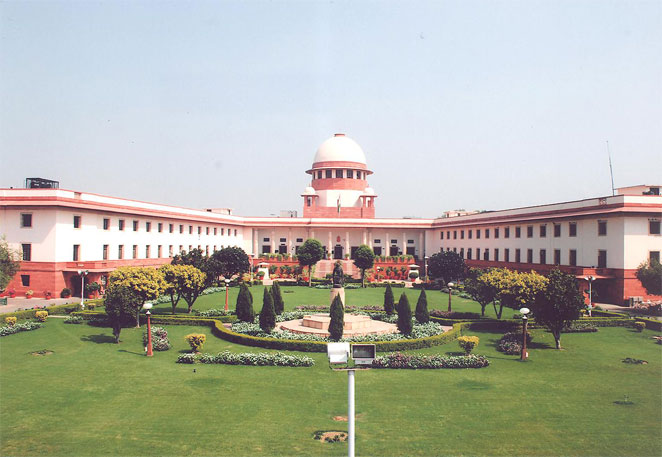
The Supreme Court today struck down the amendment to a Uttar Pradesh legislation which allowed former chief ministers retain government accommodation even after demitting office, saying it violated the concept of equality.
A bench headed by Justice Ranjan Gogoi said the amendment in the legislation was ultra vires to the Constitution since it transgresses the concept of equality.
The bench said the amendment was “arbitrary, discriminatory” and violates the concept of equality.
The apex court said once such persons demit public office, there is nothing to distinguish them from a common man.
The apex court had on April 19 reserved its verdict on an NGO's plea challenging amendments to the Uttar Pradesh legislation allowing former chief ministers of the state to continue occupying government bungalows.
The top court had earlier observed that if the provision, which has been challenged by NGO Lok Prahari, was held invalid, then similar legislation in other states might also come under challenge.
The NGO had challenged the amendments made by the erstwhile Akhilesh Yadav government to the ‘UP Ministers (Salaries, Allowances and Miscellaneous Provisions) Act, 1981'.
It had also challenged another UP law of 2016 called ‘The Allotment of Houses under Control of the Estate Department Bill-2016' to regulate the allotment of government accommodation to trusts, journalists, political parties, speaker and deputy speaker of legislative assembly, judicial officers and government officials.
The court had earlier said it had given an opportunity to the Centre and all states to express their views on the issue since its verdict might have an impact on any such rules framed by other states or the union government.
Earlier, senior advocate Gopal Subramaniam, who was assisting the court as amicus curiae in the matter, in his suggestions given to the top court had said after persons holding top constitutional posts demit office, they were like ordinary private citizens and were not entitled to official accommodation.
The apex court had sought the UP government's response in Nov. 2016, after the plea claimed that state government has sought to skirt the Supreme Court's verdict of Aug. 1, 2016 by amending the law.
In its 2016 verdict, the apex court had held that the practice of allotting government bungalows to former chief ministers of Uttar Pradesh was bad in law and they should hand over possession of the bungalows occupied by them in two months.
It had also said the state government should recover appropriate rent from the occupants of these bungalows for the period during their “unauthorised occupation”.

-
The Economic Imperative: Analysing The Material Driving Force Behind India-Canada Strategic Reset

This economic complementarity is further reinforced by deep institutional investment ties and talent mobility, which form the bedrock of the bilateral framework.
-
Medicine Pricing: Where Must Profit Stop?
India must confront excessive margins, hidden incentives and regulatory gaps that threaten the integrity of medicine.
-
Why Amazon And Flipkart Are Struggling To Beat Meesho In India's Smaller Cities
With 274 million users and lowest-cost logistics, Meesho is defending its value commerce crown against giants like Amazon and Flipkart.
-
High US Salaries, No Green Card Certainty: The Financial Calculation Facing Indian H-1B Families
The suspension of PERM processing at eight technology employers does not cancel existing H-1B visas. What it does is force a question many Indian families have been avoiding: is the US salary worth tying your career and family plans to one employer?
-
Swiggy vs Eternal: Food Delivery's Two Rivals Are No Longer In The Same Race
Eternal is building a private AI assistant, dark.ai. Swiggy is still working out how to make Instamart pay, with an operating loss of Rs 895 crore in the July-September quarter while Blinkit stayed profitable.
-
Where You Live Shapes How You Get To Work | The Reason Why
Two-wheelers are the most popular way to get to work in India, accounting for nearly 43% of workplace commutes.
-
Unhedged Position: Can India See An Indonesia-Style Time Correction?
The Nifty is trading below levels it first clocked in 2024. Is there, then, as I have suggested in the headline, potential that the current time correction drags on painfully for the next three-five, even ten years?
-
Navigating Friction And Energy Realities: An Analysis Of Marco Rubio's October Visit To India
Occurring at a critical juncture marked by stalled trade negotiations and escalating geopolitical pressures over global energy supplies, the visit offers a profound window into modern US-India relations.
-
India Exports Capital. Why Not Export Trusteeship?
The big question, then, is whether India can build an institution that global borrowers, investors, banks, and lawyers can trust, even without an Indian connection.
-
France's Economy & Politics Are In Crisis | The Reason Why
Let's look at how the French economy and politics evolved under Nicolas Sarkozy, Franois Hollande and Emmanuel Macron.










