Focus On RBI Board Returns Amid Spat Between Government And Central Bank

For the second time in two years, the central board of the Reserve Bank of India finds itself in the eye of a storm.
Two years after the government pushed its controversial decision to demonetise 86 percent of the country's currency through the RBI board, it now appears to be routing its demand for more flexible banking regulations through this body. The board will meet next on Nov. 19 to conclude the unfinished agenda of the Oct. 23 meeting. Among the issues being discussed was a relaxation of the prompt corrective action norms, which has become one of a handful of flashpoints between the RBI and the government.
The All-Powerful Central Board
The RBI Act of 1934 entrusts significant and over-arching powers in the hands of the central board. With the exception of monetary policy, now under the purview of the Monetary Policy Committee, most matters that fall under the purview of the RBI can be discussed at the central board.
“...the general superintendence and direction of the affairs and business of the (Reserve) Bank shall be entrusted to a Central Board of Directors which may exercise all powers and do all acts and things which may be exercised or done by the Bank...” says the Act.
The RBI Act entrusts all powers to the central board and not the governor, explained a former RBI official on condition of anonymity. As such, if the board passes a resolution, the governor has to go by it, this official said.
The appointees on the board include the RBI governor and not more than four deputy governors. In addition, the board has up to 10 directors nominated by the government and another four representatives picked from the local RBI boards. Two government officials are also on the board.
The RBI Act allows the board to be a voting body, although it has never voted, say former RBI officials. Still, voting powers are defined in the RBI Act.
All members except the two government officials and a deputy governor get a vote. The governor has a casting vote.
“The Governor, or [if for any reason, he is unable to attend,] the Deputy Governor authorized by the Governor under the proviso to subsection (3) of section 8 to vote for him, shall preside at meetings of the Central Board, and, in the event of an equality of votes, shall have a second or casting vote,” says the Act.
The Act also lays down the procedure to be followed for meetings of the central board.
“Meetings of the Central Board shall be convened by the Governor at least six times in each year and at least once in each quarter. Any [four Directors] may require the Governor to convene a meeting of the Central Board at any time and the Governor shall forthwith convene a meeting accordingly,” says the Act.
Theory Versus Practice
But the role of the central board, in theory, is very different from what it has been in practice.
By all accounts, the board has mostly been an advisory body and a forum for discussion. The board has been a consultative body rather than a decision making one, said the person quoted above while adding that the board, if it chooses, is fully empowered to make decisions.
Is the consultative nature of the board changing now?
The board meeting of October 23 was an extended one. Issues ranging from the flow of credit to small enterprises to the ongoing NBFC stress was discussed, said a person familiar with the matter. No resolutions were passed. In a post on his Twitter account, S. Gurumurthy, one of the recently appointed members to the central board of the RBI, said that there was consensus on four issues but not on one.
“From what I am reading, it looks like there were some very active discussions at the board level. And that is a good thing. Passive boards are boards that are not really performing. Where ever there is an active debate, that is to be welcomed,” said TT Ram Mohan, a professor at IIM Ahmedabad. He added that even if the board were to decide to put something to vote, that is not a matter of concern.
If the board members feel that something should be put to vote, it is permitted. There could be exceptional circumstances where the board members feel the need for voting. That is perfectly all right. I would say that's democratic.TT Ram Mohan, Professor - Finance & Account, IIM Ahmedabad
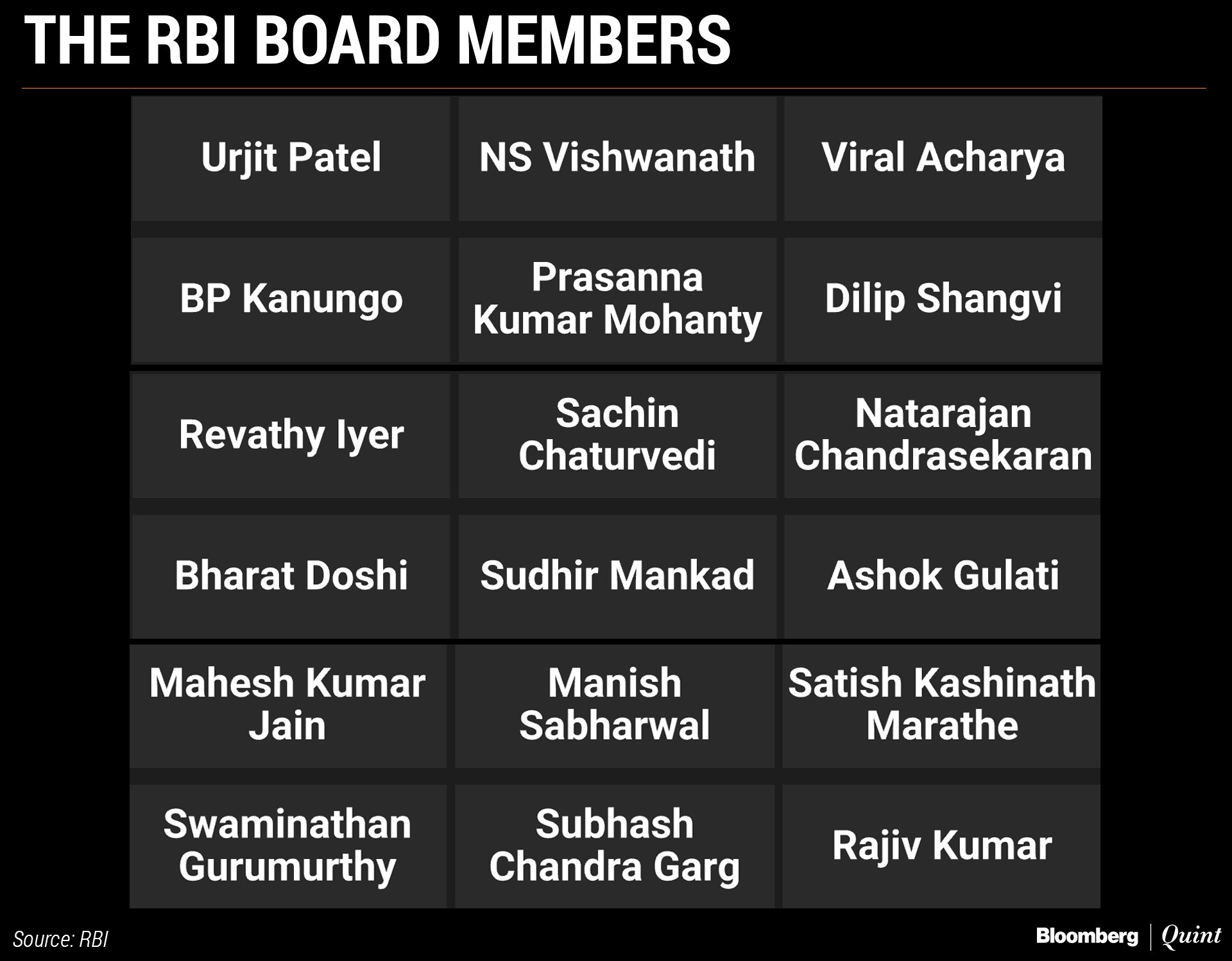
Composition Of The Board
Should the central board morph towards being a decision-making body, its composition would become more important.
In August, the government announced two appointments to the central board.
S. Gurumurthy was one of them.
Gurumurthy comes to the RBI board with strong political affiliations. He is a chartered accountant and a commentator on political and economic affairs. But Gurumurthy also has strong affiliations with the right-wing Rashtriya Swayamsevak Sangh and is the convener of the Swadeshi Jagaran Manch. Gurumurthy was also a supporter of the government's demonetisation exercise.
S. Marathe, the second appointee at the time, has had a long career in cooperative banking. However, in his youth, he too had been associated with the Akhil Bharatiya Vidyarthi Parishad, an organisation affiliated to the Rashtriya Swayamsevak Sangh.
In October, the tenure of another board member Nachiket Mor was abruptly cut short, without a clear reason.
“If the board is packed with government nominees, that is the not a problem per se, but if they have a flawed model in their heads and that is what they want to push, then its a downhill slope,” said Anantha Nageswaran, dean of the IFMR Business School at Krea University while speaking on the broader stand-off between the RBI and the Government.
While all outside appointments to the board are made by the government, former RBI deputy governor Rakesh Mohan also pointed out that the representation of government officials on the RBI board has also increased. To be sure, these government officials are non-voting members.
“The original RBI Act provided for one representative from the government and it was specifically provided that the (government) member will not have a vote on the RBI board. The government added a second member on the board as its representative once the Department of Financial Services was created,” Mohan told BloombergQuint in a recent interview. Even without a formal vote, the government's representatives can have an influential and effective voice in the board, Mohan added.

-
The Economic Imperative: Analysing The Material Driving Force Behind India-Canada Strategic Reset

This economic complementarity is further reinforced by deep institutional investment ties and talent mobility, which form the bedrock of the bilateral framework.
-
Medicine Pricing: Where Must Profit Stop?
India must confront excessive margins, hidden incentives and regulatory gaps that threaten the integrity of medicine.
-
Why Amazon And Flipkart Are Struggling To Beat Meesho In India's Smaller Cities
With 274 million users and lowest-cost logistics, Meesho is defending its value commerce crown against giants like Amazon and Flipkart.
-
High US Salaries, No Green Card Certainty: The Financial Calculation Facing Indian H-1B Families
The suspension of PERM processing at eight technology employers does not cancel existing H-1B visas. What it does is force a question many Indian families have been avoiding: is the US salary worth tying your career and family plans to one employer?
-
Swiggy vs Eternal: Food Delivery's Two Rivals Are No Longer In The Same Race
Eternal is building a private AI assistant, dark.ai. Swiggy is still working out how to make Instamart pay, with an operating loss of Rs 895 crore in the July-September quarter while Blinkit stayed profitable.
-
Where You Live Shapes How You Get To Work | The Reason Why
Two-wheelers are the most popular way to get to work in India, accounting for nearly 43% of workplace commutes.
-
Unhedged Position: Can India See An Indonesia-Style Time Correction?
The Nifty is trading below levels it first clocked in 2024. Is there, then, as I have suggested in the headline, potential that the current time correction drags on painfully for the next three-five, even ten years?
-
Navigating Friction And Energy Realities: An Analysis Of Marco Rubio's October Visit To India
Occurring at a critical juncture marked by stalled trade negotiations and escalating geopolitical pressures over global energy supplies, the visit offers a profound window into modern US-India relations.
-
India Exports Capital. Why Not Export Trusteeship?
The big question, then, is whether India can build an institution that global borrowers, investors, banks, and lawyers can trust, even without an Indian connection.
-
France's Economy & Politics Are In Crisis | The Reason Why
Let's look at how the French economy and politics evolved under Nicolas Sarkozy, Franois Hollande and Emmanuel Macron.










