Election Results 2019: Why Yogendra Yadav Thinks Historic Modi Win Is Different From 2014
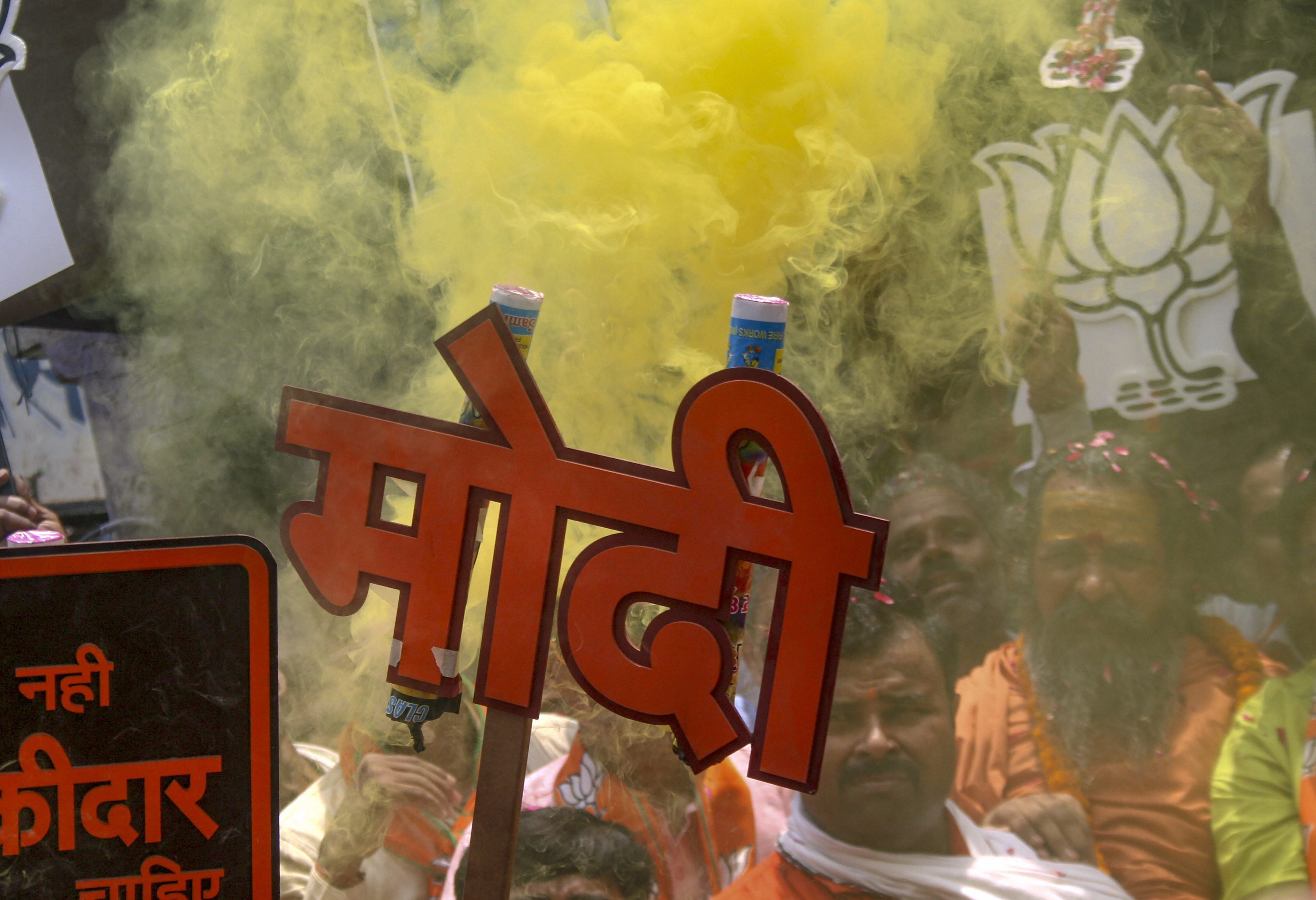
Political commentator Yogendra Yadav has said that Narendra Modi's unprecedented victory in the 2019 Lok Sabha elections is different from that five years because the mandate this time, though bigger, is much more fragile.
“In 2014, it was anger against Congress versus hope for Mr Modi. This verdict is not only about hope,” Yadav, president of Swaraj India told BloombergQuint in an interaction. “This comes with some doubts, some anxiety but a more decisive verdict against the opposition. So, it is complete rejection of available alternatives.”
This is bigger. To my mind, it is bigger and more fragile.Yogendra Yadav, President, Swaraj India
Yadav criticised the Congress for not putting itself up as a credible opposition despite the presence of serious problems like farm distress and unemployment. “Congress as the principal national opposition party had the responsibility of converting that into an electoral plank which it failed to do so. They don't seem to have leadership, strategy, vision and cadre,” he said. “How do we think of Congress as respondent to the challenge which lies in front of the country?”
The former National Executive of the Aam Aadmi Party said that there are three learnings from the results. “One is, anti-Modism doesn't work. Second is, caste coalitions don't work. Anti-Modism is counterproductive. Caste coalitions are ineffective. Third is, opportunistic coalitions may be necessary, but they are not sufficient.”
Watch the full interview here:
Here's the edited transcript of the interaction:
It has been decisive mandate in favor of BJP and the NDA. What have you made of this victory?
I have been saying from some time even before the exit polls that this is a complete one-way election. That the NDA was coming back to power. This morning I said that the only niggling doubt at the moment is whether BJP on its own will secure a majority. Of course, it has. Not just majority but they seem to be doing better than they did last year. So, it is a decisive mandate. It is the mandate in favor of BJP. Personally, it is mandate for the PM. The people have voted for him. There can be all kinds of other doubts like EVMs. But I don't think anything of that kind should be allowed to come in the way. The fact is that people have voted for Modi because they wanted to give him another chance.
To my mind, the corrector of this verdict is different from 2014. 2014 was also the mandate of equal size. This is bigger. To my mind, it is bigger and more fragile. In 2014, it was anger against Congress versus hope for Mr Modi. This verdict is not only about hope. This comes with some doubts, some anxiety but a more decisive verdict against the opposition. So, it is complete rejection of available alternatives. That is how I read the overall corrector of the verdict. To my mind, the lessons that one can draw from this are following. One is, anti-Modism doesn't work. Second is, caste coalitions don't work. Anti-Modism is counterproductive. Caste coalitions are ineffective. Third is, opportunistic coalitions may be necessary, but they are not sufficient. What you need above all is a positive message. The PM carried a message. It was not entirely positive but a message of strength. It was a message which came with enormous negativity. But it was a message addressed to the country. The opposition did not have any such message. Congress had a good manifesto but didn't have political message for the country. Second is, you need a credible messenger. PM came out as strong messenger. The opposition had no credible messenger which what has led to the result which we see today.
What does this mean to Congress party? You said that Congress has a message but did not had a messenger. They have been decimated in almost all of North India. What would Congress take back, you think, as far as its leadership is concern?
It is a major setback for the Congress for the simple reason that while the opposition has done badly, the Congress has particularly done badly. In areas in those states where it was a straight Congress versus BJP contest, like in Gujrat, Madhya Pradesh, Chhattisgarh, Rajasthan, Haryana, Delhi, Uttarakhand and Himachal, I believe it is only in three seats the Congress is leading right now. That as bad a wipe out as was 1977.
So, clearly something is fundamentally wrong. I said 3-4 days ago, which started a premature controversy, that this party must die. I said it more out of anguish because the challenge that this country is faces is that the country needs an opposition. In last 5 years, economy was not good. There where very serious problems. There was farm distress, unemployment issue. And Congress as the principal national opposition party had the responsibility of converting that into an electoral plank which Congress failed to do so. So, Congress don't seem to have leadership, strategy, vision and cadre. How do we think of Congress as respondent to the challenge which lies in front of the country?
As I look ahead, I see two principle challenges. First, there is challenge of electoral authoritarianism. I have won elections, don't ask me any questions now. Second challenge is non-theocratic majoritarianism. Hindus belong to one level, everyone else belongs to lower level. You need a party to oppose it. You need someone to counter it. This country needs an opposition. Mr Modi needs an opposition. Can the Congress be that opposition? I don't see it. Therefore, I feel this is the time to create a new alternative from scratch.
Specifically, on UP, where you saw some sort of opposition that on paper looked very strong. I am talking about the Mahagatbandhan or the partnership between Akhilesh Yadav and Mayawati. Despite them coming together and the active campaign we saw, they haven't been able to make big dent on BJP's numbers.
Absolutely. Throughout North India and the Hindi belt, the one place where there was some resistance was SP-BSP because it is a large alliance. Frankly, it is caste coalition that they brought together. If you go to their rallies the only thing they spoke about was caste coalition. Yadav, Dalit, Muslim. Is that the way to get votes? Is that the way to give hope? Is that the message? Unfortunately, that's there only message. It demonstrates that while caste works in politics, only caste doesn't work. Increasingly, we have an electorate which is sick and tired of it. People want something and they didn't have much to promise.
Therefore, despite a negative rating of Yogi government, I don't think Yogi government is popular, but people looked at Mr Modi and saw some possibility and something big and they voted in big numbers. I believe that they are getting nearly 60 seats which is unprecedented. On paper, the SP-BSP alliance was much larger than BJP. But BJP demonstrated that if you appeal to voters cutting across caste lines, you can get there. This is a positive message.
In West Bengal, the BJP has not only managed to hold on to its strong hold but also broken new ground in Bengal. What do you think worked for them?
The will to power which BJP has demonstrated. I am ideologically opposed to what the BJP stands for but if you want to look at will to power and their capacity to expand to new places. Earlier, there was Tripura. Now there is Bengal, Odisha. I won't be surprised if in couple of years' times its Telangana and Andhra Pradesh as well. BJP has gone in Bengal in a big way. Unfortunately, through a message which is very divisive and not in keeping with spirit of the country and with lot of local violence. I should add that violence began with the Left. Mamata Banerjee carried forward the tradition of violence and with the entry of BJP, it has become much worse.
Bengal sadly had a choice between going back to 1960s and 1940s. BJP represents going back to 1940s. I fear for Bengal because in next two years while BJP rises and make a bid for 2021, I fear that this will lead to enormous local violence in Bengal. Looking at it as a game, BJP has learned how to spread to areas. We used to talk about Congress as one dominant party. BJP could be one dominant party like Congress used to be in 60s and 70s.

-
One Battle After Another: India's Corporate Dynasties Battle For Control

2026 could go down as Corporate India's year of succession wars, governance battles and family fault lines.
-
Rs 50-Lakh Gold In Bank Locker, Rs 3 Lakh Of Protection: The Gap Most Families Don't Know About
The RBI ties a bank's liability to the annual locker rent and families who want to insure their jewellery face a separate question about how to prove what was inside.
-
The More Food Turns Into Fuel, The Harder It Is To Read Agricultural Markets | The Reason Why
A policy designed to reduce dependence on imported fuel can create new pressures elsewhere in the food economy.
-
Your iPhone Costs 12 Grams Of Gold, A Car About 100. What Does Your Life Weigh?
Measured in rupees, almost everything looks more expensive than it did a generation ago. Measured in grams of gold, a lot of it has become cheaper.
-
Gold Is Rs 22,000 Cheaper Than A Month Ago. Should You Buy Amid The Wedding Season?
Gold's potential slide to $3,500 could save around Rs 4,700 per 10 grams, but a soft inflation print could just as easily push prices back up. One way to split the risk is to buy in parts, some now and the rest after the Fed's Dec. 9 decision.
-
AI Agents Are Gaining Power. Who Governs Them?
Artificial intelligence agents promise to transform productivity by moving machines from assisting decisions to executing them. But as organisations delegate greater authority to these AI-agents, they must first establish who controls that authority and who remains accountable when things go wrong.
-
Why Swapping Your Old Gold Can Trigger A Rs 5 Lakh Tax Bill, And How You Can Avoid It Legally
Swapping old gold for new is taxed as a sale and a fresh purchase. Getting your own gold remade can cut most of that bill, though it has its own costs.
-
The AI Trade is Done. The Real Opportunity for Investors Starts in 2027 | Unhedged Position
As pureplay AI stocks plunge and circular, capex-led financing unwinds, 2027 is set to be a year of reckoning for AI companies. Yet the bust clears the way for a better opportunity for investors in 2027 -- shifting the spotlight from AI builders to the companies using AI.
-
Leadership As Mission: Why The Age Of AI Demands More Human Leadership
Debjani Ghosh examines how AI is changing leadership, arguing that its success must be measured by its impact on people and the accountability of those guiding its use.
-
We May Need Another Tukaram Mundhe To Fight Air Pollution | The Reason Why
Developers may install basic measures such as sprinklers and green nets, resume work, and continue violating rules when this equipment stops working.









